![5 Best AI Transcription Software [2026]](/sanity-images/ejgwz1gl/redesign/f9c84fe79da7f990b641b2ab79d0894dd6a946de-1536x1024.jpg?auto=format&w=1536.0&rect=0,128,1536,768&h=768)
Shopping for the best AI transcription software? Every tool out there promises fast, accurate transcripts. The problem is, most of them can't deliver both.
Accuracy varies more than you'd think. Run the same recording through five tools and you'll get five different transcripts. One mangles the terminology. Another drops sentences when speakers overlap. A third looks clean until you actually check it against the audio.
For a rough meeting summary, that's fine. But if you're transcribing a research interview or subtitles for a global audience, it's not.
I tested 10+ tools against real-world audio, heavy on background noise, thick accents, multiple speakers, domain-specific vocabulary, and shortlisted 5 based on accuracy, language support, privacy, and post-transcription workflow.
Here's what I found.
TL;DR ⏩
- HappyScribe is the best all-round AI transcription software, with 95%+ accuracy across 150+ languages, optional human review, and EU-hosted data storage
- Trint is built for newsrooms that need to turn interviews into publishable stories
- Descript suits podcasters and video creators who want transcription baked into a full editing workflow
- Riverside pairs studio-grade local recording with built-in transcription for interviewers
- Maestra covers transcription, subtitles, translation, and dubbing in one platform for multilingual teams
How did I evaluate the best AI transcription software?
1. Transcription accuracy across real conditions
I tested each tool against recordings that reflect how audio actually sounds in the real world. A tool that performs well on clean studio audio but falls apart on a field interview or a crowded meeting room didn't make the cut.
2. Language support
I evaluated how well each tool handles non-English audio and mid-conversation language switches. Tools that claim broad language support but treat anything outside English as a secondary use case were scored accordingly.
3. Privacy, data storage, and compliance
I reviewed where each tool stores data, how long it retains files, whether it uses customer audio to train its models, and what compliance certifications it holds. For teams handling sensitive recordings, these details matter as much as accuracy.
4. File format flexibility and workflow fit
Real workflows involve messy audio from a wide range of sources. I looked at which file formats each tool accepts, how it handles both audio and video, and how much friction exists between uploading a file and getting a usable transcript out the other end.
5. Post-transcription editing and export
I checked the built-in editing experience, export format options, and how easy it is to share or move transcripts into the tools your team already uses.
💡 Also read:
What are the best AI transcription software? At a glance
| CATEGORY | HAPPYSCRIBE | TRINT | DESCRIPT | RIVERSIDE | MAESTRA |
|---|---|---|---|---|---|
| BEST FOR | Researchers, journalists, content producers, and professionals who need accurate AI transcription across languages, with optional human review | Journalists, broadcasters, and newsroom teams that need to move from raw recordings to publishable stories | Podcasters and content creators who want transcription as part of a full production workflow | Interviewers and video creators who want high-quality recording and transcription on a single platform | Multilingual teams and content creators who need transcription, subtitles, translation, and dubbing |
| KEY FEATURES | 95%+ AI accuracy; human transcription add-on (up to 99%); 150+ languages and dialects supported; built-in editor; translation into 80+ languages; subtitles; custom glossaries; SOC 2 Type II and GDPR-compliant | Story Builder for multi-transcript drafts; live transcription; full-library keyword search; custom dictionary; real-time collaboration; ISO 27001 certified | Text-based audio/video editing; filler word removal; multi-track transcription (up to 10 guests); AI Actions; voice cloning; Studio Sound; SOC 2 Type II-compliant | Local recording up to 4K video/48kHz audio; AI Speaker Detective; "Correct Everywhere" bulk fixes; Magic Audio noise reduction; AI Show Notes | AI dubbing with lip-sync; voice cloning in 29 languages; Chrome extension for live transcription; 800+ AI voices; chapter generation and sentiment analysis |
| LANGUAGES SUPPORTED | 150+ | 40+ | 25 | 100+ | 125+ |
| INTEGRATIONS | API, Zapier, MCP server, Google Drive, Dropbox, Box, Vimeo, YouTube | Premiere Pro, Final Cut Pro, Media Composer, LiveU, Mimir, Saga | Desktop app (macOS, Windows), web app, mobile viewer | Built-in recording platform; free standalone transcription tool | YouTube, TikTok Ads Manager, Zoom, Slack, Zapier |
| PRICING | Free plan available; paid from $8.50/month | From $90/month per seat | From $24/month per user | From $29/month | Pay-as-you-go from $12/60 min; subscriptions from $29/month |
1. HappyScribe
Best for: Researchers, journalists, content producers, business leaders, and professionals who need accurate AI transcription across 150+ languages, with optional human review
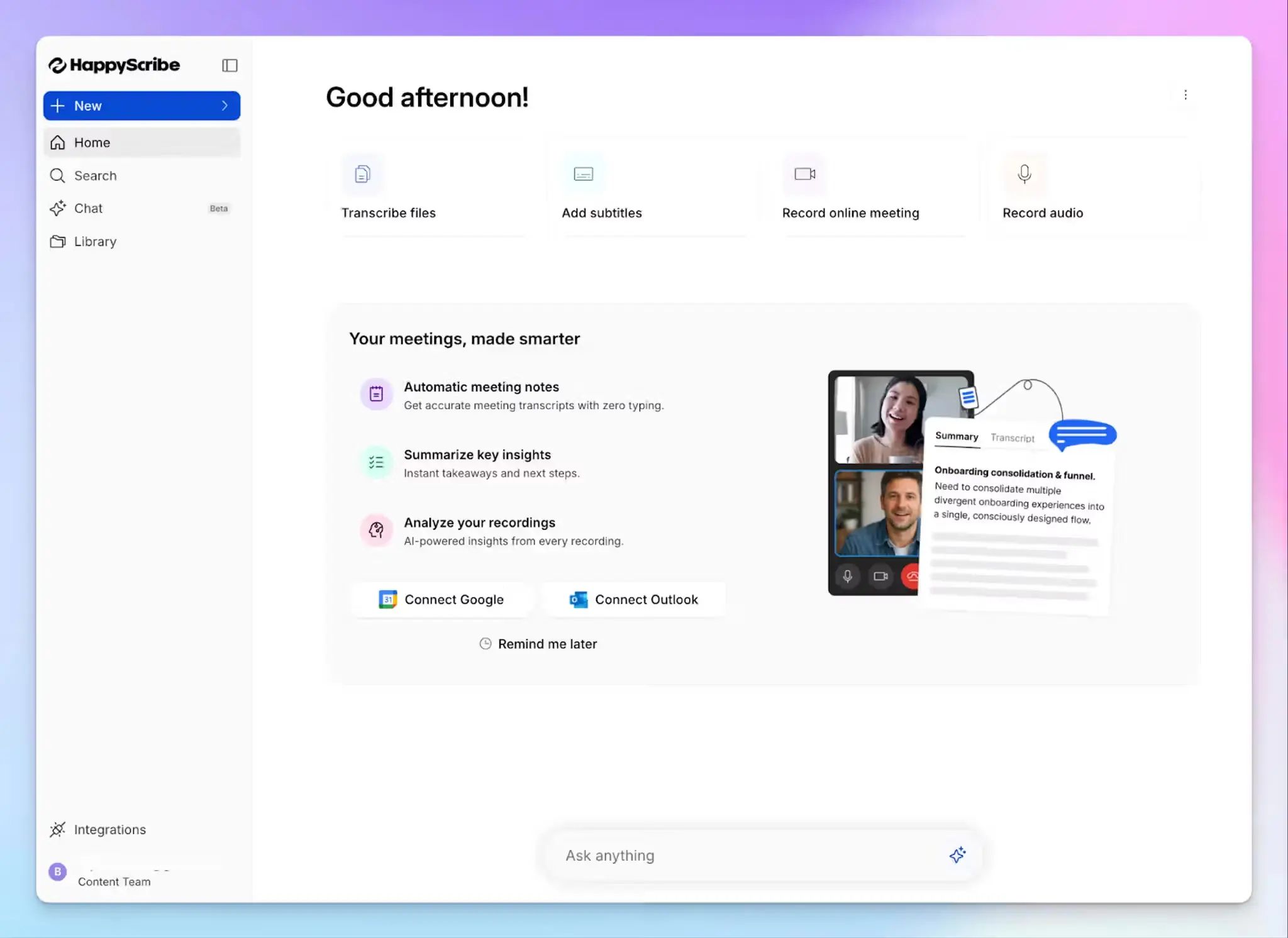
HappyScribe is the top AI transcription software for teams that need high-quality transcription across a wide range of file types, languages, and use cases.
Upload an audio or video file, or paste a link from YouTube, Zoom, Vimeo, Google Drive, or Dropbox, and HappyScribe turns it into an editable, exportable transcript in minutes.
It handles both audio-to-text and video-to-text in a single workflow, so there's no need to convert files or switch between tools based on the recording's format.
HappyScribe's key features
1. AI transcription across 150+ languages and dialects
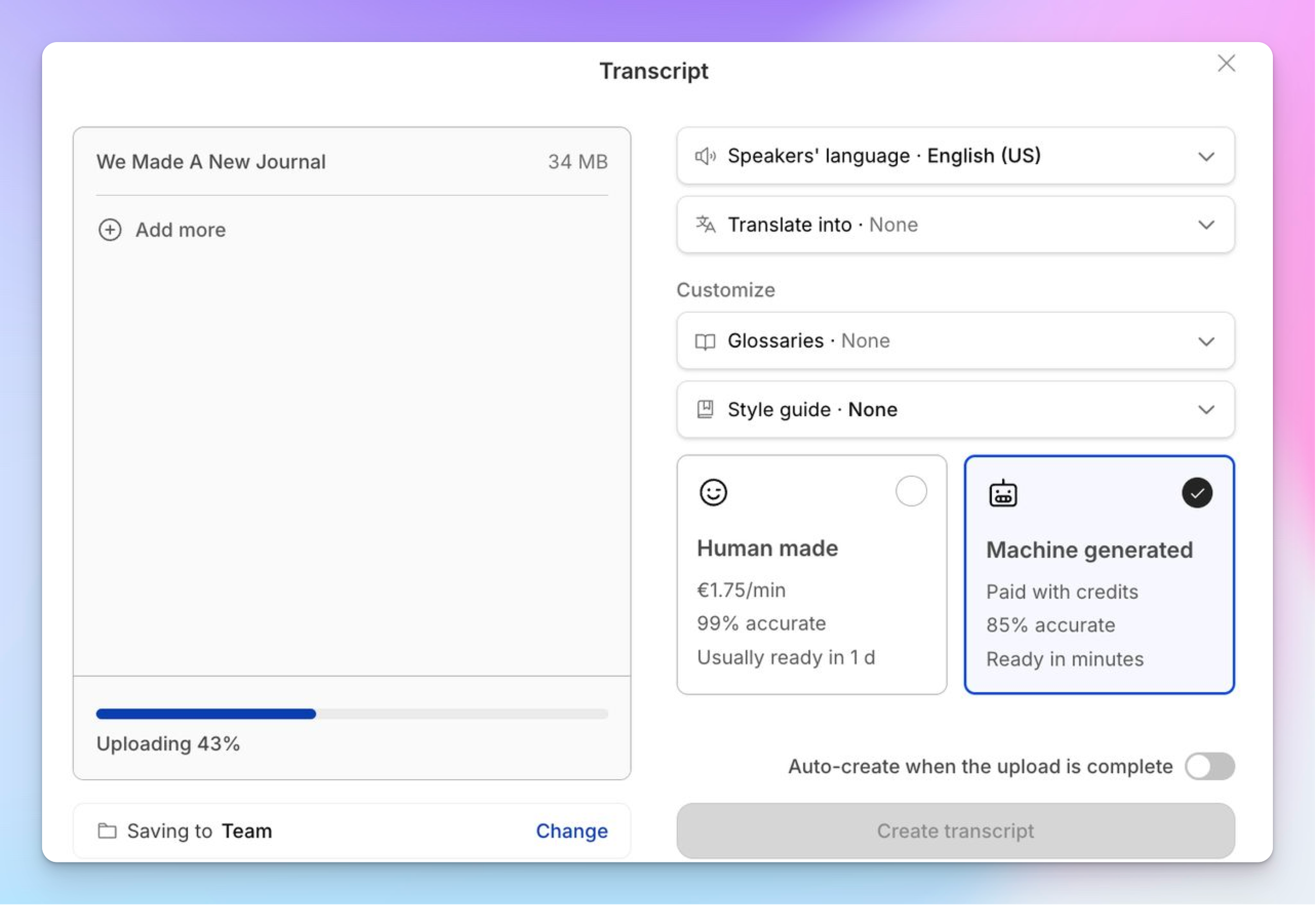
HappyScribe's speech recognition handles the full range of real-world audio conditions, including fast speakers, background noise, heavy accents, and overlapping voices.
It delivers 95%+ accuracy and automatically detects the language being spoken, so you don't have to select it manually for every file.
Coverage spans 150+ languages and dialects, making it a great fit for global, multilingual teams.
2. Works for any file, any platform
HappyScribe accepts 45+ audio formats, including MP3, WAV, M4A, AAC, FLAC, and OGG, and video formats, including MP4, MOV, AVI, MKV, and WebM.
You can upload directly from your computer, import from Google Drive, Dropbox, Box, or Vimeo, or paste a link from YouTube.
3. Built-in editor and flexible export
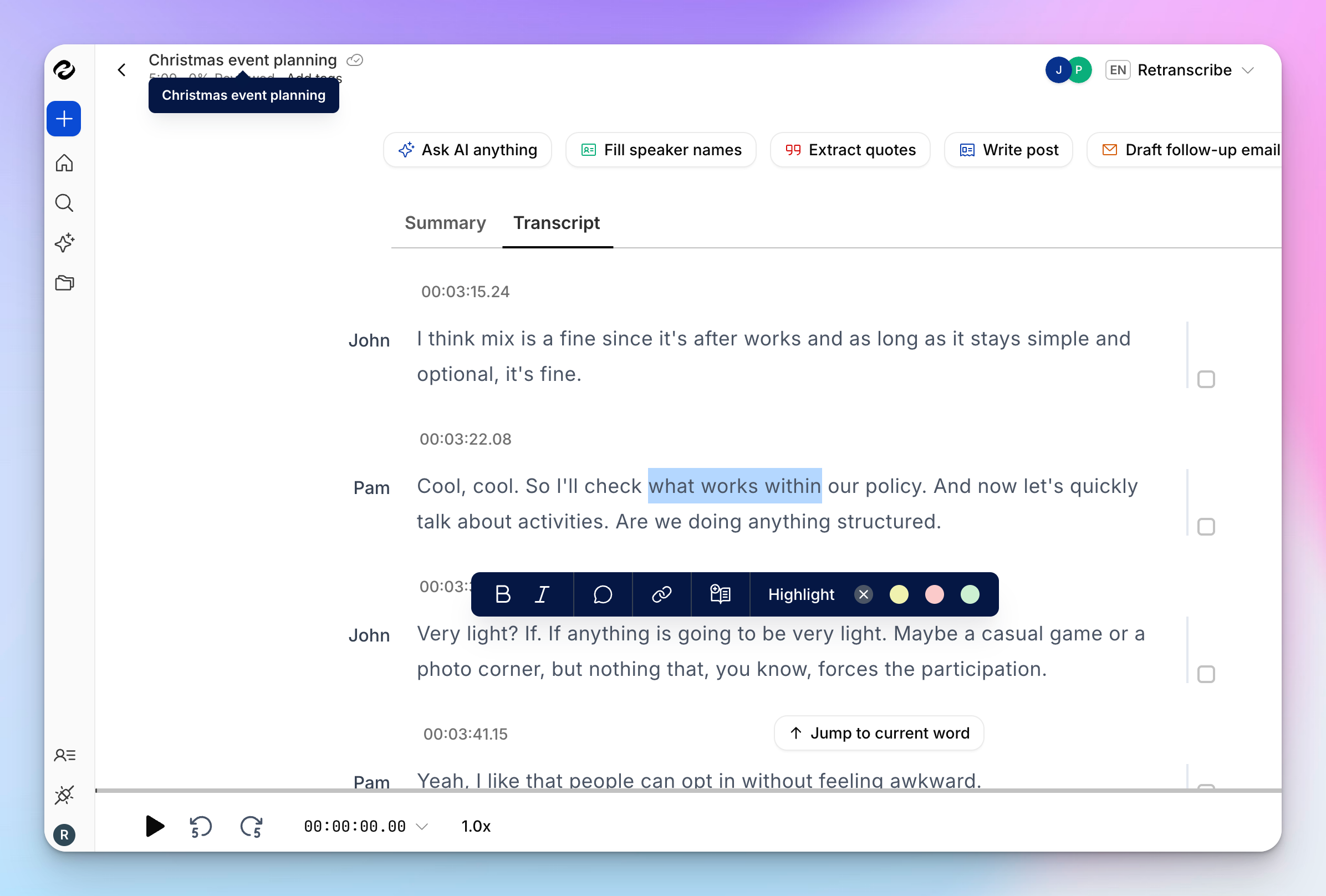
Once the transcript is ready, you can edit, highlight, search, and correct it directly in HappyScribe's browser-based editor without downloading anything first. Speaker labels, timestamps, and formatting are all adjustable in the same interface.
Export to TXT, DOCX, PDF, SRT, VTT, or 10+ other formats depending on whether you need a clean document, a subtitle file, or both.
4. Chat with your transcript
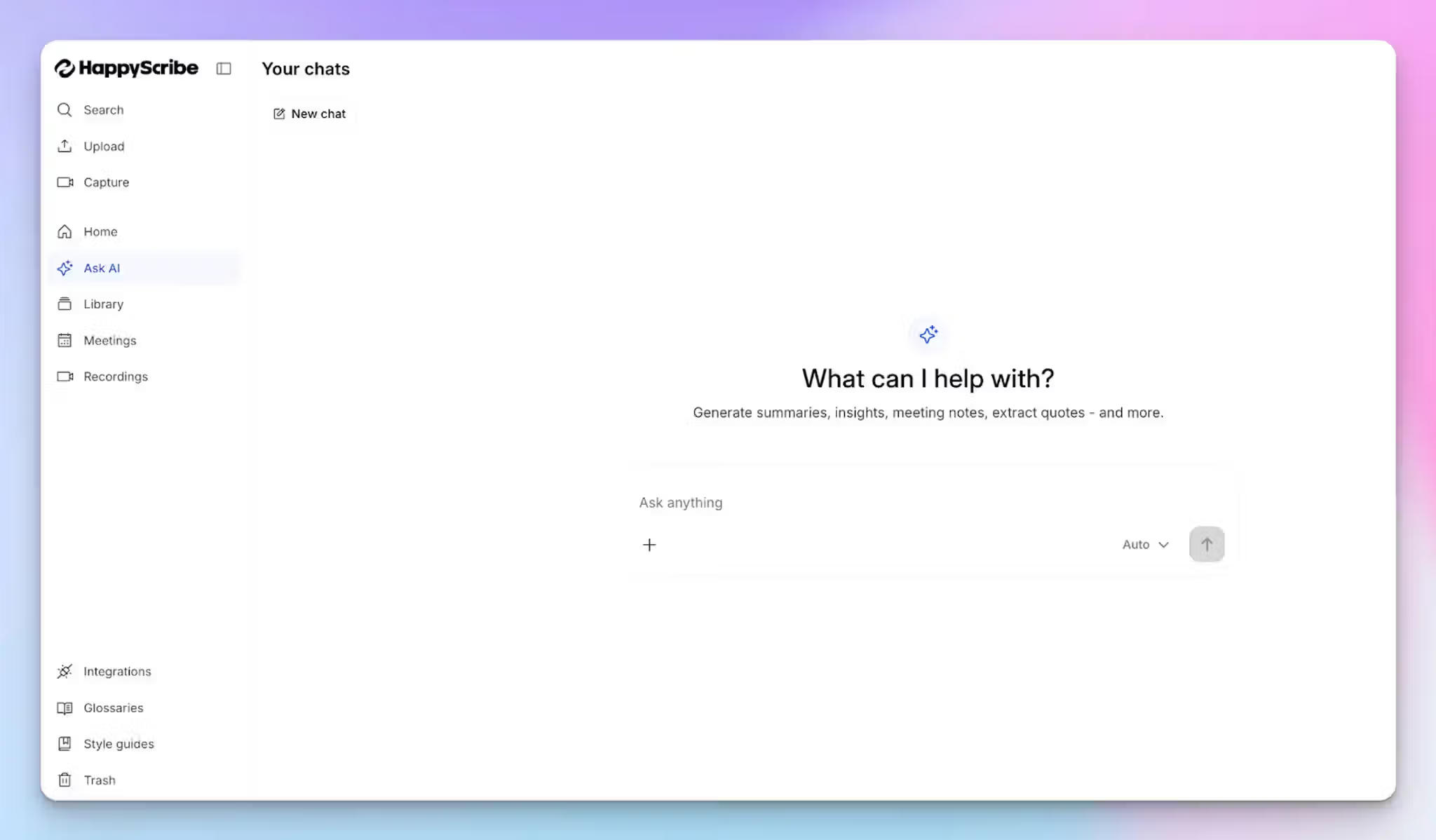
You don’t have to read the transcript line by line to get value from it. HappyScribe’s Chat lets you jump straight to what you need. Pull out key decisions, surface quotes, identify action items, or trace how a topic evolved across the recording.
It works across your entire library, so if you’re trying to revisit something from a few months ago, you can get the answer in seconds without digging through old transcripts manually.
5. Translation and subtitles
Once your transcript is ready, you can translate it into 80+ languages without leaving the platform. No need to copy text into Google Translate or switch to a different tool.
Subtitles are generated directly from any audio or video file, and you can export them in your preferred formats, be it SRT, VTT, or something else.
6. Human transcription add-on for accuracy-critical content
For content where every word is critical, HappyScribe's human transcription service connects you with native linguists who review and correct the AI output. Accuracy reaches up to 99% with a turnaround time of 24 hours.
You can also request verbatim transcription, clean-read formatting, or rush delivery, depending on the project's needs. NDAs are available for sensitive content.
7. Built-in privacy and compliance
If you're regularly handling sensitive recordings, HappyScribe offers the ideal setup.
Your data stays in the EU, stored in a Tier IV data center with AES-256 encryption in transit and at rest.
HappyScribe is GDPR- and SOC 2 Type II-compliant. You can opt out of AI training anytime, and also request permanent file deletion once you're done with a project.
HappyScribe's pricing
- Free: First 10 minutes of AI transcription free, no credit card required
- Basic: $8.50/month (billed annually) or $17/month (billed monthly)
- Pro: $19/month (billed annually) or $29/month (billed monthly)
- Business: $59/month (billed annually) or $89/month (billed monthly)
- Enterprise:Contact sales
- Human transcription: Available as an add-on; starts from $2/minute
HappyScribe's pros
- Get transcription, translation, subtitling, and an AI note taker; all in one place
- Over 95% AI accuracy and up to 99% human accuracy
- Custom glossaries and style guides keep terminology consistent across files
- Integrates with your existing tech stack via API, Zapier, or MCP server
- Translate transcripts into 80+ languages and generate subtitles from any recording
- Collaboration features, including secure sharing links, comments, and highlights
- Offers a range of free tools for transcription and subtitling
- SOC 2 Type-II and GDPR-compliant with EU-only data storage
- Get support from real human agents, not chatbots
HappyScribe's cons
- Free plan is limited to 10 minutes of transcription
- Human transcription adds cost and turnaround time compared to AI-only tools
What are real users saying about HappyScribe?
I needed to transcribe talks given 30 years ago and the accuracy was astounding. Highly recommend it!
This transcriber works great. It is fast and very accurate even with specialized terminology as the one used in ATC (air traffic control)
How to transcribe audio or video with HappyScribe
- Upload your file from your computer, or paste a link from YouTube, Zoom, Google Drive, or Dropbox. HappyScribe supports 45+ audio and video formats with no size limits.
- Choose AI transcription for fast results, or human transcription for critical content. Select your language or let HappyScribe detect it automatically from 150+ options.
- Review and edit in the browser editor, then export in your preferred format: DOCX, PDF, TXT, SRT, VTT, or more.
2. Trint
Best for: Journalists, broadcasters, and newsroom teams that need to move from raw recordings to publishable content without switching tools
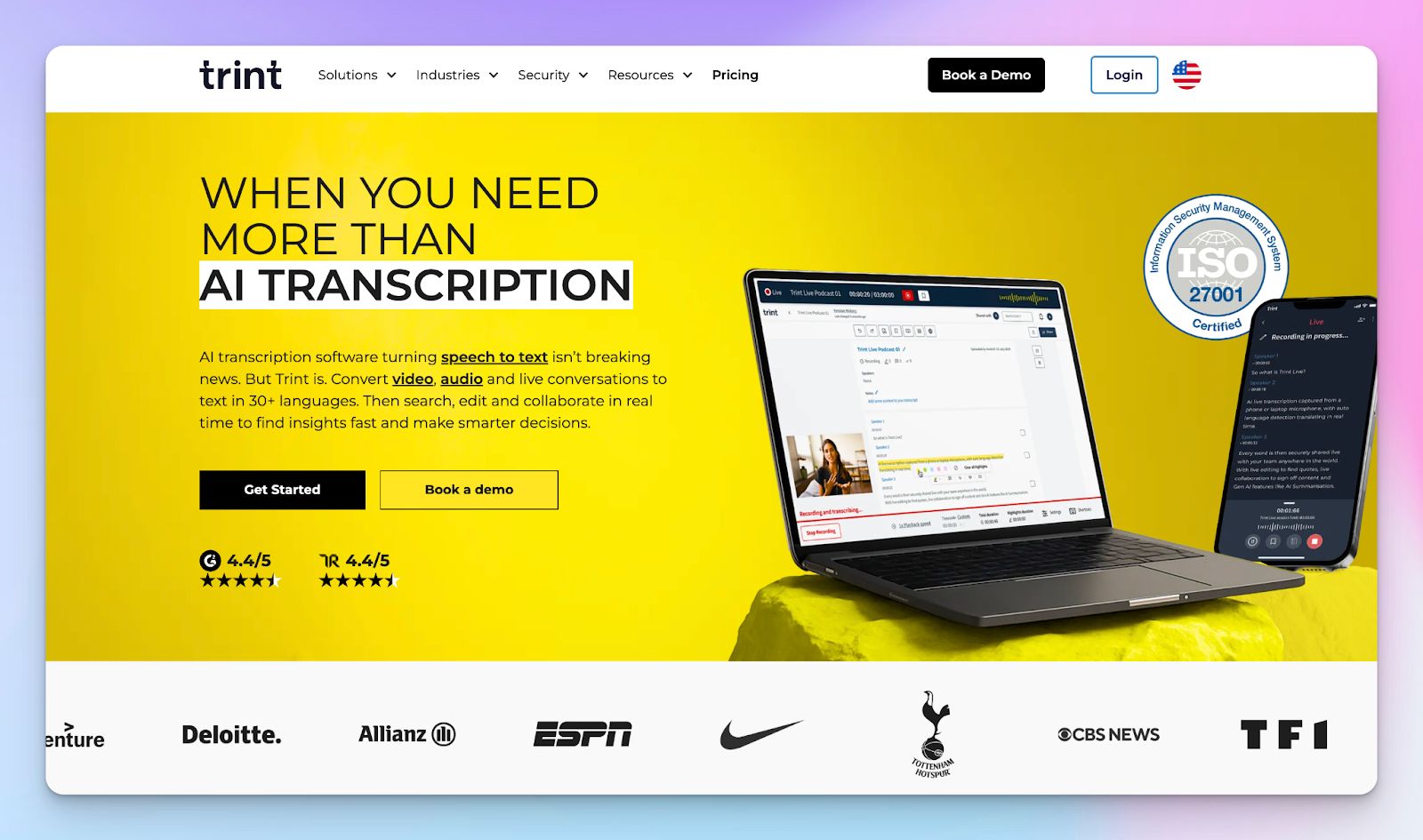
Trint helps you move from a finished interview to building a finished story.
Story Builder lets you highlight quotes across multiple transcripts and pull them into a structured draft inside the platform. It’s a useful transcription software for journalists working across several interviews on the same story.
Live transcription in 40+ languages runs in real time from desktop, mobile, or microphone; ideal for correspondents covering press conferences or breaking news who need a searchable record before the event is over. A keyword search across your entire transcript library lets you extract a quote across months of recordings without opening individual files.
But the limits are worth noting. No human transcription option for when accuracy is non-negotiable. Files cap at 3GB and three hours, so longer recordings need splitting first.
Trint's key features
- Full-library keyword search finds specific quotes across all your files
- Real-time collaboration lets multiple users edit, comment, and annotate simultaneously, without needing a Trint account
- Custom dictionary for names, terminology, and beat-specific jargon
- ISO 27001 certified; never trained on customer files; granular access permissions across shared drives
Trint's pricing
- Pro: $100/month per seat
- Team: $90/month per seat
- Business: Custom pricing
Trint's pros
- Exports directly to video editing project formats (XML for Premiere Pro, Final Cut Pro; EDL for Media Composer), so broadcast teams can move from transcript to rough cut without manual timecode matching
- Built-in translation covers 50+ languages, letting newsrooms localize stories for global audiences without leaving the platform
- Collaborators can view and edit transcripts without a Trint account, which removes friction when working with freelancers, stringers, or external editors on tight deadlines
- Integrates natively with broadcast-grade production systems like LiveU, Mimir, and Saga, fitting into existing newsroom infrastructure rather than requiring workflow changes
Trint's cons
- File size and duration caps require splitting longer recordings before upload
- Built primarily for newsrooms; less suited to research, legal, or general business transcription, pushing users to look for Trint alternatives
3. Descript
Best for:Podcasters and content creators who want transcription as part of a full production workflow rather than a standalone output
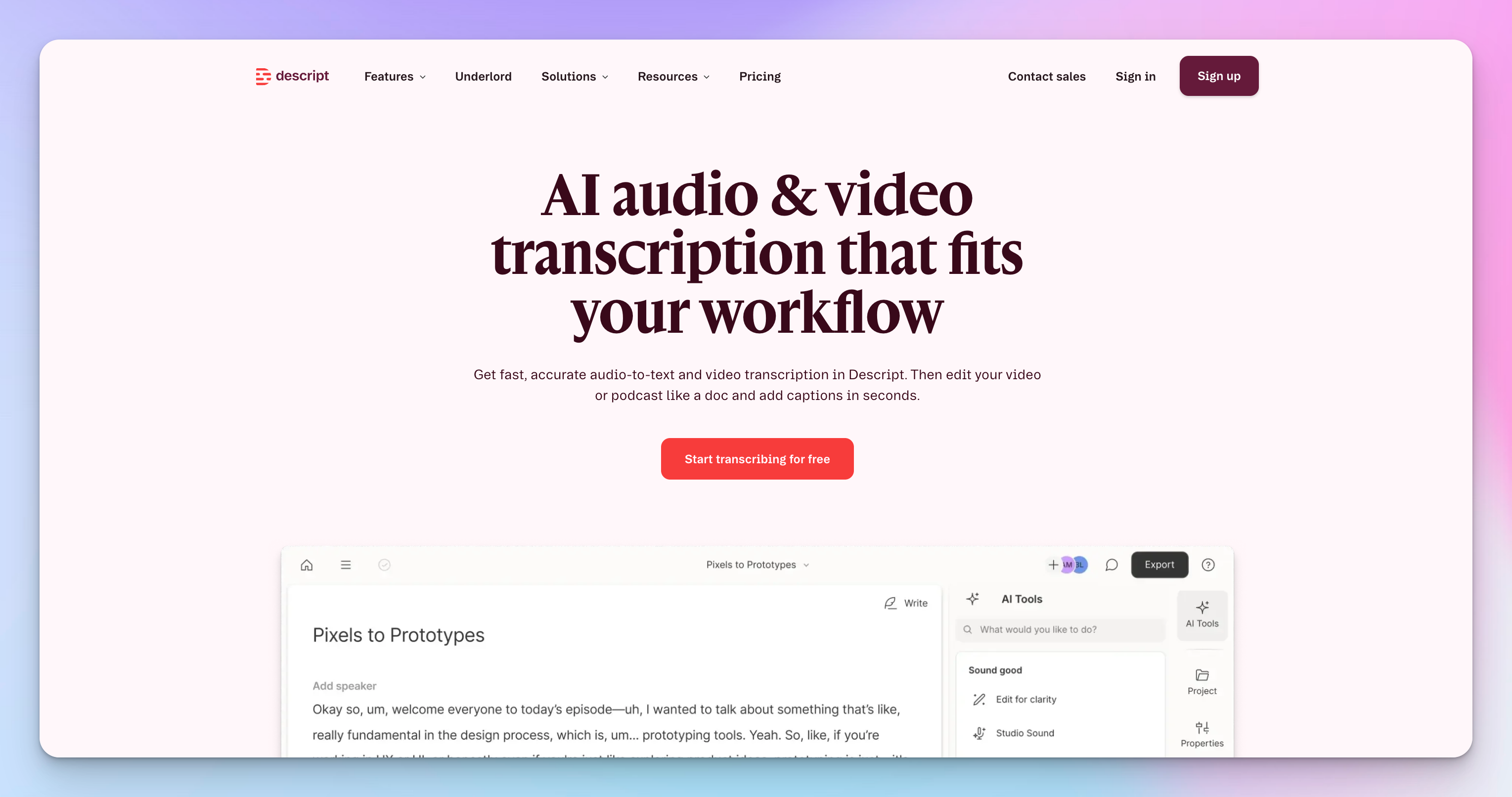
Descript treats the transcript as the editing interface. Delete a word, and the audio gets cut. You can also strip every "um" and "uh" from a recording with a single click. For podcasters and video creators who spend hours trimming recordings, that changes the entire production process.
The transcription itself is reliable, offering up to 95% accuracy across 25 languages. You get automatic speaker detection and multi-track support for remote recording sessions with up to 10 guests.
However, if you just need a clean transcript exported to Word or PDF, the platform is overkill. Descript is built for creators who want to produce finished content, not analysts who want a text record to work from.
Descript's key features
- Text-based audio and video editing; deleting words or sentences in the transcript cuts the corresponding media from the timeline automatically
- Multi-track transcription supports remote recording sessions with up to 10 guests, with speaker labeling per track
- AI Actions turn any transcript into blog posts, show notes, social clips, summaries, and captions without leaving the platform
- Voice cloning and AI voice synthesis let you correct mispronounced words or fix audio errors by typing the correction
- The platform is SOC 2 Type II-compliant
Descript's pricing
- Hobbyist: $24/month per user
- Creator: $35/month per user
- Business: $65/month per user
- Enterprise: Custom pricing
Descript's pros
- Studio Sound enhances audio quality in a single click, removing background noise, room echo, and mic hiss to bring recordings closer to broadcast quality
- AI eye contact correction adjusts your gaze to face the camera in post-production, so you can read from a script or notes while still appearing to address the viewer directly
- Available as a desktop app (macOS and Windows), a web app, and a mobile viewer
Descript's cons
- No human transcription option for accuracy-critical content
- Language support is limited to 25 languages, one of the key reasons why users look for Descript alternatives
- Media minute limits on lower plans can feel restrictive for high-volume users
4. Riverside
Best for: Interviewers and video creators who want high-quality recording and transcription on a single platform
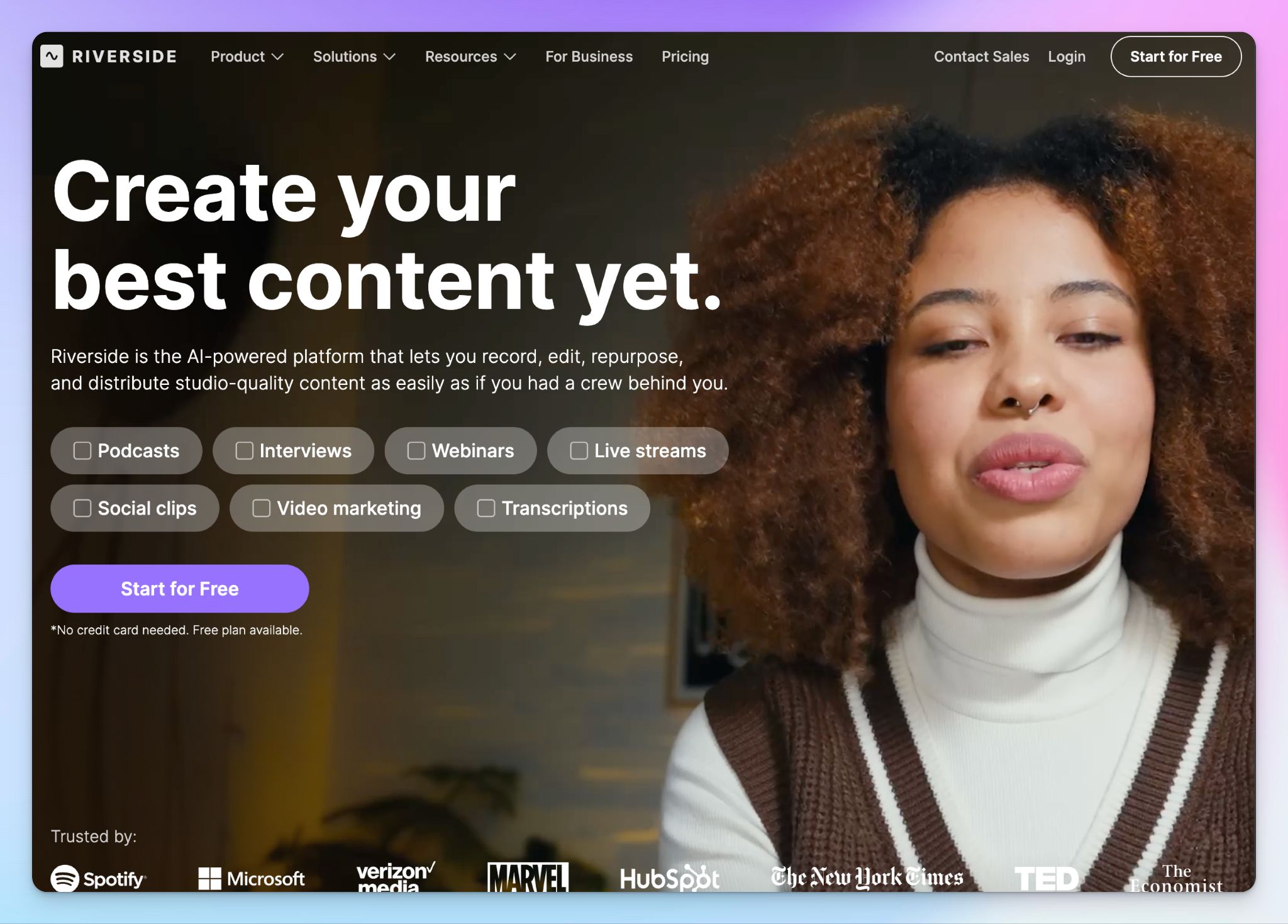
Riverside is a recording tool first and a transcription tool second. It captures audio and video locally on each participant's device at up to 4K video and 48kHz audio, so the source quality going into the transcription is better than what you'd get from a compressed Zoom recording.
Transcription kicks in automatically after recording. It supports 100+ languages, includes speaker labels, and exports in TXT and SRT.
You can also edit recordings by editing the transcript text, generate social clips, add captions, and create AI show notes without leaving the platform.
The downsides are that if you're not recording through Riverside, the transcription features are thin. There’s no DOCX or PDF export, and no collaborative editing.
Riverside's key features
- AI Speaker Detective automatically detects and labels each speaker in the transcript, even for uploaded files
- "Correct Everywhere" lets you fix a recurring transcription error once and applies the correction across the entire transcript
- Magic Audio reduces background noise and reverb per track with adjustable intensity, which improves caption and transcript accuracy on rough recordings
- AI Show Notes pulls titles, chapters, keywords, takeaways, and soundbites directly from the transcript, no separate summarization tool needed
Riverside's pricing
- Pro: $29/month
- Live: $39/month
- Webinar: $99/month
- Business: Custom pricing
Riverside's pros
- Per-participant local recording means the transcript starts from studio-grade audio, not a compressed stream; fewer correction passes needed
- Free transcription tool accepts MP3, WAV, MP4, and MOV uploads with no signup, word limit, or watermark on the transcript output
- Transcript doubles as an editing interface: deleting a sentence from the text removes it from the audio and video in sync
Riverside's cons
- Transcription features are built around Riverside recordings
- Standalone file transcription is basic; export is limited to TXT and SRT only. No DOCX, PDF, or VTT
- Not built for teams handling large volumes of pre-recorded files from outside sources
Did you know? You can convert pre-recorded audio to text with HappyScribe, and you get full support for high-volume use cases.
5. Maestra
Best for: Multilingual teams and content creators who need transcription, subtitles, translation, and dubbing
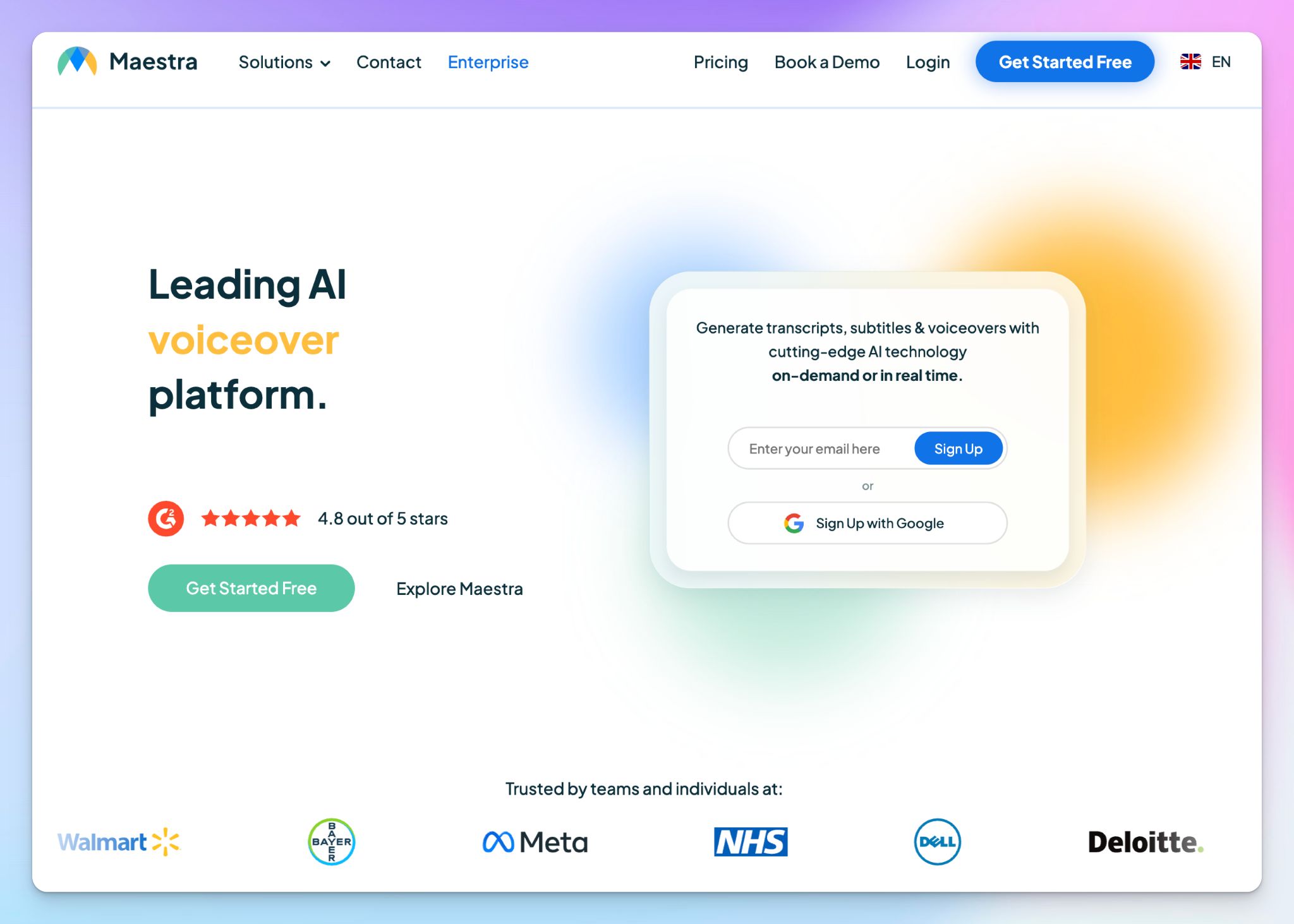
If your workflow involves transcribing a recording, translating it, generating subtitles, and dubbing it into another language, Maestra lets you do all of that without leaving the platform.
It supports transcription in 125+ languages, with automatic speaker labels, timestamps, and AI summaries. There's also a free live transcription tool that runs in your browser without needing an account, which is handy for meetings.
From any transcript, you can generate subtitles, translate them, or create AI voiceovers and dubs in 30+ languages.
The downside is that the transcript editor feels basic next to dedicated tools. Pricing is another consideration: $12 gets you 60 minutes on pay-as-you-go, and the cheapest subscription caps out at 180 minutes a month for $23.
Maestra's key features
- Chrome extension for live transcription and translation, projecting real-time captions onto any browser tab
- 800+ AI voices across 125+ languages with dialect and accent options, plus lip-sync to match dubbed audio to on-screen mouth movements
- Voice cloning in 29 languages that preserves your tone and cadence for both pre-recorded and live content
- Direct integrations with YouTube, TikTok Ads Manager, Zoom, Slack, and Zapier for publishing and automating localization workflows
- AI-powered content tools inside the transcript editor: chapter generation, keyword extraction, quiz creation, and sentiment analysis
Maestra's pricing
- Pay-as-you-go: $12 per 60 minutes
- Lite: $29/month
- Basic: $49/month
- Premium: $99/month
- Enterprise: Custom pricing
Maestra's pros
- Real-time voice cloning during live sessions lets speakers address multilingual audiences in their own voice
- YouTube integration pulls videos directly from your channel and lets you push edited subtitles back without leaving Maestra
- Shareable live sessions via link or QR code let remote attendees pick their preferred caption language on the fly
Maestra's cons
- Transcript editor lacks the depth and polish of tools built specifically for post-transcription work
- Performance on lower-resource languages is uneven and hard to verify before committing
So, which AI transcription software should you choose?
The right tool depends on what happens before and after the transcript. Every tool on this list transcribes well, but the differences show up in what you can do with the output and how far it stretches across languages, formats, and workflows.
👉 Trint is built for newsrooms that need to turn interviews into publishable stories. Story Builder and live transcription make that fast, but file caps and per-seat pricing limit its fit outside editorial teams.
👉 Descript belongs in a production workflow. If you're cutting podcasts or videos, editing audio by deleting words from the transcript saves hours. But 25 languages and no human review option narrow its range.
👉 Riverside gives transcription a cleaner starting point. Local recording at up to 4K and 48kHz means fewer artifacts and fewer corrections. Outside its own recording environment, though, the transcription features are thin.
👉 Maestra handles the full multilingual pipeline: transcription, subtitles, translation, dubbing, and voice cloning in one platform. The trade-off is a basic editor and per-minute pricing that adds up at volume.
👉 HappyScribe handles the widest range of use cases without cutting corners. 150+ languages, 95%+ AI accuracy with a human review layer for high-stakes content, 45+ file formats, and data stored in the EU by default. Researchers, content teams, and compliance-conscious businesses all get what they need from the same platform.
FAQs on AI transcription software
What is the best AI transcription software for transcribing audio and video files?
HappyScribe is the best AI transcription software for teams that work with both audio and video. It accepts 45+ file formats, so you can upload audio recordings or video files without converting anything first. AI transcription runs across 150+ languages with automatic language detection, and you can add human transcription services too. Other AI tools like Descript and Riverside also handle audio and video, but their transcription features are tied to production and recording workflows rather than standing on their own.
How accurate is AI transcription compared to manual transcription?
The best AI transcription tools deliver 95%+ accuracy on clean recordings with a single speaker. Accuracy drops with background noise, multiple speakers, or technical jargon. Manual transcription still produces the most accurate transcription for challenging audio, which is why HappyScribe offers human powered transcription as an add-on. Their human transcription service reaches up to 99% accuracy, with native linguists delivering highly accurate transcripts without the turnaround time of fully manual workflows.
Can AI transcription software handle meeting recordings with multiple speakers?
Yes, but speaker identification quality varies across transcription tools. Meeting transcription software needs to handle overlapping voices and varying audio quality from video conferencing platforms like Microsoft Teams and Google Meet. HappyScribe's meeting transcription tool automatically detects speakers in multi-speaker settings and generates meeting transcripts with timestamps, AI summaries, and key takeaways.
Is there a free plan for AI transcription?
Several transcription apps offer a free plan, but limits vary. HappyScribe gives you 10 minutes of free AI transcription with no credit card required. Riverside offers a free transcription tool for basic transcription of uploaded files. Descript has a free tier with limited media minutes. Trint only offers a 7-day trial with no generous free plan to fall back on. For teams that need unlimited transcription, collaboration features, and advanced features like custom vocabulary and AI generated summaries, paid plans are the realistic path forward.
What's the best transcription software for multilingual teams?
For multilingual transcription, the best transcription services support multiple languages without sacrificing accuracy. HappyScribe leads with 150+ languages, translation into 80+ languages, and accurate transcripts across real-world conditions. Maestra covers 125+ languages and adds AI dubbing. Riverside supports 100+ but is limited as a standalone transcription service.

Rodoshi Das
Rodoshi is the Content Lead at HappyScribe, the privacy-first transcription and AI notetaker platform based in Barcelona. Shaping content strategies and building AI workflows excites her as much as exploring new SaaS tools. She specializes in product-led content that informs rather than sells, grounded in honest product benchmarking and low tolerance for empty marketing speak.