TL;DR ⏩
- Recording consent for research interviews operates on three separate layers: local recording law, data protection regulation (GDPR, DPDP, etc.), and your institutional ethics framework. Satisfying one does not satisfy the others.
- Consent must cover the full lifecycle of the recording, not just the interview itself. Transcription, storage, sharing with co-investigators, and secondary use are each separate data processing events that need to have been disclosed before the participant said yes.
- When the researcher and participant are in different jurisdictions, the stricter rule applies. A participant in California or the EU triggers that jurisdiction's consent standard regardless of where the researcher is based.
- Before submitting an ethics application, verify that your transcription service can provide a Data Processing Agreement, that your consent form names the service and its storage location, and that any transfer of EU participant data outside the EEA has a valid legal mechanism in place.
A researcher in London interviews a participant in Berlin over Zoom. The recording goes to a US-based transcription service. The transcript lives on a Canadian university server.
Four jurisdictions. One consent form. Written for none of them.
This is the reality of modern qualitative research, and it's the reason why consent for research recordings cannot be treated as a local compliance question.
The requirements depend on where each participant is located, where the data travels, how it is stored, and who processes it along the way. Get any one of those wrong, and a legally recorded interview can still become a data protection violation.
In this guide, I'll cover the full picture: the three consent layers every researcher must satisfy, what a consent form must cover, a jurisdiction-by-jurisdiction breakdown of recording law, and a look at what changes once a recording becomes a transcript.
This article is intended for informational purposes and does not constitute legal advice. Researchers with questions about specific jurisdiction requirements should consult their institutional research ethics office and, where necessary, a qualified legal professional.
Why researchers face a different consent standard
Recording consent law applies to everyone, but research interviews carry an additional compliance burden that journalists, podcasters, and business teams do not face. Three factors create that difference.
1. IRB requirements
Institutional review boards (IRBs) in the United States and research ethics committees in the UK, EU, Canada, and Australia require documented consent that recording law alone does not mandate.
A researcher in a one-party consent state can legally record without telling anyone, but their IRB will not approve a study where participants were recorded without being informed.
📚 Also read:
2. Dealing with personally identifiable information (PII)
Research interviews frequently involve sensitive personal data. Health histories, political opinions, religious beliefs, sexual orientation, and experiences of trauma all appear routinely in qualitative interviews.
Under GDPR Article 9 and its equivalents in most national frameworks, this "special category" data triggers a higher standard of consent and additional safeguards, regardless of what local recording law allows.
3. What happens after the recording stops
Recordings do not end at the interview.
They get uploaded to transcription services, coded in qualitative data analysis software, shared with co-investigators, and stored for years.
Each step creates a new data processing event that must have been covered in the original consent.
If a participant agreed to be recorded but was never told the recording would be uploaded to a cloud transcription platform, the researcher may be in breach of their consent terms even if local recording law was satisfied.
A revision of the Common Rule (45 CFR 46) reinforced this by expanding requirements for how consent forms describe data handling and storage, including requirements around the storage, maintenance, and secondary use of identifiable private information.
GDPR Article 89 requires researchers to apply safeguards (such as data minimization and pseudonymization) where possible.
Once those safeguards are in place, member state or EU law can use them as the basis for limiting certain data subject rights, such as the right to access, correct, or object to one's data, specifically for research purposes.
But it does not relax the consent or lawful basis requirements for processing in the first place.
The three consent layers every researcher must satisfy
Before getting into jurisdictions, let’s understand the structure of consent obligations for research recording. There are three distinct layers, each governed by a different body.
| Layer | What it governs | Who enforces it |
|---|---|---|
| Local recording law | Whether you can legally capture the audio at all | Courts, law enforcement |
| Data protection regulation | How you store, process, share, and delete the recording and transcript | Data protection authorities (ICO, CNIL, etc.) |
| Institutional ethics framework | Consent form content, participant rights disclosures, data retention | IRB, ethics committee, research ethics board |
Satisfying one layer does not satisfy the others. A researcher in a one-party consent US state who records without telling the participant has complied with local recording law but has likely violated their IRB approval and may have breached GDPR if the participant is an EU resident.
The consent form that passes IRB review must also meet the disclosure requirements of the data protection framework that applies to the participants.
In practice, researchers who build their consent process around the most demanding applicable framework, like GDPR or their institutional ethics board requirements, will usually satisfy the other layers automatically.
What a consent form must cover for research recordings
A valid consent form or verbal consent script for research recording needs to address eight things. The specifics will vary by jurisdiction and study design, but none of these elements should be missing.
1. Purpose of the study and the recording
Participants need to know why the study is happening and why the conversation is being recorded, not just that it's for research purposes. A concrete statement, such as "this will be used to produce an accurate transcript for analysis," gives them something real to base their consent on.
2. Who will access the recording
Name the specific individuals or roles that will hear the audio, e.g., the principal investigator, co-investigators, or a research assistant. If anyone outside the core research team will have access, state that as well.
3. Transcription process
If the recording will be transcribed, you must inform the participant. If transcription will be handled by a third-party service or a cloud-based AI tool, that must be disclosed.
Researchers can follow a clear framing like this:
"The recording will be transcribed using [tool/service], which operates under [GDPR/SOC 2 Type II/relevant framework] compliance standards. The transcript will be accessible only to [named individuals]."
4. Storage location, country, and retention period
Where the data lives matters legally, particularly for EU residents. Specify the country, the platform, and how long the data will be retained. This does not need to be a technical document, but it needs to be honest and specific.
5. Anonymization method
Will names be replaced with codes or pseudonyms in the transcript? Will the recording be deleted once the transcript is verified? Participants should know what steps will be taken to protect their identifiability.
6. Right to withdraw
Participants must be told they can withdraw consent at any time, including after the interview, and what that means in practice: whether they can request deletion of the recording, the transcript, or both.
7. Publication and quotation
If verbatim quotes from the transcript may appear in publications, reports, or presentations, this must be stated in the consent form, along with whether those quotes will be attributed or anonymized.
8. Contact for questions
Add a named individual or institutional contact through whom participants can exercise their data subject rights (access, correction, deletion) or raise concerns.
Recording consent laws by region: What researchers need to know
| Region | Consent standard | Key legal framework | Research-specific notes |
|---|---|---|---|
| United States (federal) | One-party consent | Federal Wiretap Act (ECPA); Common Rule (45 CFR 46) | IRB approval required for federally funded research; 13 states have some form of all-party consent requirement (CA, CT, DE, FL, IL, MD, MA, MT, NV, NH, OR, PA, WA), with CT applying all-party consent only to electronic recordings (one-party for in-person) and OR applying it only to in-person conversations (one-party for electronic) |
| European Union | All-party consent effectively required | GDPR Article 6; Article 9; Article 89; national implementations | Research exemptions under Article 89 apply with safeguards; transfers of data outside the EEA (e.g., to cloud transcription platforms) require additional safeguards such as adequacy decisions or standard contractual clauses |
| United Kingdom | One-party (personal use); disclosure required for third-party use | UK GDPR; Data Protection Act 2018; Data (Use and Access) Act 2025 | ICO treats research recordings as personal data; explicit consent needed if sharing externally |
| Canada | One-party consent | Criminal Code s. 184; PIPEDA | Organizations must disclose recording purpose; ethics board approval required at most universities |
| Germany | All-party consent (criminal offense otherwise) | §201 StGB; GDPR | Among the strictest enforcement in EU; verbal consent at the start of the recording is generally sufficient under the tacit/implied consent standard |
| Australia | All-party consent in some states | State Surveillance Devices Acts; Privacy Act 1988; Privacy and Other Legislation Amendment Act 2024 | NSW, WA, SA, TAS, and ACT require all-party consent; VIC, QLD, and NT operate under one-party consent; research exemptions require documentation |
| India | All-party consent recommended | Indian Telecommunications Act 2023; DPDP Act 2023; DPDP Rules 2025 | DPDP Rules notified November 2025; full processing obligations take effect May 13, 2027; research institutions should treat recordings as requiring explicit, informed consent given DPDP's emphasis on consent and transparency |
The EU and GDPR
GDPR is the dominant data protection framework for researchers working with EU or EEA participants, regardless of where the researcher is based. If the participant is in Germany, France, or any other EEA country, GDPR governs how their data is handled even if the researcher is in the US or Australia.
The lawful basis most researchers use is consent under Article 6(1)(a), supplemented by explicit consent under Article 9(2)(a) for special category data.
Some institutions use legitimate interest or the research exemption under Article 89, but both require documentation and ongoing justification. The safest approach is to obtain clear, informed consent and document it.
Since GDPR came into force in 2018, regulators have issued over €7.1 billion in cumulative fines, with approximately €1.2 billion issued in 2025 alone, broadly matching 2024's total, according to the DLA Piper GDPR Fines and Data Breach Survey (January 2026).
Enforcement remains active across Europe, with regulators continuing to issue substantial penalties year over year.
The United States
Regarding recording consent in the US, federal law sets a one-party consent baseline under the Electronic Communications Privacy Act. It means a researcher can legally record a conversation they are part of without notifying the participant.
However, IRB approval for most federally funded research requires informed consent that covers recording, and 12 states impose all-party consent requirements.
Oregon separately applies all-party rules to in-person conversations only, while treating electronic recordings under the one-party standard.
Cross-border and online interviews
When the researcher and participant are in different countries or states, the safest practice is to follow whichever rule is stricter, even though no single law always settles the question.
For instance, a researcher based in New York interviewing a participant in California should follow California's all-party consent requirement.
The same logic applies internationally: a researcher anywhere in the world who interviews an EU resident must comply with GDPR because GDPR's protections follow the participant's location, not the researcher's.
📚 Also read:
Online and remote research interviews: Additional considerations
The shift to remote qualitative research over the past several years has created consent complexities that in-person research did not face. Three deserve specific attention.
Platform-level vs. researcher-controlled recording
When a researcher uses a platform's built-in recorder (such as Zoom's local recording or Teams' in-meeting recording), participants usually see a visual notification on screen.
When a researcher records using a separate tool or a bot-free recorder, no such notification appears.
Consent must explicitly cover the recording method being used, not just the fact that recording will happen.
Bot-based AI notetakers
If a bot joins the meeting as a participant to handle recording and transcription, this must be disclosed in the consent form and explained in the ethics application.
Some participants object to visible bots, particularly in sensitive research contexts.
Bot-free recording options allow researchers to capture audio without adding a visible participant to the call.
But the use of any recording tool still needs to be disclosed to participants before the interview begins.
Cross-border online interviews
A UK researcher running Zoom interviews with participants across the EU, North America, and Australia in a single study is managing potentially four or five different consent frameworks simultaneously.
The practical approach is to identify the strictest applicable rule for each jurisdiction and build a consent form that satisfies all of them.
For most international research teams, this means designing to GDPR standards as a baseline.
👉 Good news is, HappyScribe supports both bot and bot-free recording modes, which gives researchers the flexibility to choose the method that fits their consent framework and ethics application.
For multi-site or multilingual research, HappyScribe's AI transcription covers 150+ languages with the option to escalate to human proofreading at 99% accuracy.
Its EU-based data storage, GDPR compliance, and SOC 2 Type II certification make it easy to reference as a compliant data processor in ethics applications and IRB protocols.
Sending recordings to a transcription service: What are your compliance obligations?
Uploading a recording to a cloud transcription service is a separate data processing event, and it needs to have been covered in the original consent.
Under GDPR Article 4(8), any organization that processes personal data on behalf of a data controller is a data processor. A transcription service that receives, stores, and processes a research recording is acting as a data processor.
Two compliance obligations follow from this:
1. The researcher (as data controller) needs a Data Processing Agreement (DPA) with the transcription service. IRBs and ethics committees at EU-affiliated institutions require evidence of this agreement in research ethics applications. Researchers should check whether their transcription service can provide a DPA before submitting an ethics application that names it.
📌 HappyScribe offers a Data Processing Agreement (DPA)
Because HappyScribe processes personal data on behalf of our customers, it acts as the "data processor" under the GDPR while you remain the "data controller" of your own files.
To formalize that relationship, HappyScribe can provide a signed DPA along with a current list of our sub-processors, on request.
The DPA sits alongside the wider safeguards HappyScribe has in place: all data is encrypted, files are hosted in an EU data centre that is Tier IV, PCI DSS and ISO 27001 compliant, and your uploads remain 100% your property and are fully deleted from the systems when you remove them.
For teams with stricter procurement requirements, HappyScribe signs NDAs and offers SSO. To request a DPA, reach out to our team.
2. The participant's consent form must explicitly cover transcription by a third party. If the form says only "the recording will be heard by the research team," using a cloud service without further disclosure may breach the consent terms, regardless of whether local recording laws were satisfied.
AI-generated transcripts are also personal data if they contain identifiable information, which most research interview transcripts do.
The same protection obligations that apply to the recording apply to the transcript, including storage location, access controls, and retention limits.
What about storage location?
Storage location is a separate issue under GDPR. Transfers of EU participant data outside the EEA require a valid transfer mechanism, such as a European Commission adequacy decision or standard contractual clauses.
Researchers should verify what transfer mechanism their transcription service relies on before using it for EU participant interviews.
Special cases that change your consent obligations
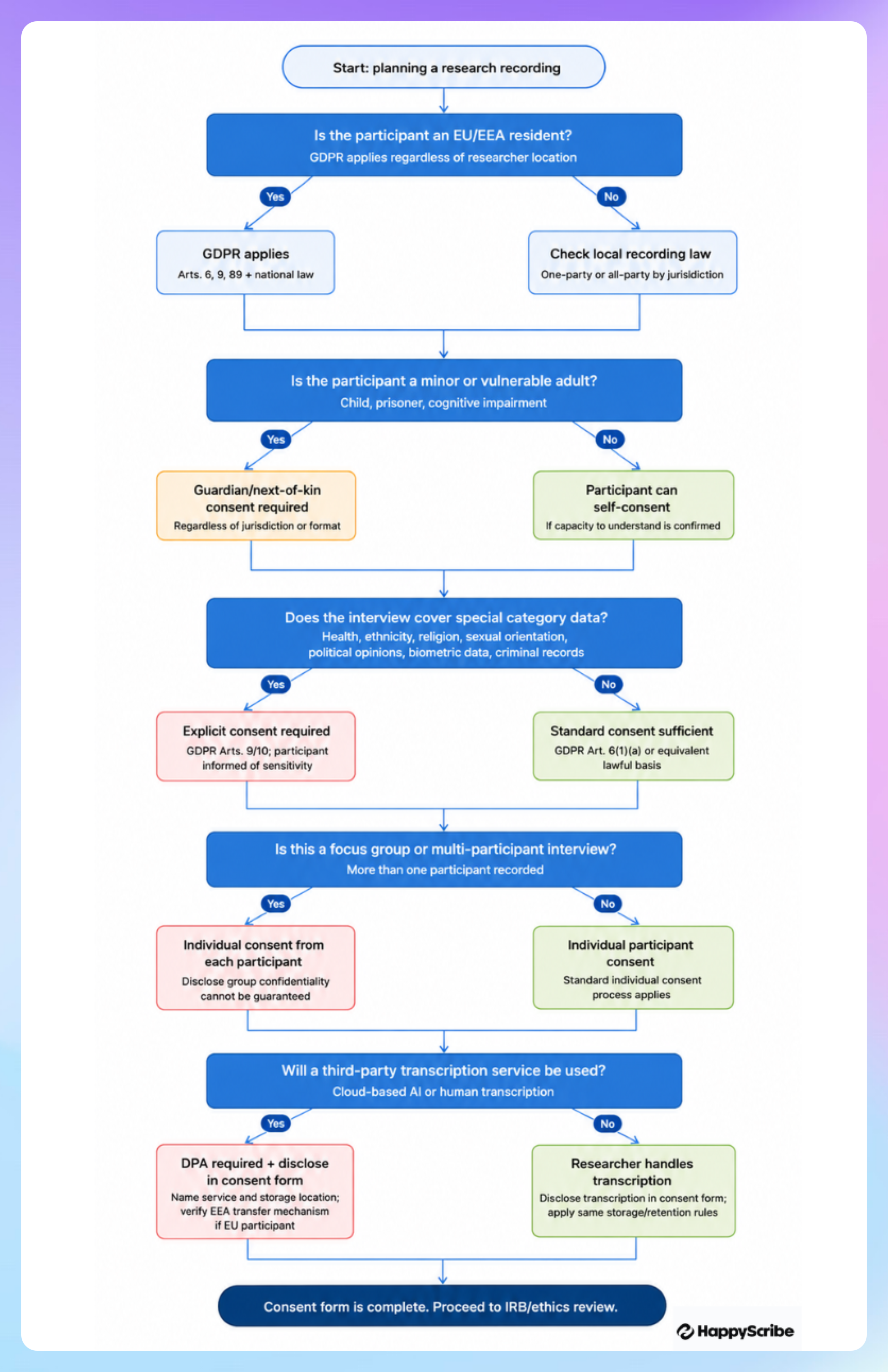
The following research contexts require more than standard consent.
Vulnerable populations
Research involving children, prisoners, or people with cognitive impairments requires additional consent layers.
The applicable test for in-person research interviews is whether the participant has sufficient capacity to understand and freely consent, a judgment that IRBs and ethics committees assess in their approval criteria.
Where capacity is in doubt, or the participant is clearly a minor, guardian or next-of-kin consent is required.
GDPR Article 8 sets age thresholds for self-consent, but only for information society services (online platforms and apps), not for research interviews. As a reference point, Germany sets the threshold at 16; the UK, Denmark, and several others have set it at 13.
Special category data
If the interview covers health, ethnicity, religion, sexual orientation, political opinions, or biometric data, GDPR Article 9 requires explicit consent, which is a higher standard than standard consent under Article 6.
Criminal records and convictions fall under the separate Article 10 regime, which also requires additional safeguards.
Explicit consent means the participant has been specifically informed about the sensitive nature of the data and has given a clear affirmative agreement to its processing. A generic consent form that covers the study broadly is not sufficient.
Focus groups and multi-participant interviews
Every participant requires individual consent. Confidentiality within the group cannot be guaranteed by the researcher because other participants may disclose what was discussed.
Consent forms for focus groups should acknowledge this explicitly and invite participants to consider what they share accordingly.
Longitudinal and multi-stage research
Participants who consent at the start of a study need to be re-consented if the scope of data use changes, if new researchers join the team with access to recordings, or if the originally stated retention period needs to be extended.
Close the consent gaps before data collection starts
Consent requirements for research recordings vary by jurisdiction, but the structure is consistent everywhere: local recording law sets the floor, data protection regulation governs what happens to the file afterward, and your IRB or ethics committee ties both together through the consent form.
The details that create compliance problems tend to be operational, not jurisdictional: a transcription service that cannot provide a DPA, a consent form that covers recording but not storage, or a retention period that was never stated.
These are easy to close at the planning stage but costly to address once data collection has begun.
Map the full lifecycle of your recording before drafting your consent form. Everything else follows from that.
FAQs on consent requirements for recording and transcribing research interviews
Do I need consent to transcribe a research interview?
Yes, if transcription involves a third-party service or any cloud-based platform. The participant's original consent form should explicitly cover transcription, identify who performs it (the researcher, a human transcriptionist, or an AI service), and state where the resulting transcript will be stored.
Uploading a recording to a transcription service without disclosing this in the consent form may breach the participant's consent terms and the applicable data protection framework, even if local recording law was satisfied.
What should a research interview consent form include?
At minimum, a research interview consent form should include:
- The purpose of the study and why the interview is being recorded
- Who will access the recording and transcript
- The transcription method and service provider
- Data storage location, country, and retention period
- The anonymization or pseudonymization process
- The participant's right to withdraw consent and request deletion
- Whether verbatim quotes may appear in publications
- A contact for exercising data subject rights
Consent forms for EU participants should also include the lawful basis for processing and a reference to GDPR rights.
Does GDPR apply to academic research recordings?
Yes, if the researcher or their institution is based in the EU or EEA, or if the participant is an EU resident.
GDPR Article 89 provides limited research exemptions, primarily around certain data subject rights (including access, rectification, and objection) and storage limitation, but does not exempt researchers from the requirement to have a lawful basis for processing.
Consent under Article 6(1)(a) and explicit consent under Article 9(2)(a) for special category data remain the standard approach.
Universities operating within the EEA are directly subject to GDPR regardless of funding source.
What is the difference between one-party and all-party consent in a research context?
One-party consent means the researcher can record legally without notifying the participant, because the researcher is a party to the conversation.
All-party consent requires every participant to be explicitly informed before recording begins.
In Germany, parts of Australia, and 12 US states (with Oregon applying all-party rules to in-person conversations specifically), all-party consent is the legal standard.
In research practice, this distinction matters primarily for cross-border online interviews.
IRBs and ethics committees at the vast majority of institutions require informed consent regardless of local recording law, so researchers in one-party states already operate at a higher standard in practice.
The legal distinction becomes relevant when determining whether a recording made in good faith but without explicit notice would be admissible, or when operating across jurisdictions where different standards apply simultaneously.
Can I use AI transcription for sensitive research interviews?
Yes, with appropriate safeguards in place. The AI transcription service must operate under data security standards appropriate to the sensitivity of the data, at minimum GDPR compliance and SOC 2 Type II certification for research involving personal or special category data.
A Data Processing Agreement (DPA) must be signed before any recordings are uploaded. Participants must have been informed of AI transcription in the consent form.
For sensitive data, human transcription by a vetted linguist working under a confidentiality agreement may be preferable, and some IRBs will require it.
HappyScribe is a transcription service provider that covers both options: AI transcription across 150+ languages for standard research use, and NDA-bound human proofreading at 99% accuracy for contexts where precision and confidentiality are critical. Its EU-based data storage, GDPR compliance, and SOC 2 Type II certification make it easy to reference as a compliant data processor in ethics applications and IRB protocols.

Rodoshi Das
Rodoshi is the Content Lead at HappyScribe, the privacy-first transcription and AI notetaker platform based in Barcelona. Shaping content strategies and building AI workflows excites her as much as exploring new SaaS tools. She specializes in product-led content that informs rather than sells, grounded in honest product benchmarking and low tolerance for empty marketing speak.