Turnaround time sounds like a simple question: how fast will you get your transcript? But honestly, it’s about more than just speed. It tells you when you’ll actually know if that transcript is good enough to use.
These days, so much work happens through recorded conversations. Recording them is easy, but you can’t really do much with them until they’re written down. That’s where turnaround time shapes decisions, deadlines, and cost of transcription services.
In this article, we’ll break down what turnaround time really means, what timelines to expect, and how to choose speed without committing too early.
TL;DR
- Turnaround isn’t just speed: Fast delivery doesn’t always mean a usable transcript; accuracy and practical use matter more
- Delivery method affects timing: AI drafts appear in minutes, human transcription takes 24-48 hours for standard files, longer for complex recordings; rush options shorten time but cost more
- Key factors that slow down transcription: Poor audio, multiple speakers, and technical or dense content all increase processing time
- Flexible modern workflows help: AI-first audio to text platforms like HappyScribe provide instant access and let you add human review selectively
What turnaround time means in transcription services
Turnaround time is just the gap between when you send in your audio or video and when you get your finished transcript back.
It covers all the steps a transcription service follows: reviewing your file, transcribing the content, checking for errors, and formatting the transcript for delivery.
So, what does this actually mean in real life? Let’s explore how long these turnaround times really are.
What turnaround time can you realistically expect from a transcription service provider?
When it comes to transcription services, turnaround times tend to fall into a few predictable patterns.
- AI transcription is usually lightning-fast. Audio-to-text platforms like HappyScribe pump out drafts in just a few minutes. But throw in tricky accents, speaker labels, or audio cleanup, and you might have to wait a bit longer
- Human transcription moves at a different pace. Standard delivery commonly ranges from 24 to 48 hours for clear recordings under an hour, with longer or more complex files extending to two or three days
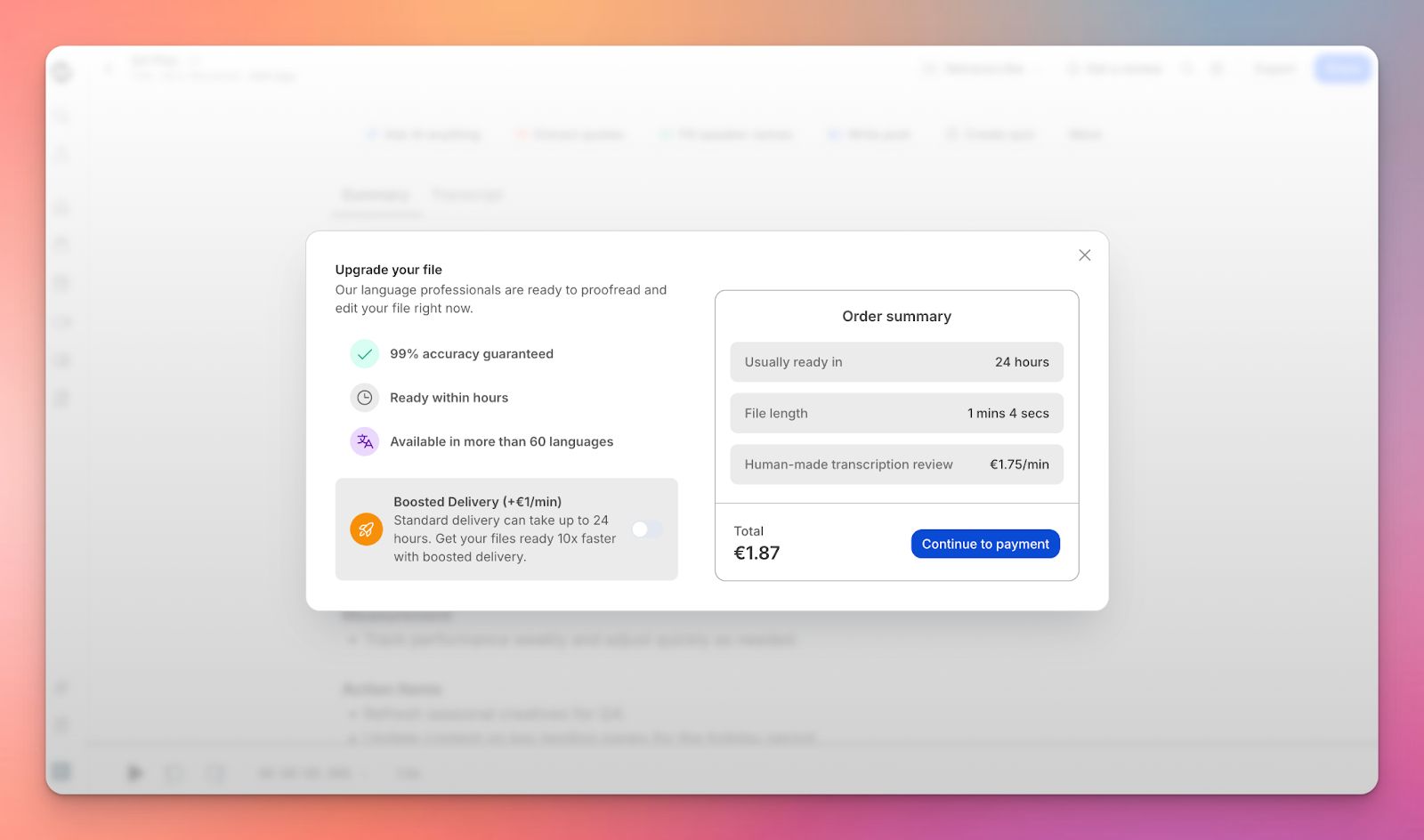
- Rush delivery shortens that window by prioritizing work. For instance, HappyScribe offers rush transcription (Boosted Delivery) for an extra fee, delivering your files up to 10 times faster with the same human accuracy and care. Available in English, French, and Spanish
Of course, knowing how quickly you’ll get your transcript is only part of the story. What really matters is what that speed means for you.
Why "fast" isn’t the right question for turnaround time
When people ask how fast a transcript can be delivered, they're usually assuming faster is always better. But guess what…it isn't.
A transcript that arrives in four hours but takes three more to fix is less useful than one that arrives the next day and works right away. Speed only helps when it lets you actually use the content sooner.
What really matters is how sure you need to be. If you're getting your notes ready for a meeting tomorrow, sometimes "good enough" is all you really need. If you're using the same words in a legal document, you'll want them checked carefully, even if that takes longer. Same recording, very different needs.
To understand why speed isn't always the primary factor, let’s take a look at the core elements that influence the time it takes to transcribe.
Also read: Speaker Labels and Timestamps: How They Impact Transcription Quality and Speed
Real factors affecting turnaround time
Marketing often focuses on speed. In reality, delivery time depends on limits that rush pricing can’t always overcome.
Here’s what really affects how fast your transcript is delivered:
1. Audio quality
Background noise doesn't only reduce accuracy; it doubles processing time. If you opt for human transcription, transcribers have to replay sections again and again to separate speech from noise. When audio is recorded in a quiet space, it usually sounds clear and plays at a normal pace.
2. Speaker count
It's simple to transcribe recordings with just one person talking compared to conversations with a group. It's tough when you have so many people talking because you must identify speakers, manage overlapping speech, and distinguish between similar voices.
This usually adds an extra 25-40% to your processing time, always, no matter the service level you pick.
3. Content complexity
A short medical interview can take as long to transcribe as a much longer casual conversation, because technical terms must be verified when transcribing an interview in specialized fields. When services don’t slow down for this step, they may deliver faster, but with more errors.
In general, complex or low-quality audio takes much longer to process. Ignoring this reality leads to missed deadlines or lower-quality transcripts.
Also read:What Impacts AI Transcription Accuracy?
How modern transcription platforms speed up turnaround without sacrificing quality
Traditional transcription treats speed and accuracy as mutually exclusive. Modern, AI-first workflows bring them together by adding human review only when needed.
Here’s how modern platforms speed up transcription without sacrificing quality:
- Instant draft access: See what was said, spot key sections, and assess audio quality within minutes.
- Layered accuracy: AI does the heavy lifting for the transcript, but you still get to mark any parts you need humans to double-check for accuracy. You only pay for accuracy when it really counts.
- Early problem detection: The AI draft reveals if audio issues, accents, or technical terms may cause errors, letting you adjust before committing to premium services.
- Flexible workflow: Instead of choosing between “fast but expensive” or “cheap but slow,” you start fast and affordable, then add review selectively.
- No wasted costs: Avoid paying for high-precision human transcription unless it’s absolutely necessary
How turnaround time affects transcription costs
For AI transcription service, you don’t have to pay extra for speed.
But for human transcription, faster transcription costs more. The shorter the deadline, the bigger the price jump.
There are three main reasons:
- Extra work for staff: Companies have to pay extra to transcribers to get the job done earlier than usual, or employ more people for the same task
- More careful checking: Normally, transcribers can finish a job, take a break, and review it again. With rush delivery, there’s no break, so extra checks or faster work may be needed to keep quality high
- Higher risk: Problems like unclear audio or unexpected terms are harder to fix quickly. Fixing them in a short time costs more
Standard delivery is cheaper because it lets the team work normally and check their work carefully. Expedited delivery costs more because it disrupts normal work hours and processes. You should only pay more if you genuinely need the faster delivery.
Choosing the right turnaround time for your needs
Most people don’t know upfront whether a transcript will remain internal, be shared externally, or end up published. Traditional transcription services force that decision too soon by locking you into a turnaround tier before the use case is fully clear.
That’s where a more flexible approach makes sense.
Enjoy fast AI transcription with optional human review using HappyScribe’s transcription services
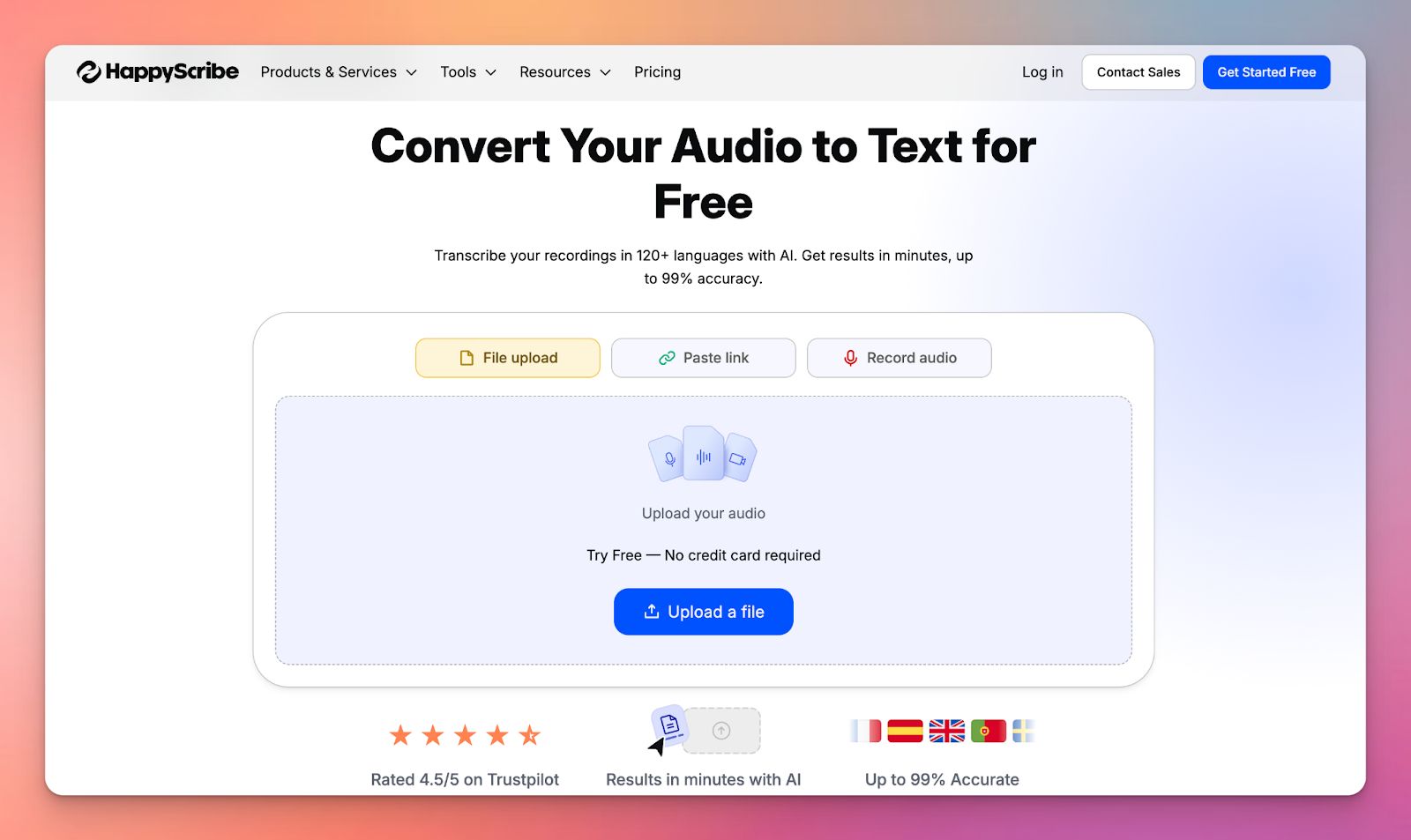
Some modern transcription platforms treat turnaround time as a progressive choice, not a one-time commitment. With HappyScribe, you can start with fast AI transcription to review and assess the content. Then, if it needs to be perfect for publishing, you can add human verification.
This changes how transcription services are used:
- You don’t pay extra for accuracy you may not need
- You don’t hold back or slow down work meant for internal use
- You don’t restart the process when requirements change
The result is simple: turnaround time adapts to the outcome, not the other way around.
HappyScribe’s AI transcription starts at $8.50/month, where you get your transcripts delivered in a few minutes. Human proofreading starts from $2/minute and the transcripts are usually ready in 24 hours. Boosted delivery adds $1/minute on top of the human transcription charges, and you can get them delivered 10x faster.
If you’re confused between AI and human transcription, you can always start with HappyScribe’s AI transcription and upgrade when needed.
FAQs
How can I tell if a transcription is accurate?
You can check that all speakers are correctly identified, key terms are captured, and content matches the audio. Performing a quick check of the important parts makes sure the transcript is good to go.
What if a transcription contains errors?
Mistakes can cause miscommunication or wasted effort. HappyScribe lets you use its interactive editor to correct errors yourself, or you can add professional human proofreading to improve accuracy and catch issues before they become problems.
How much do AI transcription services cost?
HappyScribe offers AI transcription starting at $8.50/month on the annual plan. Depending on how many minutes of audio or video you want to transcribe, expect the price range to be around $8.5 to $59 per month.

Akshay Kumar
Akshay builds pieces meant to reach people and stay visible where it matters. For him, it’s less about the name and more about whether the words did what they were meant to.