“Reading long and complex documents is fun,” said no one ever.
We all look for a summary upfront to get the main ideas and context behind a document. But it only works when the summary is truly comprehensive and free from bias.
When you're involved in creating a document, it can be difficult to step back and write an objective summary. And that's why you're here.
I'll help you write an objective summary with AI that not only saves you time but also stays true to the document’s purpose. Let's dive in!
What is an objective summary?
An objective summary is a concise restatement of a document’s core ideas, written without interpretation, opinion, or emotional framing. It tells the reader what the document is all about, not how to interpret the arguments or how they should feel about it.
An objective summary:
- Preserves the original intent
- Reflects the author’s or speaker’s priorities
- Avoids adding emphasis, criticism, or conclusions
In practical terms, it lets someone understand a long document without having to read it, while still trusting that nothing important has been skewed.
Want to see how a good objective summary reads in a document vs a bad one? Check the next section.
Objective vs subjective summary
It's easier to theorize an objective summary than to write one. That's why so many of us miss the mark on a solid summary.
Here's a breakdown of what makes a good objective summary:
| Objective summary | Subjective summary |
|---|---|
| Reports facts and main points to speed up learning | Interprets and evaluates them, which misleads readers |
| Uses neutral language | Uses opinionated or emotional language |
| Stays close to the source | Adds commentary or framing |
| Can be verified against the original | Depends on the writer’s viewpoint |
Here are examples of objective summaries in various contexts:
Example #1
Meeting context:
A 45-minute product roadmap meeting between product, engineering, and sales. The discussion covered feature delays, customer feedback, and revised delivery timelines.
Objective summary:
The team discussed delays in two planned features due to engineering capacity constraints. Sales shared customer feedback requesting clearer timelines. A revised delivery schedule was proposed, pushing the affected features to the next quarter.
Subjective (poor) summary:
The meeting focused on problems caused by engineering delays, which frustrated sales and forced the team to push important features back.
The objective summary reports what was discussed and decided. The subjective summary introduces blame and emotions that were not explicitly stated, distorting readers’ perception.
Example #2
Meeting context:
A weekly leadership meeting reviewing customer churn, onboarding issues, setup delays, and next-quarter priorities.
Objective summary:
The team reviewed an increase in customer churn during onboarding. Support flagged recurring setup issues, and marketing shared plans to update onboarding materials. No final decisions were made on ownership or timelines.
Subjective (poor) summary:
Leadership expressed concern over rising churn caused by poor onboarding, prompting marketing to step in and fix the issue.
The objective summary reports what was discussed and what was not decided. The subjective version adds causality and resolution that were never explicitly stated.
What are the key features of an objective summary?
By now, you know what's NOT an objective summary and how to spot a good one. But before you write an objective summary, it's important to know the features that make summaries truly objective.
Here are non-negotiable features of an objective summary:
1. Fact-based and neutral
Everything in the summary must be traceable back to the original text, audio, or video. No assumptions or extrapolation. Remember that major points should receive more space than minor ones.
2. Neutral language
Make sure to avoid adjectives that imply personal judgment, such as “successful,” “weak,” “impressive,” or “disappointing,” unless those exact words appear in the source.
3. No added conclusions
An objective summary does not tell the reader what to think. It does not suggest next steps, risks, or outcomes unless they were explicitly stated.
4. Structurally aligned to the source
The flow of the summary follows the structure of the document or conversation, preventing AI or humans from accidentally prioritizing secondary points over the main idea.
This is also why objective summaries work best when they are built on top of a clean, verbatim transcript rather than rough notes or memory. Without an accurate source, neutrality is impossible.
How to write an objective summary with AI?
By now, you know about all the moving pieces that contribute to an objective summary. Let's put them into practice.
Step 1: Start with a clean, verbatim source
Objectivity starts at the source. If the input is incomplete, unclear, paraphrased, or based on memory, the summary will inherit those gaps. Always begin with the full document or an accurate transcript of the meeting, interview, lecture, or or any other type of recording.
This is especially critical for summarizing audio and video content, where tone and phrasing are important. AI can only stay neutral if it has access to exactly what was said.
Step 2: Define the scope before summarizing
Before prompting AI, decide what the summary is meant to cover.
Ask yourself:
- Is this a high-level overview or a detailed recap?
- Is the goal context-setting, documentation, or decision review?
- Who is the summary for?
Setting boundaries prevents AI from overemphasizing side discussions or compressing important sections too aggressively.
Step 3: Use explicit, constraint-based prompts
Generic prompts might trigger interpretation. Instead, lead the AI with clear constraints:
- Ask it to restate key points only
- Instruct it to avoid opinions, emotions, conclusions, or recommendations
- Specify that nothing should be added that is not explicitly stated
Step 4: Cross-check the summary against the source
AI-generated summaries should always be reviewed against the original material.
Check for:
- Added causality or intent
- Emotional language that did not exist in the source
- Conclusions that were implied but never stated
If a sentence cannot be traced back to a specific part of the document or transcript, it does not belong in an objective summary.
Step 5: Refine for clarity
Shorten sentences, remove redundancy, and improve flow, but do not reframe key discussions at any point. The structure should mirror the source, just more compactly. When done right, AI becomes a time-saver instead of distorting arguments.
Best AI tools for writing objective summary
1. HappyScribe
HappyScribe is the best tool to write an objective summary. It's not only easy to generate summaries, but you also get additional features with HappyScribe AI, such as adjusting the length of the summary and choosing between bullet point-style or paragraph-based summaries.
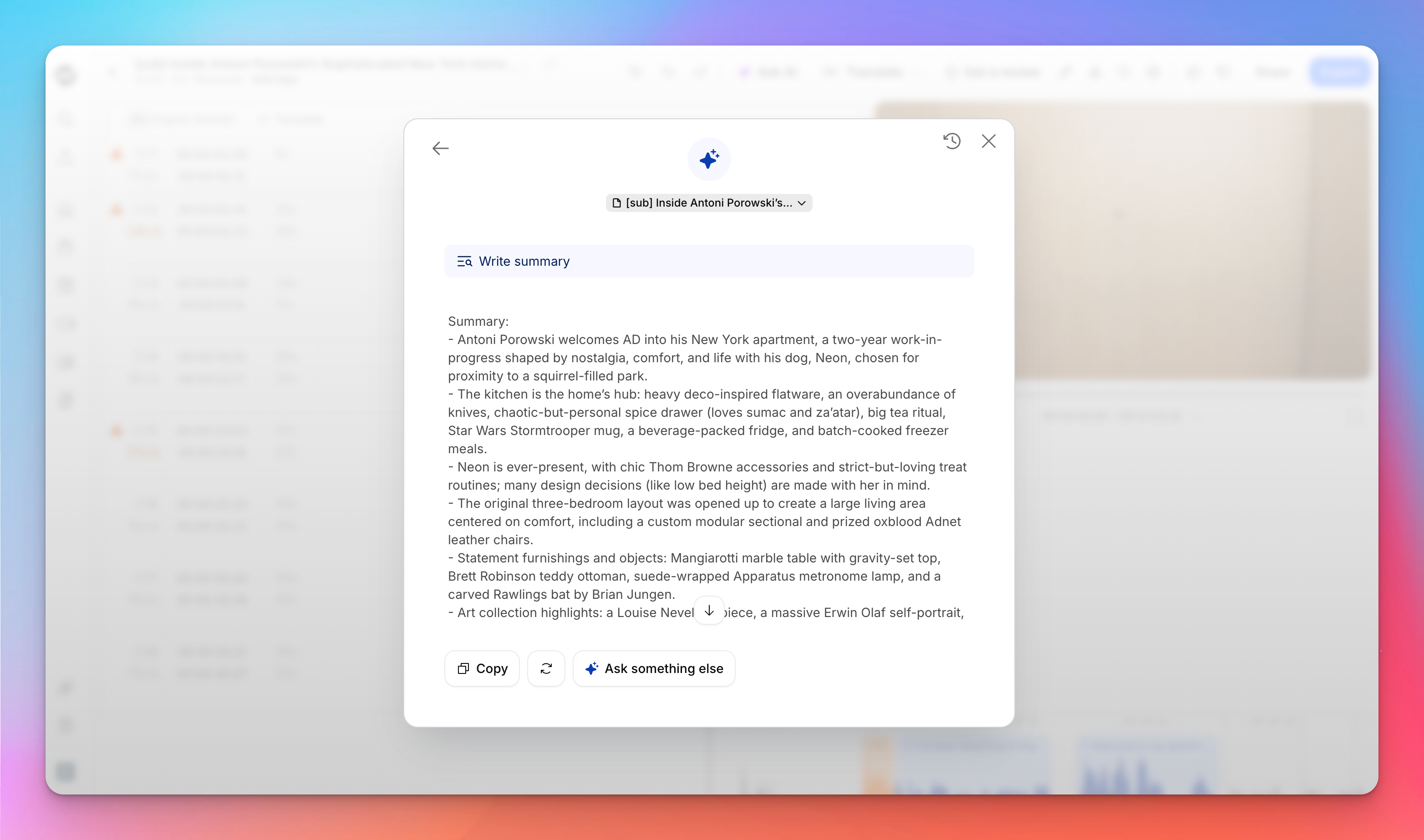
With HappyScribe, you can transcribe meetings and audio and video files in 140+ languages, with up to 99% accuracy. Once you have the transcription ready, you can:
- Create structured meeting notes
- Extract verbatim quotes
- Turn conversations into blog drafts
- Generate video chapters for faster skimming
The AI meeting note taker makes sure it captures all the information verbatim and creates a summary that's relevant and accurate.
How to write an objective summary with HappyScribe
Follow these simple steps to generate an objective summary with HappyScribe:
1. Upload your audio or video recording, or let HappyScribe notetaker transcribe live meetings
2. Review the transcript and edit speaker labels. You can create a custom vocabulary and let a human expert review your transcription
3. Click on “Ask AI” from the top menu and then “Write summary”
4. You can copy the summary to save in notes, generate another one, or ask AI something else. That's it!
Pro tip:
To get the best out of HappyScribe’s features and organize your notes, sign up for a HappyScribe account. It’s free!
2. Grammarly AI summarizer
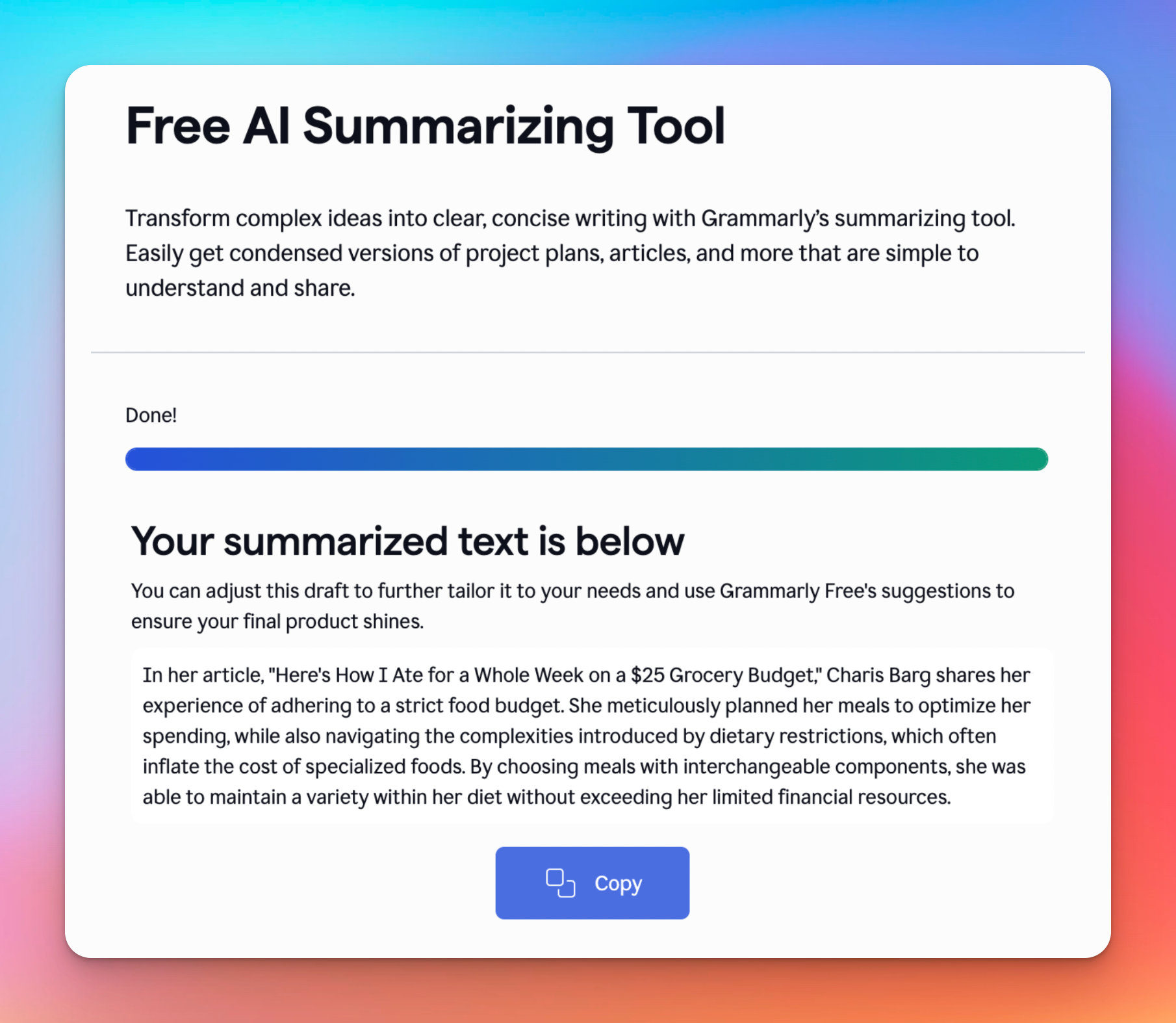
Grammarly’s AI summarizer is designed for condensing written text rather than working from raw audio or meetings. The tool focuses on speed, so if you already have a text ready, it'll perform well.
How to write an objective summary with Grammarly AI summarizer
-
1
Open Grammarly’s AI summarizer page
-
2
Paste your document, article, or large text block you want to summarize
-
3
Select summarization settings: tone and whether you want bullets or paragraphs
-
4
Summarize the text and copy the output
Be aware, though. Grammarly does not provide transcription, timestamps, or source traceability. That limitation makes it less reliable for objective summaries, especially for meetings or business recordings.
3. Quillbot AI text summarizer
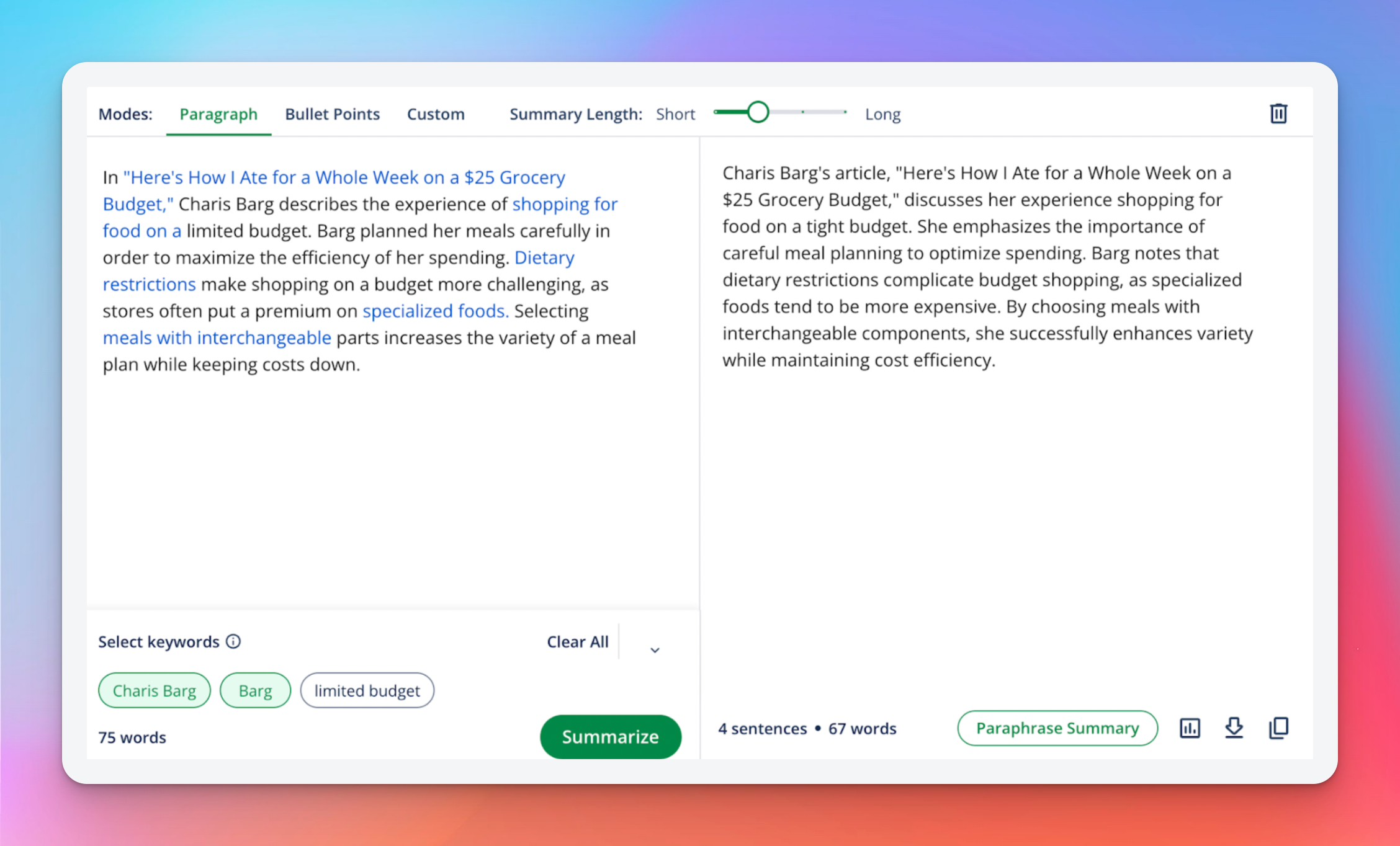
QuillBot’s AI summarizer is another tool built for paraphrasing text quickly. It supports different summary lengths and formats, which makes it flexible for academic and marketing tasks.
How to write an objective summary with Quillbot AI summarizer
-
1
Open the QuillBot AI summarizer
-
2
Paste your text or upload a file like a PDF or DOCX. It doesn't support audio or video
-
3
Choose language, summary length, and whether you want paragraph or bullet points
-
4
Copy the summary or download it as a DOCX file
QuillBot offers several quality-of-life features like export options, keywords, word count, and statistics. But it ranks below Grammarly simply because of a comparatively inferior summary output. There's also no native support for audio or video transcription.
4. ChatGPT
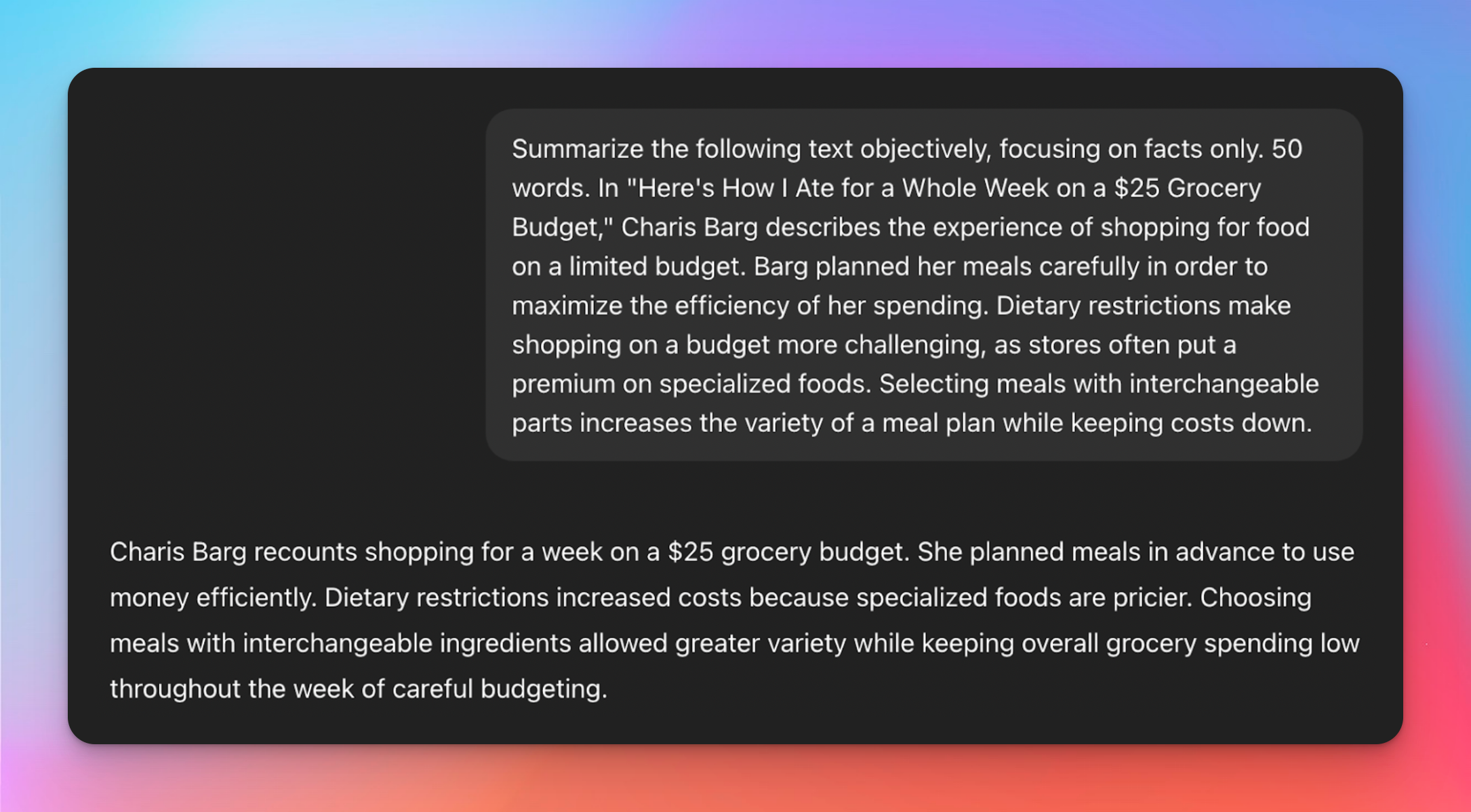
ChatGPT can summarize any text you provide, with tailored control over format and tone. However, it does not generate summaries from audio or video without a text transcript.
How to write an objective summary with ChatGPT
-
1
Open the ChatGPT app or website and paste your text
-
2
Craft your prompt for objectivity. You could try something like “Summarize the following text objectively, focusing on facts only”. You can also mention specific length and tone
-
3
Generate the summary and ask for edits if you’re not happy with the output
ChatGPT’s conversation-style feedback is great for flexibility, but also its main risk. ChatGPT does not inherently distinguish between objective summarization and interpretive rewriting unless you explicitly instruct it to do so.
Best practices for writing objective summaries with AI
Even with the right tool, objective summaries can drift if you don't have clarity. These best practices help keep AI output reliable without rehashing what you already know.
- Summarize from the full source, not excerpts. Feeding partial sections or highlights increases the risk of distorted emphasis
- Prefer extraction over compression. When possible, ask AI to extract stated facts, decisions, and topics instead of simply shortening the text
- Avoid emotional or outcome-driven prompts. Prompts that reference failure or implications push AI into analysis mode. Keep prompts descriptive and linked to what was explicitly discussed
- Treat AI output as a draft, not a record. An objective summary still requires human review to validate objectivity
Pick the right tool to create objective summary
Writing an objective summary with AI is less about the model and more about the workflow behind it. Text-only tools can help when your source is already clean and structured, but they struggle when accuracy and neutrality is important.
If you're confused about which tool to use, here's a quick comparison guide to help you make a decision:
| Tool | Works with audio/video | Built-in transcription | AI meeting note taker | Best use case |
|---|---|---|---|---|
| HappyScribe | Yes | Yes | Yes | Objective summaries from meetings, interviews, and recordings |
| Grammarly | No | No | No | Fast summaries of polished documents |
| QuillBot | No | No | No | Quick text compression for essays |
| ChatGPT | No | No | No | Flexible, prompt-driven text summaries |
If your goal is to save time without compromising accuracy, use HappyScribe for objective summaries.
FAQs on how to write an objective summary with AI
1. What is an objective summary?
An objective summary is a neutral overview of a document, meeting, or call that presents the central idea and core facts without adding personal opinions or interpretation. It focuses on factual information only.
2. How do you write an objective summary?
You write an objective summary by identifying the core message, extracting supporting facts and key details, and restating them clearly without paraphrasing intent or adding conclusions. Starting from a clean source is critical, which is why tools like HappyScribe are effective. By generating a verbatim transcript first and then summarizing directly from it, the summary stays grounded in factual information rather than inferred meaning.
3. Which is the best example of an objective summary?
The best example is one that lists key points, supporting details, and meeting outcomes exactly as stated, without emotional language or judgment. For example, a meeting summary that reports decisions and action items without assigning blame or success.
4. What is the difference between an objective summary and a subjective summary?
An objective summary reports factual information and supporting points from the source. A subjective summary adds personal opinions or interpretations, which can distort the original meaning.
5. When should you use an objective summary?
Use an objective summary for business reports, research papers, market research, meeting minutes, internal documents, and client feedback, where accuracy and neutrality are more crucial than persuasion.
6. Is AI good for summarizing research papers and business reports?
Yes, AI is effective for summarizing a research paper or business report when it works from the full text and focuses on data points, supporting ideas, and stated conclusions. Tools like HappyScribe help by converting recordings into structured text before AI summarization, reducing the risk of missing key details or misrepresenting conclusions.
7. How does AI write an objective summary from meeting recordings?
AI first creates a meeting transcription from meeting recordings, then extracts key points, decisions, and action items. When used correctly, AI note-taking tools like HappyScribe can generate summaries grounded in what was actually said.

Rodoshi Das
Rodoshi is the Content Lead at HappyScribe, the privacy-first transcription and AI notetaker platform based in Barcelona. Shaping content strategies and building AI workflows excites her as much as exploring new SaaS tools. She specializes in product-led content that informs rather than sells, grounded in honest product benchmarking and low tolerance for empty marketing speak.