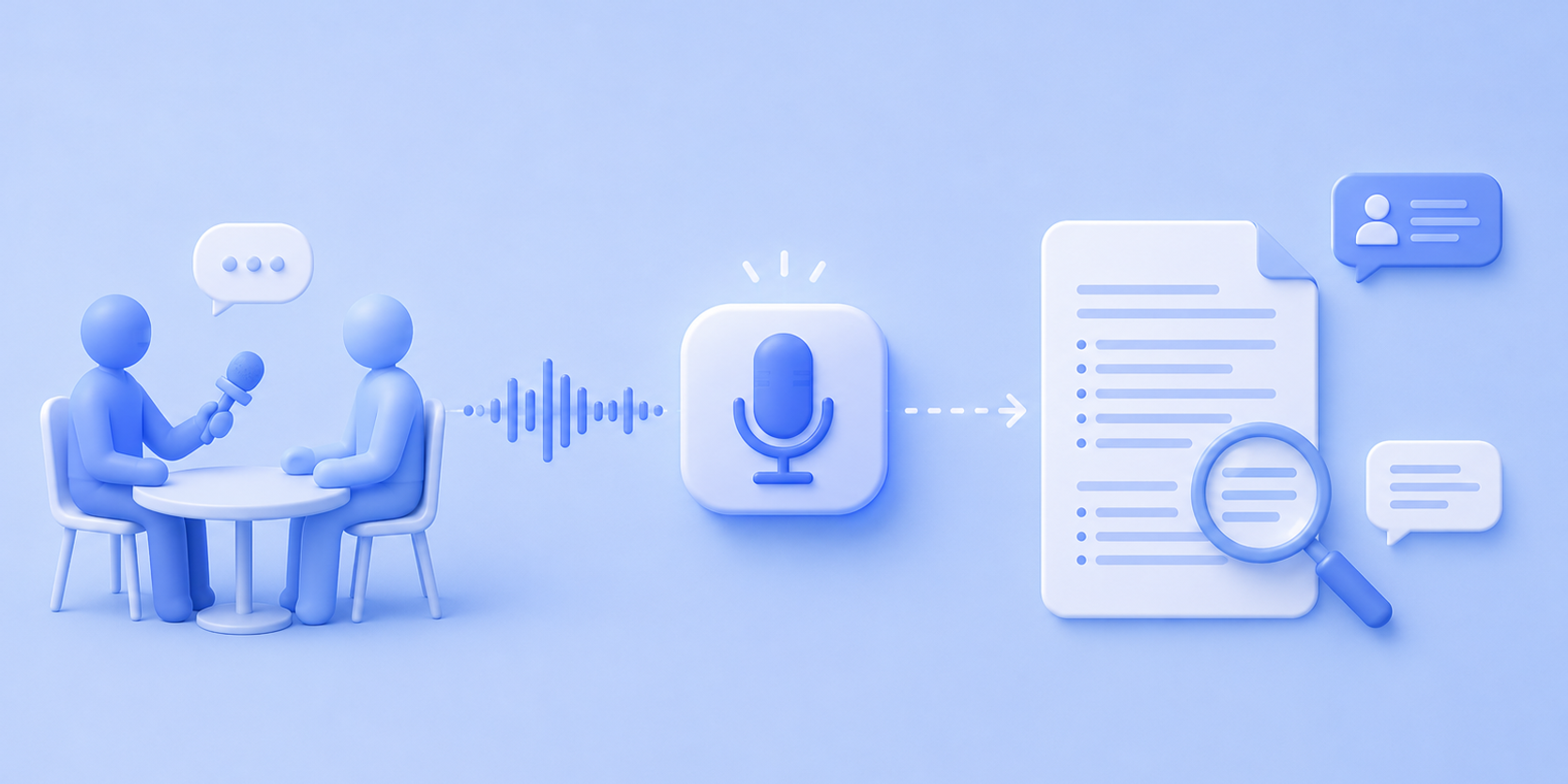
Qualitative research interviews should be transcribed because transcripts make coding, pattern analysis, participant quoting, and collaborative review possible.
They also create a searchable, auditable record of your data. The record improves the credibility of your research findings and helps you analyze interviews more systematically.
Why transcription is a methodological decision, not a logistics task
Picture this: you’ve just wrapped up 15 in-person interviews for your qualitative research project. Hours of audio recording sit on your hard drive.
Now comes a choice that will shape your entire research process:
- Do you transcribe every word spoken, including filler words and pauses?
- Do you clean up the spoken language to make it more readable?
- Do you skip the transcription process entirely and work straight from the recordings?
That choice is not administrative. It is methodological. As Julia Bailey argued in her foundational paper on the topic, transcription is the first step in analyzing data, not a task that precedes analysis.
The level of detail required in your transcripts, the notation conventions you adopt, and whether you capture non-verbal cues like body language or background noise directly affect what your qualitative data analysis can reveal.
Translating spoken words into written text is an interpretive act, and the decisions you make during qualitative research transcription shape the data you will later analyze.
Transcribing interviews is also time-consuming. Professional transcriptionists generally need 4-6 hours to produce accurate transcripts from one hour of clear audio. Manual transcription by the researcher can take even longer.
Good quality transcription is a key part of the qualitative research process, and understanding why it strengthens your qualitative studies helps you avoid common pitfalls.
What transcription adds to your research
Qualitative researchers transcribe data for reasons that go well beyond convenience. Unlike quantitative research, where numerical data speaks for itself, qualitative data gains meaning through careful reading and repeated coding.
Here’s what the transcription process contributes when you analyze interview transcripts in a qualitative research project.
It makes your data codable
Interview transcripts are the raw input for qualitative data analysis. Whether you’re running thematic analysis or grounded theory, you need written text to systematically code.
Qualitative data analysis software like NVivo and ATLAS.ti require written transcripts or text-based data to function. You cannot systematically tag themes or search for patterns across an audio recording the way you can with a transcript.
It creates an auditable trail
Written transcripts give supervisors and other researchers a verifiable record of your interview data. They can check your interpretations against the exact words participants used.
This kind of transparency is essential for credibility in qualitative studies where findings are built on subjective interpretation.
It surfaces patterns invisible in real time
Reading a transcript multiple times reveals recurring themes and contradictions that are nearly impossible to catch during a live conversation.
You can compare responses across participants, flag speech patterns, and identify connections that only become visible when spoken interaction is converted into written form. That’s where key insights tend to emerge.
It enables direct participant quotation
Accurate transcripts let you quote participants' exact words in your findings. Direct quotation is a hallmark of rigorous qualitative research, lending credibility and nuanced understanding to your analysis.
Without a reliable transcript, you are paraphrasing from memory or notes, which introduces bias.
It supports collaborative analysis
When multiple researchers work on the same qualitative research project, transcripts make collaborative analysis possible.
Different analysts can independently code qualitative interview transcripts and compare their coding to calculate inter-rater reliability. This kind of cross-checking is nearly impossible with audio or video recordings alone.
Choosing the right transcription type for your methodology
Not all transcripts look the same. The type of data transcription you choose should align with your research methodology and the level of detail required for your analysis. Here’s a quick overview of the three main types:
1. Full verbatim transcription captures every utterance, including pauses and filler words. It preserves the conversation verbatim, including speech patterns and non-verbal cues like laughter or sighs.
2. Intelligent transcription (also called clean verbatim) preserves the substance of what was said but removes filler words and repetitions. The result is more readable while retaining the speaker's original language and meaning.
3. Edited transcription corrects grammar and restructures sentences for clarity. The focus is on what was said, not how it was said.
Now, which type fits your research needs? That depends on your methodology. Use the table below to map common qualitative research approaches to their recommended transcription style.
| RESEARCH METHODOLOGY | RECOMMENDED TYPE | WHY |
|---|---|---|
| Conversation analysis | Full verbatim | Paralinguistic detail, such as pauses, overlaps, and intonation, is the data |
| Discourse analysis | Full verbatim | Language structure and delivery are central to the analysis |
| Grounded theory | Intelligent | Content and meaning are key; filler words add noise to coding |
| Thematic analysis | Intelligent | Focus is on identifying themes and patterns across content |
| IPA | Intelligent | Focus is on meaning-making and lived experience |
| Content analysis | Edited | Focus is on what was said, rather than how it was spoken |
For more details on each type of research transcription and when to use what, see our guide on types of transcription in qualitative research.
Manual, AI, or professional transcription: How to decide
Once you have settled on a transcription type, the next question is the method. Qualitative researchers generally choose one of these 3 approaches to transcribe audio and video files:
- Manual transcription (DIY)
- AI/automatic transcription
- Professional transcription (Outsourced)
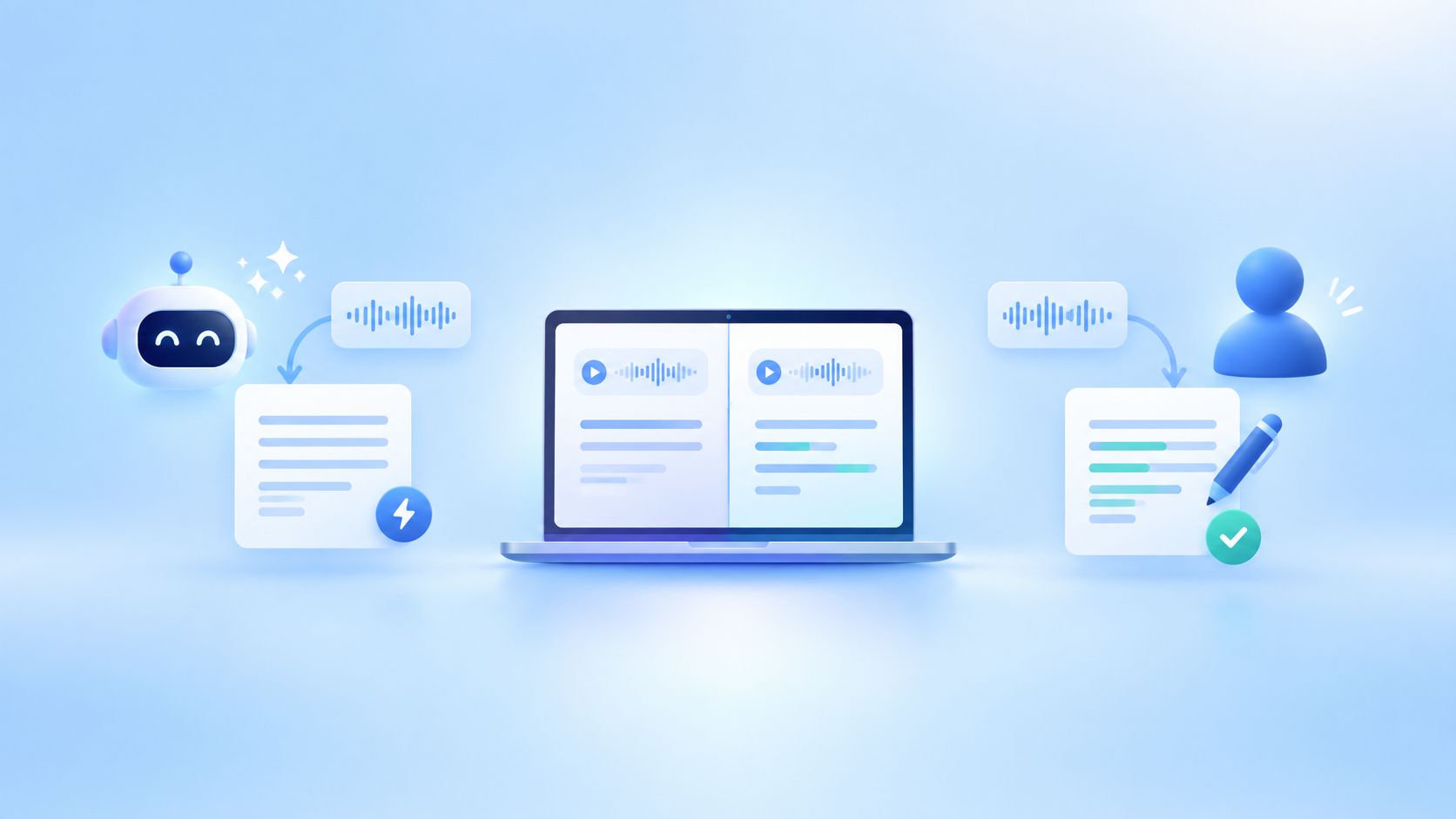
| METHOD | TIME PER HOUR OF AUDIO | APPROX. COST | ACCURACY | BEST FOR |
|---|---|---|---|---|
| Manual transcription (DIY) | 4–6 hours | Free, but requires the researcher’s time and attention | High (if skilled) | Small projects where deep data familiarity matters |
| AI/automatic transcription | Few minutes | Low | 85–95% (needs review) | Large datasets, fast turnaround, budget-conscious projects |
| Professional human transcription service | 24–48 hours | Higher (per-minute pricing) | 99%+ | High-stakes research, complex terminology, multi-speaker recordings |
Each method has trade-offs.
Manual transcription builds deep familiarity with interview data, which can benefit the research process, but it is extremely time-consuming and impractical for large qualitative studies.
Automatic speech recognition tools deliver speed, but audio quality and domain-specific terminology can significantly impact accuracy.
A professional transcription service offers the highest accuracy and handles poor audio quality or multiple speakers well, but costs more.
A smart alternative is to use a hybrid approach: AI transcription software for a fast first draft, followed by careful human review.
This is where tools like HappyScribe fit well. HappyScribe offers both AI transcription in 150+ languages, delivered in minutes, and human proofreading with 99% accuracy and 24-hour turnaround.
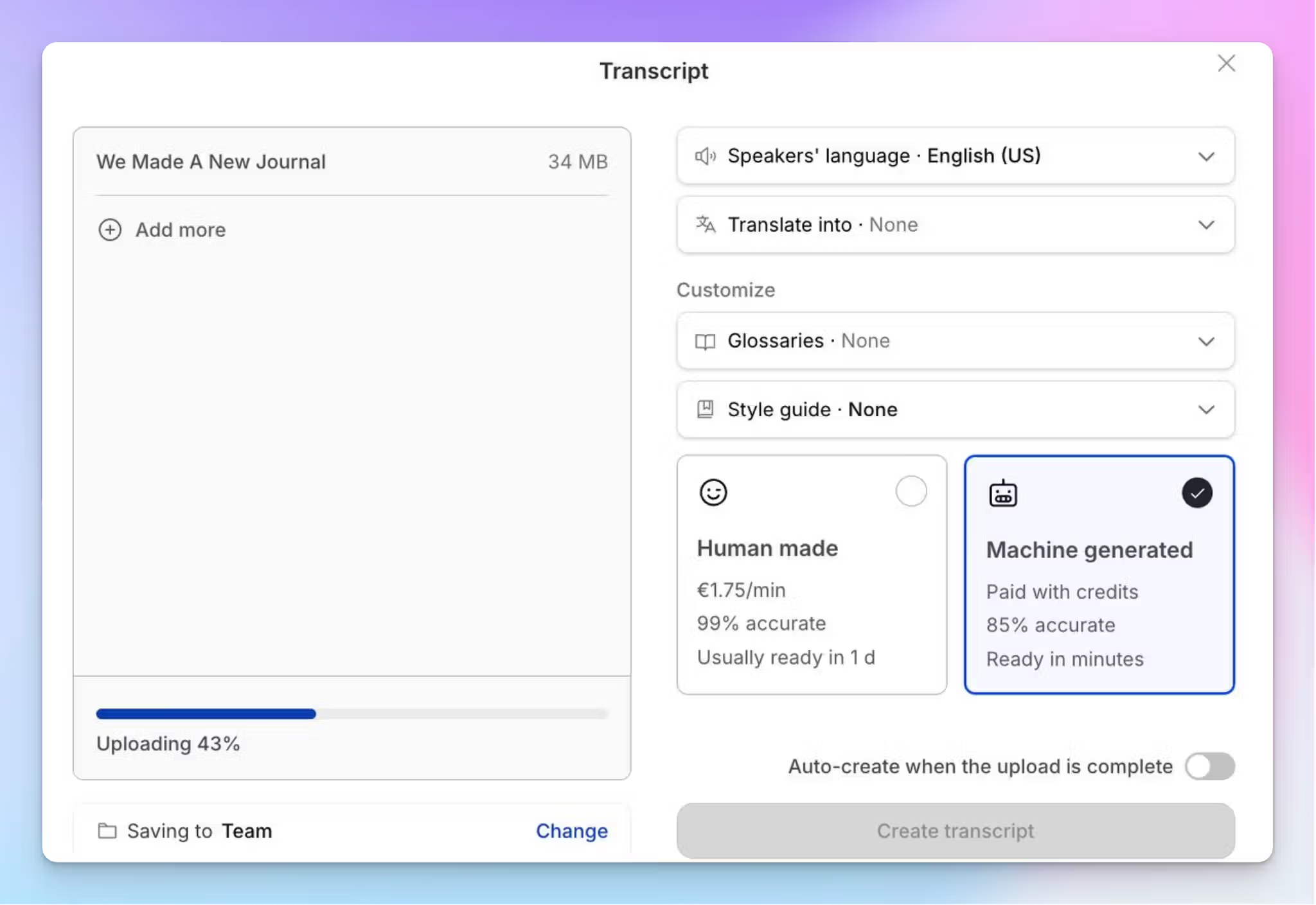
The interactive editor provides a user-friendly interface that lets you play back the audio recording synced with the transcript, add speaker tags, and correct errors before exporting in formats compatible with qualitative data analysis software.
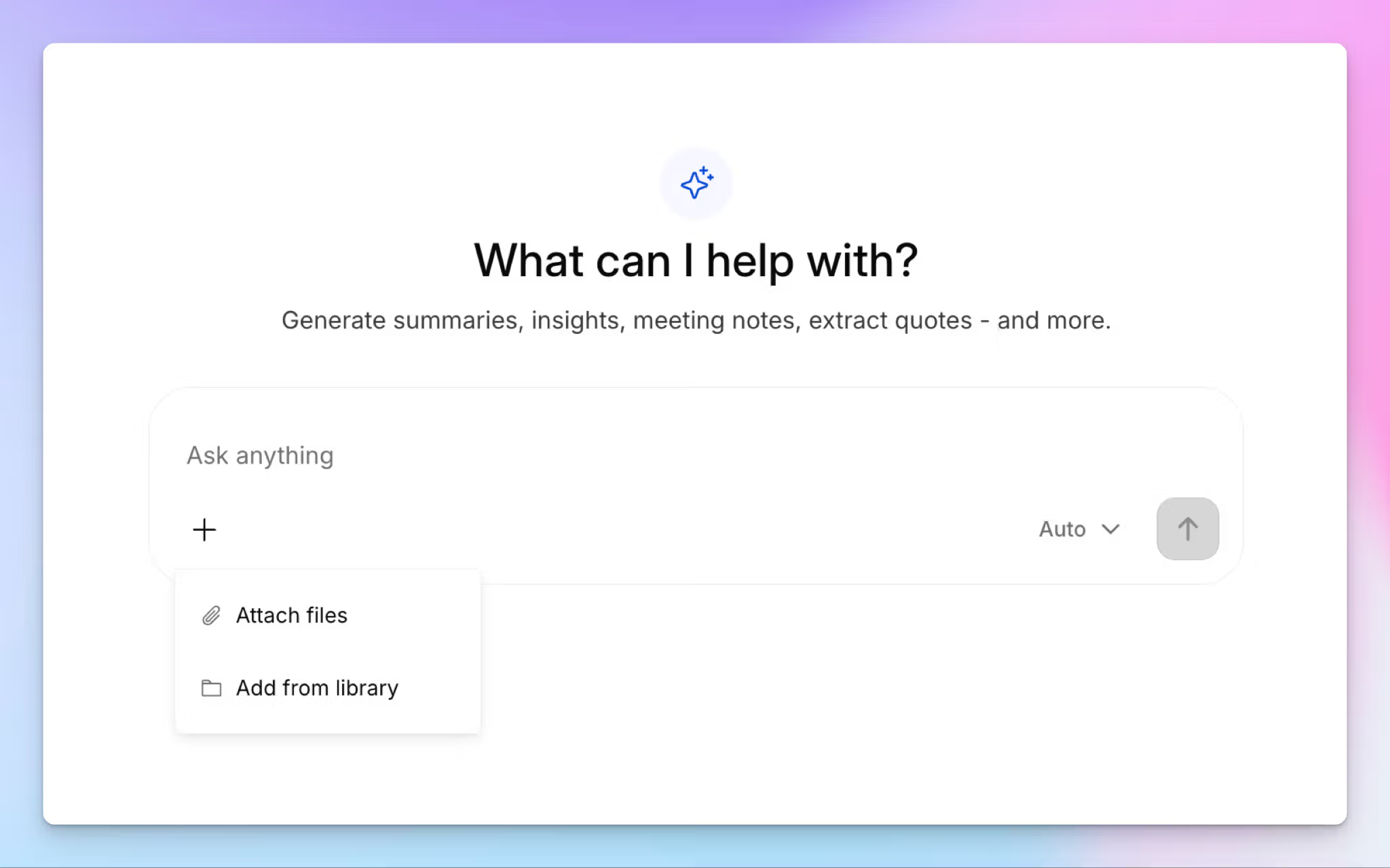
Research teams can ask questions across multiple transcripts, extract quotes, and identify patterns using HappyScribe’s AI Chat feature.
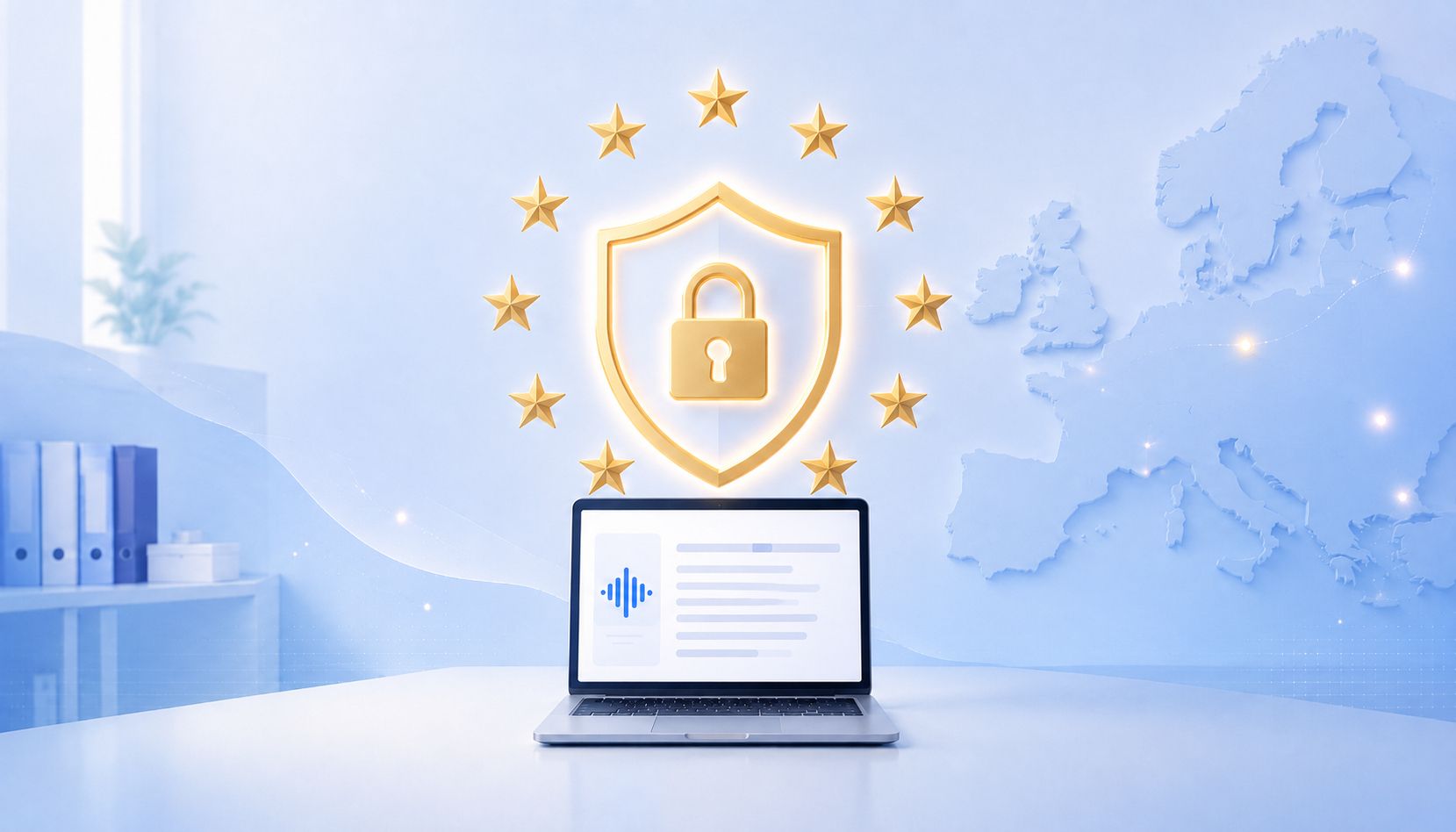
Since HappyScribe is based in Barcelona and stores data exclusively in an EU data center, you can rest assured that your data stays within the European borders.
Also, if you opt for human transcription services, HappyScribe ensures there’s a strict NDA in place to maintain confidentiality.
How to maintain ethics and data security in research transcription?
Transcribing research interviews involves handling sensitive personal data, and qualitative researchers have specific obligations here.
1. Informed consent is the starting point. Participants need to know that their interviews will be transcribed, how the data will be stored, who will have access to it, and when the recordings and transcripts will be destroyed. All of these should be covered in your consent form before any audio recording begins.
2. Anonymization requires replacing participant names with pseudonyms and stripping identifying details from transcripts before sharing with other researchers or publishing findings. This is not optional; it is a core ethical requirement in virtually every qualitative research project.
3. Data residency and GDPR compliance matter if your research involves EU participants. Where your audio and video recordings are stored, and whether a transcription service processes them on servers outside the EU, are questions your ethics board or IRB may ask.
4. AI tool transparency is an emerging concern. If you use automatic transcription, disclose this in your methodology section and note whether recordings were uploaded to external servers or processed locally. HappyScribe is GDPR-compliant with enterprise-grade security, which can simplify this part of your ethics documentation.
The permanence of a transcript also carries responsibility. Unlike a conversation that fades from memory, a written transcript creates a permanent record of words spoken in confidence. Handle it accordingly.
Build a transcription workflow that fits your research
Transcription is where qualitative analysis begins, not a chore that precedes it.
The decisions you make here about verbatim vs. clean copy, manual vs. automated, and how you handle participant data, determine what your research can reveal.
For most projects, a hybrid workflow strikes the right balance.
HappyScribe lets you generate an AI draft in minutes, review it against synced audio in the interactive editor, and send recordings for human proofreading, when required. All data stays in Europe, which keeps your IRB paperwork simpler.
FAQs
Is AI transcription accurate enough for qualitative research?
AI transcription works well for qualitative research projects if the audio quality is clear and speakers are easy to distinguish. Most researchers still review transcripts manually before analysis, particularly when interviews include technical terminology, accents, overlapping speech, or sensitive participant responses. Tools like HappyScribe also let researchers edit synced transcripts while listening back to the original recording, which speeds up verification.
Should I choose verbatim or intelligent transcription for interview analysis?
That depends on your methodology. Full verbatim transcription is useful when pauses, interruptions, filler words, or speech patterns are analytically important, such as in discourse or conversation analysis. Intelligent transcription is often a better fit for thematic analysis or grounded theory because it removes verbal clutter and makes coding easier.
How do researchers protect sensitive interview data during transcription?
Researchers anonymize transcripts by removing names and identifying details before sharing or analyzing data. It is also important to use transcription platforms with strong security standards, encrypted storage, and GDPR compliance when handling participant recordings. HappyScribe, for example, offers GDPR-compliant transcription workflows and EU-based data handling options for research teams working with sensitive data.
Can transcription software help analyze interview data too?
Yes. Many transcription platforms now support more than transcription alone. Researchers use them to search across interviews, extract quotes, identify recurring themes, and organize findings faster during qualitative analysis. HappyScribe includes the AI Chat feature, which helps teams query multiple transcripts without manually digging through hours of interview text.
Does HappyScribe have a mobile app?
Yes. HappyScribe has a free mobile app on iOS and Android. It works as a recorder tied directly to your HappyScribe workspace. You tap Record, capture the conversation, and the audio uploads to your library automatically in the background. From there, you can transcribe it in 150+ languages, send it for human review, or query it with AI Chat. The app is available on all plans, including free accounts.

Rodoshi Das
Rodoshi is the Content Lead at HappyScribe, the privacy-first transcription and AI notetaker platform based in Barcelona. Shaping content strategies and building AI workflows excites her as much as exploring new SaaS tools. She specializes in product-led content that informs rather than sells, grounded in honest product benchmarking and low tolerance for empty marketing speak.