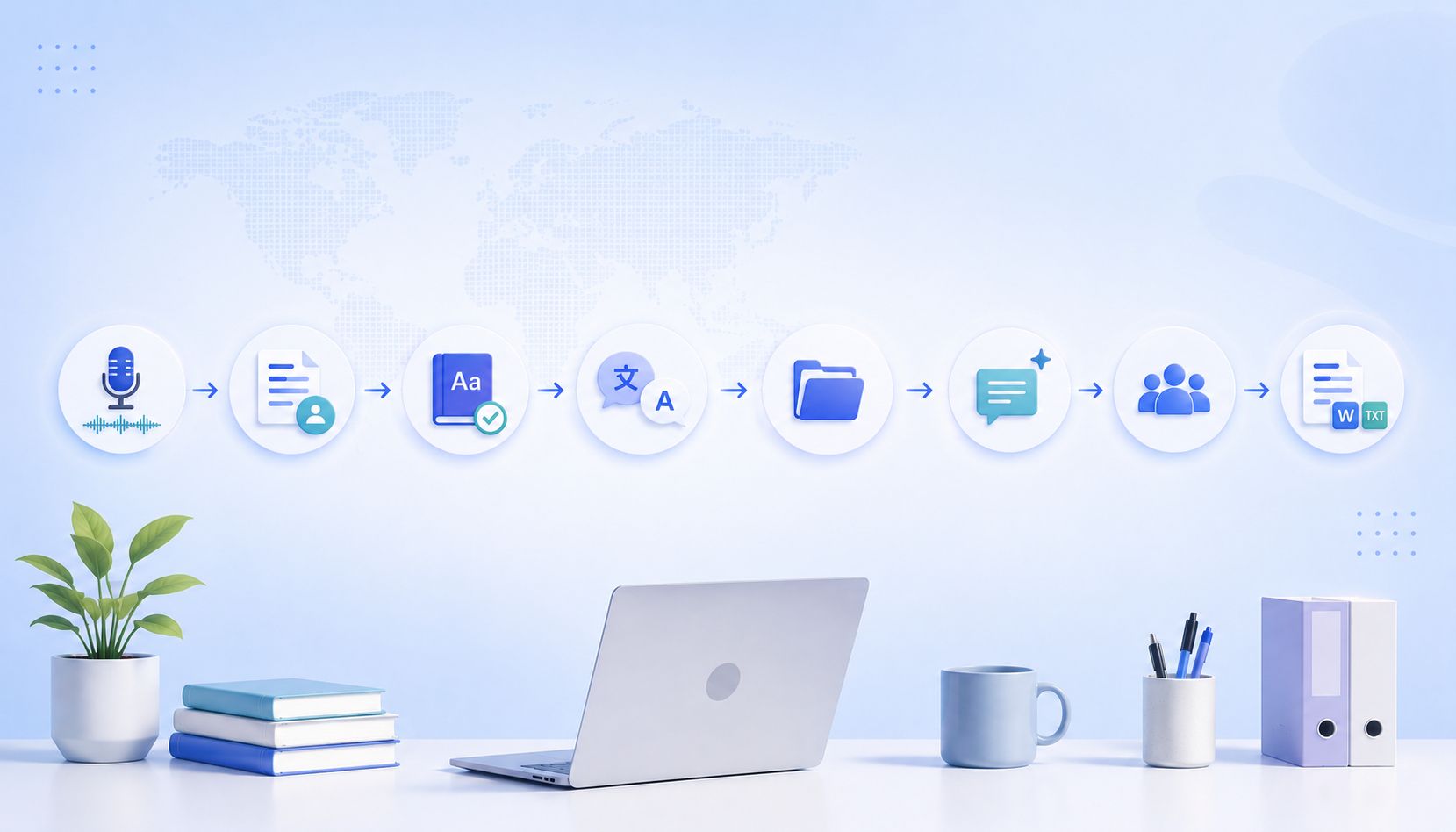
The five types of transcription in qualitative research are full verbatim, clean verbatim (intelligent verbatim), edited transcription, phonetic transcription, and Jeffersonian transcription. The right choice depends on how you approach the analysis. Clean verbatim works well for thematic analysis and grounded theory, while discourse analysis and conversation analysis require full verbatim or Jeffersonian conventions.
I’ll discuss all types in detail and help you pick the right one for your research project.
Why transcription type matters more than transcription speed
I once ran a thematic analysis on 30 hours of focus group recordings transcribed in full verbatim. Every filler word and false start was captured. Even though the transcripts were thorough, they were nearly impossible to code. I had to spend hours working through stutters and half-finished sentences instead of identifying patterns.
Since full verbatim captures everything, it’s great for conversation analysis. But for thematic coding, you need to avoid extra details that slow down your analysis. I learned it the hard way.
So now I can confidently say that transcription type has more impact on your analysis than turnaround time. A clean verbatim transcript returned in 48 hours will serve a theory study far better than a full verbatim transcript delivered overnight. The type you choose determines what counts as data in your study, and that decision shapes how you code and how reviewers evaluate your efforts.
The five types of transcription in qualitative research
These five types range from capturing every sound to distilling only the core meaning. The success of your qualitative data transcription depends on matching the type to your analytical method.
1. Full verbatim transcription
As I mentioned earlier, full verbatim captures every sound in the recording: filler words, false starts, stutters, non-verbal cues like laughter and sighs, timed pauses, and overlapping speech. Nothing is cleaned up.
This level of detail is needed for methodologies where how something was said carries as much weight as what was said. Conversation analysis and discursive psychology both treat speech patterns and delivery as primary data. Discourse analysis often requires it too, along with psychological studies that examine speech behavior.
The trade-off is time. A single hour of audio takes 4 to 8 hours of human labor to transcribe in full verbatim. The transcripts can be dense, and if your methodology doesn't require that granularity, it will slow down your coding.
2. Clean verbatim (intelligent verbatim) transcription
Clean verbatim strips out filler words and false starts but preserves all meaningful spoken content. It gives you the best of both worlds, making it the default option for most qualitative research.
Both thematic analysis and grounded theory benefit from clean, scannable transcripts that put focus back on meaning. Phenomenological studies work well with it as well, particularly when the research focuses on lived-experience language rather than speech mechanics. If you're working on a dissertation, there’s a good chance that clean verbatim is what your committee expects.
But it’s not without its limitations. With a clean verbatim transcription, you lose speech-pattern data. If hesitations or delivery patterns are important to your framework, clean verbatim won't preserve them. If you're already thinking about how to organize your coding, using themes and tags during transcription can save time later.
3. Edited transcription
Edited transcription corrects grammar and restructures sentences for readability. The result reads like a polished essay rather than spoken language.
It's common in policy research and applied qualitative studies where transcripts need to be accessible to non-specialist readers, like stakeholders. It also works for report-ready summaries and public-facing interview content.
Having said that, editing alters the speaker's original voice, which can introduce researcher bias. If exact wording matters more in your analysis, an edited transcription isn't the right fit.
4. Phonetic transcription
Phonetic transcription records how words sound rather than how they're spelled, using IPA (International Phonetic Alphabet) symbols. It captures pronunciation and dialect in ways standard orthographic transcription can't.
Phonetic transcription is a specialized tool for linguistic research. Sociolinguistic studies and phonological analysis both depend on it, and it's also used in speech therapy research.
But the barrier to entry is high. You need IPA training to produce and read these transcripts, and the method is rarely used outside linguistics. Most qualitative researchers don’t need it unless their study specifically focuses on how words are pronounced.
5. Jeffersonian Transcription
Jeffersonian transcription is a notation system that layers on top of full verbatim transcription. Developed by Gail Jefferson for conversation analysis (CA), it uses standardized symbols to encode interactional details that plain text can't capture.
Here are some of the core conventions:
| Symbol | Meaning |
|---|---|
| [ ] | Overlapping speech |
| (0.5) | Pause duration in seconds |
| ↑ ↓ | Pitch shift (upward or downward) |
| Underlining | Speaker emphasis |
| = | Latching (no gap between turns) |
For the full set of conventions, Hepburn and Bolden (2017) is the standard reference.
Jeffersonian transcription is best used for CA and interaction studies. Applied CA in healthcare and education research also relies on it, particularly when turn-taking and micro-timing are central to the analysis.
The learning curve is steep, and the method requires high-quality audio to work from. AI transcription tools don't produce Jeffersonian notation, so the work is almost always done by hand.
How to choose the right transcription type for your study: At a glance
This table maps common qualitative methodologies to the type that serves them best:
| Methodology | Recommended type | Rationale |
|---|---|---|
| Thematic analysis | Clean verbatim | Focus on meaning over delivery, readable for coding |
| Grounded theory | Clean verbatim | Constant comparison coding works faster without filler noise |
| Phenomenology | Clean or full verbatim | Depends on whether lived-experience language patterns are central |
| Discourse analysis | Full verbatim | Delivery and hesitation patterns are coded directly |
| Conversation analysis | Jeffersonian | Turn-taking, overlap, and micro-timing are the data |
| Narrative analysis | Full or clean verbatim | Story structure is the priority; filler words usually aren't |
| Sociolinguistic study | Phonetic or Jeffersonian | Pronunciation, accent, and dialect are the research focus |
If you're not sure where your study falls, three questions can help you decide:
- Does how something was said carry as much weight as what was said?
- Will non-specialists (stakeholders, reviewers, funders) need to read the transcripts?
- What's your budget and timeline for transcription?
AI transcription in qualitative research: Is it the right fit?
Manual transcription is one of the biggest time sinks in qualitative research. If your study calls for clean verbatim transcription, you don't need to do it by hand anymore. AI transcription tools now produce clean verbatim output at over 95% accuracy for clear, single-speaker recordings. That's accurate enough to use as a working draft.
Accuracy drops only when conditions get harder. Factors like overlapping speakers, heavy accents, and background noise push error rates up, and field-specific jargon can confuse ASR models that weren't trained on your discipline's vocabulary. Some tools address this with custom glossaries and style guides.
But the academic consensus has adopted a balanced approach. AI transcription followed by human verification is now widely accepted for peer-reviewed qualitative research. The exception is conversation analysis and detailed discourse analysis, where Jeffersonian notation is required, and no AI tool can produce it.
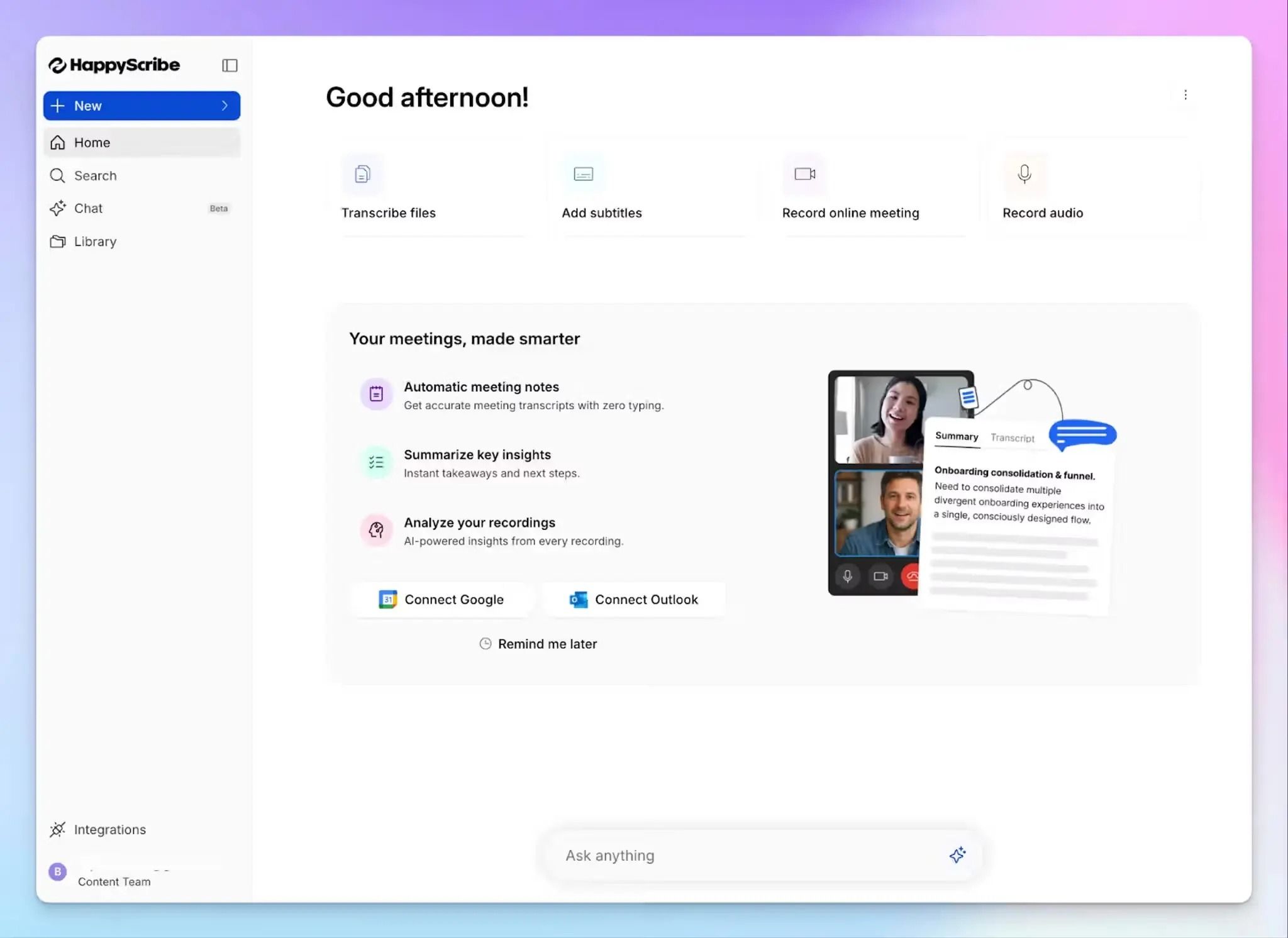
HappyScribe is built for the workflows of qualitative researchers. You upload the recording, configure your output style, and get a working transcript back in minutes with AI transcription in over 150 languages and dialects.
If your recordings involve regional accents and speech overlaps, you can send your file or AI transcript to professional linguists who deliver 99% accurate transcripts in 24 hours. For research teams working across multilingual datasets, this combination of AI speed and human accuracy keeps the project moving without compromising transcript quality.
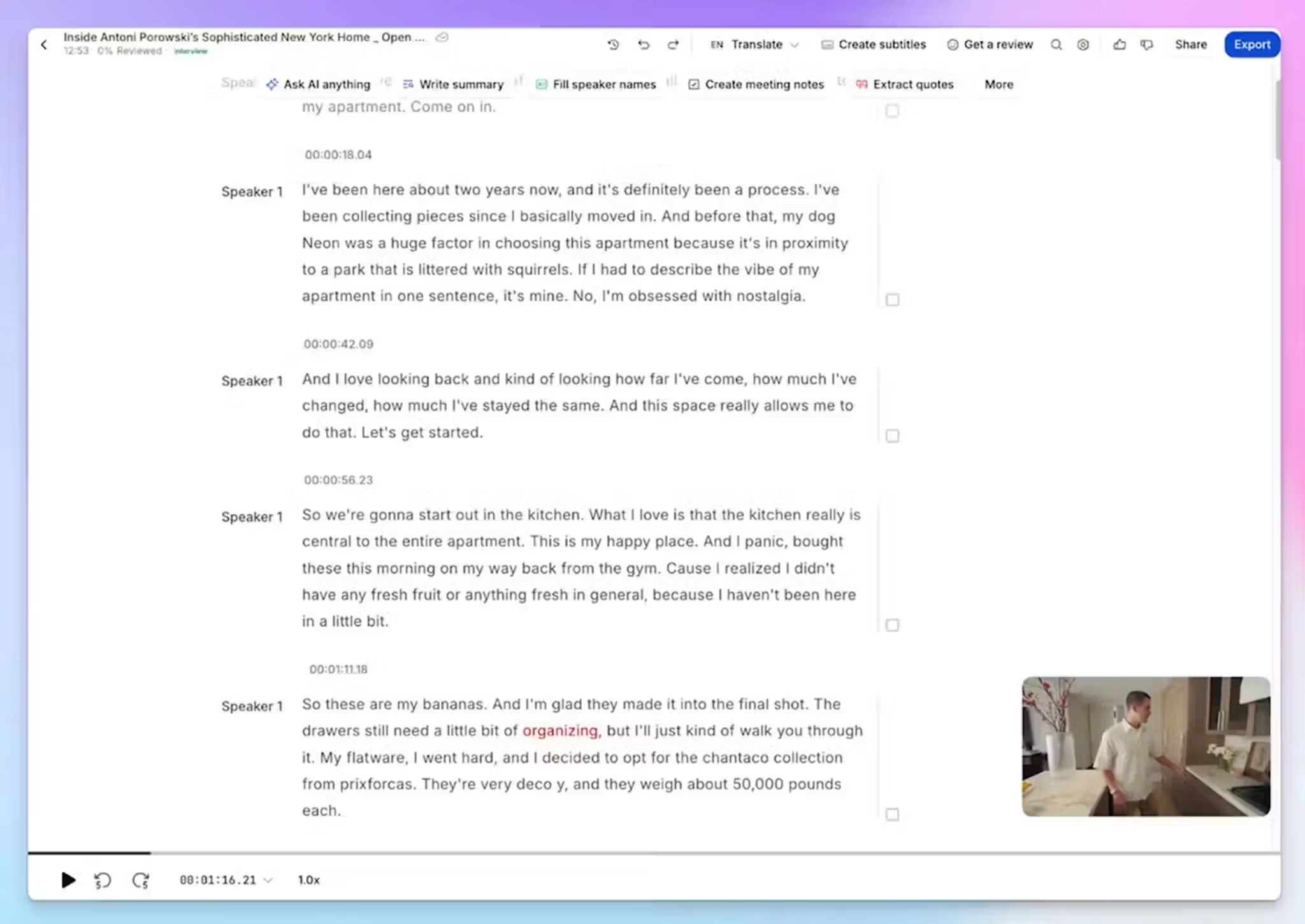
The interactive editor is where verification happens. You can play back audio alongside the transcript, jump to any timestamp, and correct errors in-line. Speaker labels are applied automatically, so you're not manually tagging P1 and P2 across 40 pages of focus group data.
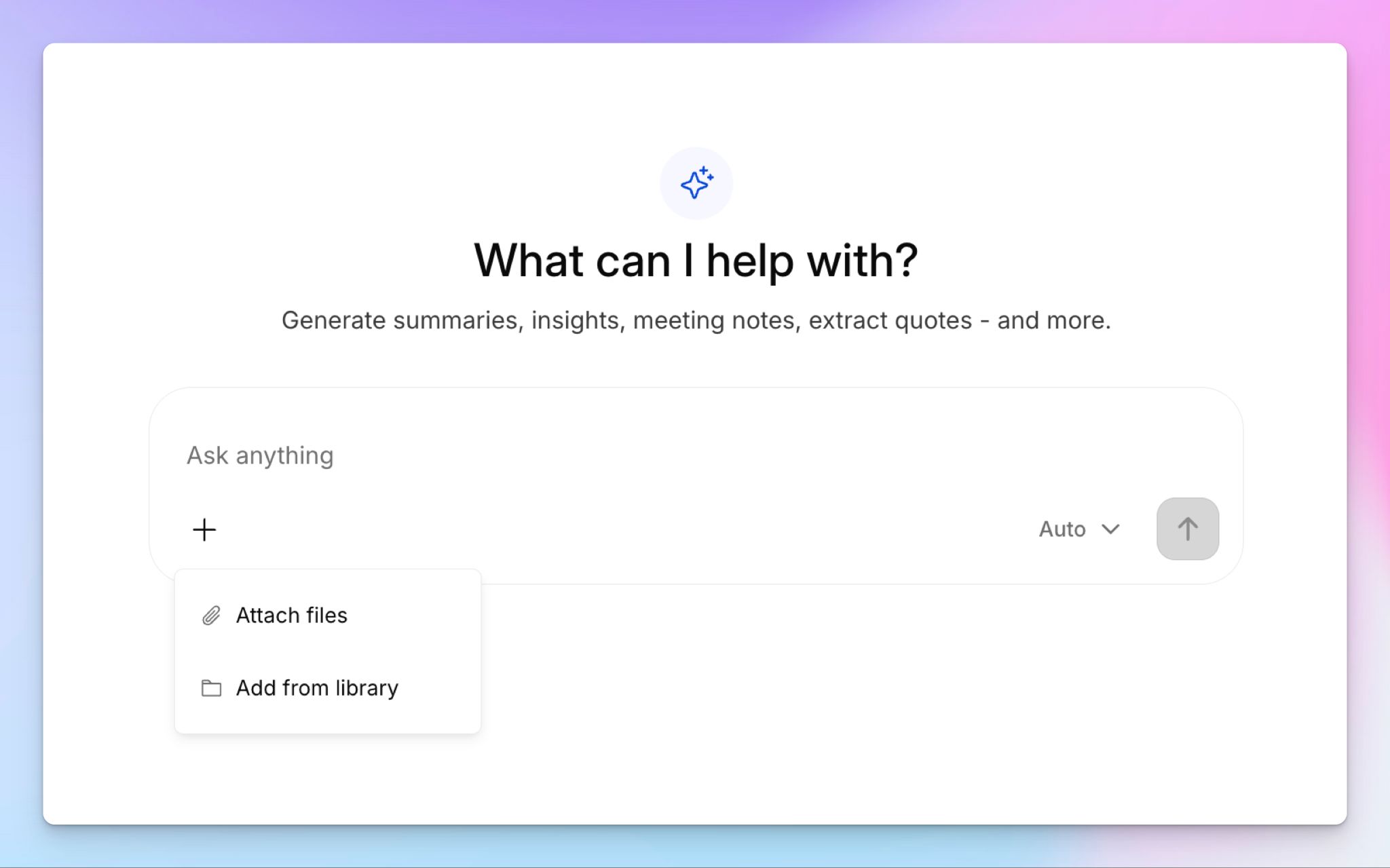
Once you have all the transcript data, you can use the AI Chat to find key insights, approaches, and observations you might have missed. The AI Chat searches through your files and transcripts to help you with summaries, quotes, and even email drafts. It acts like a research assistant, so you can speed up the analysis process.
Best practices for transcription in qualitative research
If you're figuring out how to transcribe qualitative interviews, these five practices apply regardless of the type you choose:
- Decide your transcription type before data collection. Document the choice in your methodology section and, if applicable, your IRB protocol. Changing transcription types mid-study creates inconsistencies that are hard to justify during peer review.
- Create a transcription protocol. Specify how you'll handle unclear audio, overlapping speakers, non-English words, and sensitive content. Share this protocol with anyone else transcribing for the project so every transcript follows the same conventions.
- Use consistent speaker labels and timestamps. Whether you're transcribing manually or with AI transcription tools, label speakers consistently ("Interviewer," "P1," "P2"). Add timestamps at regular intervals or at key moments. Consistent labeling saves hours when you're searching for specific passages during coding.
- Always verify against the source audio. Even with professional human transcription services, spot-check at least 10 to 15% of the transcript against the recording. Errors compound during analysis if they're not caught early.
- Anonymize during transcription, not after. Replace names, locations, and other identifying details as you transcribe. If you run a simple find-and-replace filter later, you will miss some contexts.
Start with the right transcript
Transcription type is a methodological decision, not just a formatting preference. Match it to your analytical method before you start recording and document the choice in your protocol. With the right type, transcription disappears into the background of your research workflow.
For clean verbatim transcription, HappyScribe handles the full workflow from AI draft to human-verified transcript.
FAQs on types of transcription in qualitative research
What are the types of qualitative research methods?
The main qualitative research methods are interviews, focus groups, ethnography, case studies, and observational studies. Your research objectives determine which method you need to choose. Interviews work best when you need a nuanced understanding of individual experiences, while focus groups surface shared perspectives and group dynamics.
Most of these methods produce research data in the form of audio recordings or video files, not structured quantitative data you can drop into a spreadsheet. The transcription process converts that raw data into written text that you can code and organize into data segments for qualitative analysis. As a result, the quality of your transcribed data directly shapes the key insights you can draw from your research findings.
What are the five types of transcription in qualitative research?
The five types are full verbatim, clean verbatim (also called intelligent transcription), edited transcription, phonetic transcription, and Jeffersonian transcription. Full verbatim captures every sound, including filler words and pauses, while clean verbatim removes those fillers but keeps all meaningful content. Edited transcription restructures speech for readability, and phonetic transcription uses IPA symbols to record pronunciation. Jeffersonian transcription adds notation for overlap, pitch, and timing on top of the full verbatim.
Clean verbatim is the default for most qualitative research. Full verbatim and Jeffersonian are reserved for conversation analysis and discourse analysis, where delivery patterns are part of the research data.
How to pick the right transcription type for research?
Start with your analytical method. If you're running thematic analysis or grounded theory, clean verbatim gives you research transcripts that make it easy to extract valuable insights without fighting through filler words. If your study examines speech patterns or turn-taking, full verbatim or Jeffersonian transcription is the better fit.
Two practical factors narrow it further: whether your research objectives require speech-pattern data, and whether non-specialists will read the transcripts. If you're working with video files or video data, confirm if your transcription tool handles the format. For projects involving sensitive data, choose a platform with strong privacy controls. HappyScribe is GDPR-compliant and SOC 2 Type 2 certified, which covers most IRB requirements.
Is a verbatim transcript best for qualitative research?
Not always. Full verbatim captures every utterance, which makes it essential for conversation analysis and discourse analysis. But for thematic analysis and grounded theory, a clean verbatim is the better choice. It strips out filler words and false starts, so your transcribed data is easier to code and organize.
Full verbatim can actually slow down qualitative data analysis if your framework doesn't use speech-pattern data. The extra detail creates noise in your data segments when you're running collaborative analysis or sharing transcripts with a research team. Choose full verbatim only when how something was said is as important as what was said.
Which transcription software works best for qualitative research?
HappyScribe is a strong fit for qualitative research because it covers both sides of the workflow: automatic transcription for speed and a professional transcription service for recordings that need human accuracy. It handles audio and video uploads, applies speaker detection and timestamps automatically, and exports to formats your qualitative analysis tool can read.
Audio quality is the biggest variable in choosing any transcription software. For clean, single-speaker recordings, automatic speech recognition delivers strong results on its own. For recordings with poor audio quality or overlapping speakers, having access to professional linguists alongside the AI option means you're not switching platforms mid-project.
The automatic transcription software must support speaker labels, let you review the transcript against the source audio, and process video data directly rather than requiring you to strip the audio first.
Can I use AI tools for qualitative research transcription?
Yes. AI tools use automatic speech recognition to convert an audio recording into written text in minutes. For clean, single-speaker recordings with good audio quality, accuracy runs over 95%.
The output works best as a first draft. You review the transcript against the source audio, correct errors, and the transcription task is done in a fraction of the time it would take by hand. This hybrid approach is now widely accepted in peer-reviewed research.
But there are limits. Poor audio quality and overlapping speakers reduce accuracy, and for conversation analysis where Jeffersonian notation is required, human transcribers are still necessary. HappyScribe combines automatic transcription with expert human transcribers for recordings that need higher accuracy, enabling researchers to handle both clean interviews and challenging audio in the same project.

Biplab Mazumder
Biplab is a content marketer and writer who helps high-growth brands scale content visibility across AI search channels. His works have been published in HubSpot, Freshworks, Atlassian, SurferSEO, etc. When he's not planning content strategy, he's testing AI content workflows and use cases.