


TL;DR ⏩
- Yes, lawyers can use AI note takers. Privilege is far easier to defend when counsel controls the tool and the client has agreed to the recording.
- Consumer AI tools are the main risk. In United States v. Heppner (S.D.N.Y. 2026), a court refused privilege for a client’s AI-generated documents because the tool’s privacy terms allowed model training and disclosure to third parties.
- Get client consent and vet the vendor. NYC Bar Formal Opinion 2025-6 requires consent for AI recording, even in one-party consent states. Choose a tool with no model training on your data by default, a signed DPA, and retention controls.
- No tool guarantees privilege on its own. Always take consent, and have a lawyer review every transcript before anyone relies on it.
Lawyers are adopting AI faster than their firms are writing rules for it. The 8am 2026 Legal Industry Report found that nearly seven in 10 legal professionals (69%) now use generative AI for work, more than double the year before. Firm-level adoption of legal-specific tools reached only 34%, and the majority of firms still have no formal AI policy or training.
AI note takers sit at the center of that tension. They record the exact conversations privilege exists to protect, then hand the audio to a software vendor.
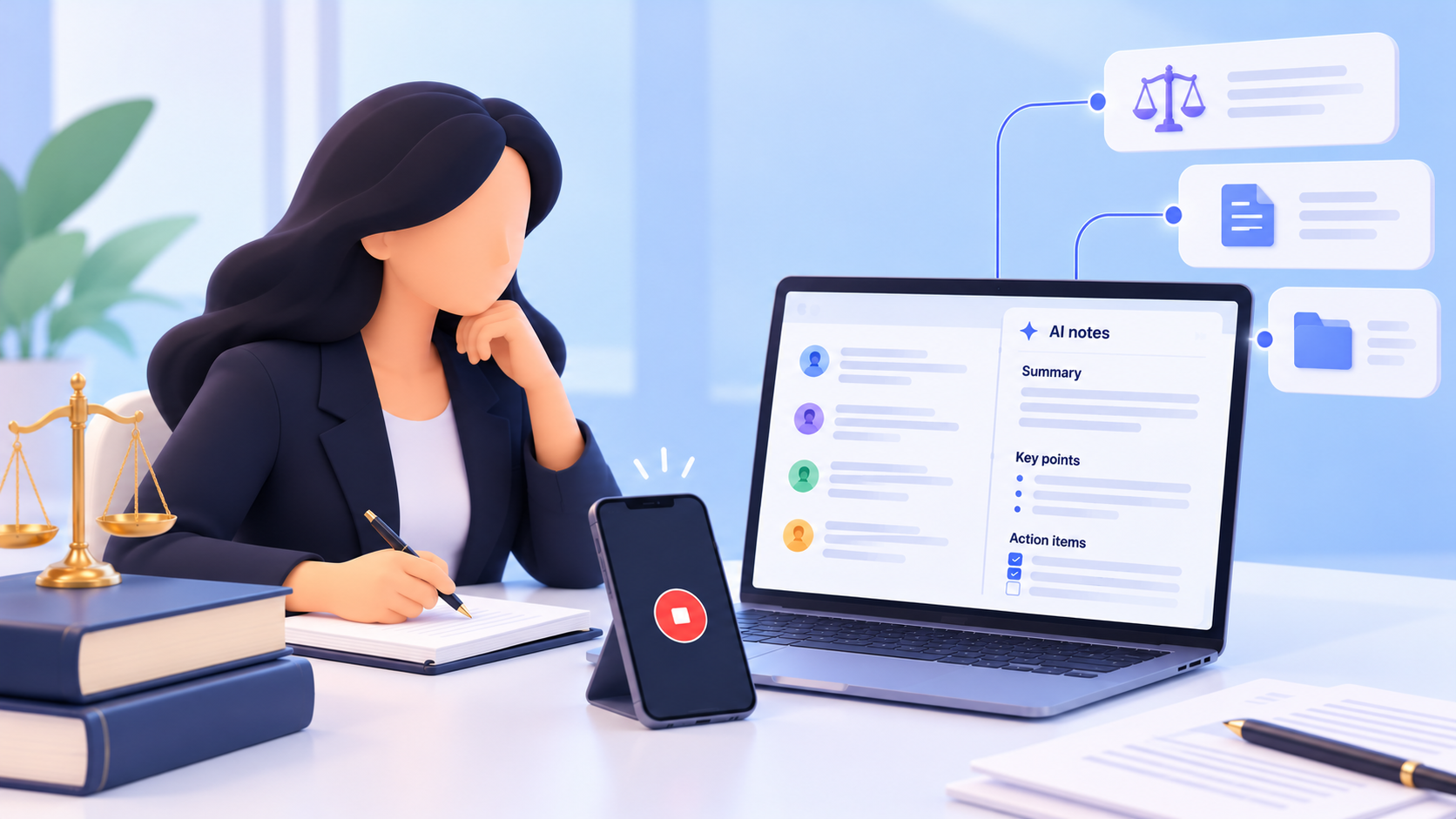
The short answer is yes, lawyers can use AI note takers, and privilege is easier to defend when counsel controls the court transcription service or tool, and the client has agreed to the recording. This guide covers what courts and bar regulators have said so far, and how to build a workflow that survives a challenge.
What makes an AI note taker a privilege risk?
Attorney-client privilege covers confidential communications between lawyer and client made to give or obtain legal advice.
Voluntarily sharing those communications with an outsider can waive the protection.
An AI note taker for lawyers brings that outsider into the room. The vendor holds the recording and transcript on its servers, and its terms may give it rights to use that data.
A June 2026 Cahill Gordon client alert on AI note takers warns that an opposing party could treat vendor access as third-party disclosure, and courts have not yet ruled squarely on that question.
A second risk sits in the record itself. Verbatim transcripts preserve offhand remarks and half-formed advice that curated minutes would leave out. If privilege fails, every word becomes discoverable.
📚 Read more:
What did the Heppner ruling decide?
In United States v. Heppner, No. 25 Cr. 503 (S.D.N.Y.), a defendant facing securities fraud charges used the consumer version of Anthropic’s Claude to draft reports on possible defense strategies. He later sent about 31 of those documents to his lawyers and claimed privilege. His counsel conceded they had not told him to run the searches.
Judge Jed Rakoff ruled from the bench on February 10, 2026, and followed with a written opinion explaining the Heppner ruling on February 17.
Why privilege failed
The court found the AI exchanges failed the privilege test on separate grounds:
- No lawyer on the other end. Claude is not an attorney, and the court said privilege depends on a “trusting human relationship” that a public AI platform cannot offer
- No reasonable expectation of confidentiality. Anthropic’s consumer privacy policy allowed retention, model training, and disclosure to third parties, including government authorities
- No purpose of seeking legal advice from the tool. Claude disclaims giving legal advice, and the court asked whether Heppner sought advice from Claude, not whether he planned to share the results with his lawyers
Sending the output to his lawyers afterward could not make it privileged retroactively. The Illinois State Bar Association’s review of Heppner adds a sharper warning: by typing information from his lawyers into the tool, Heppner also put privilege over those underlying attorney communications at risk.
Why work product failed
Work product protects material that counsel prepares or directs in anticipation of litigation. Heppner acted alone, so the doctrine did not apply.
What the ruling leaves open
Rakoff signaled the result might differ if counsel had directed the AI use, since the tool could then function as the lawyer’s agent.
That points to the Kovel doctrine, which extends privilege to third parties who help counsel give legal advice under counsel’s direction and a duty of confidentiality.
Two other federal courts have reached different results on work product.
In Warner v. Gilbarco (E.D. Mich., February 2026), the court refused to compel a self-represented plaintiff’s ChatGPT materials.
In Morgan v. V2X (D. Colo., March 2026), a magistrate judge held that routing information through a third-party AI system does not, by itself, waive work product protection.
Both cases involved self-represented litigants, and neither addressed attorney-client privilege.
What do bar ethics opinions require?
ABA Formal Opinion 512
The ABA issued Formal Opinion 512 on generative AI on July 29, 2024. It requires informed client consent before a lawyer enters information about the representation into a self-learning AI tool. A boilerplate clause in the engagement letter does not satisfy that standard.
NYC Bar Formal Opinion 2025-6
The New York City Bar released one of the first ethics opinions aimed squarely at note takers in December 2025.
Formal Opinion 2025-6 on AI recording and transcription concludes that clients need notice and must consent “whenever their calls are being recorded by an AI-empowered system.”
The opinion applies even in New York, a one-party consent state, and treats secret recording as deceptive conduct under Rule 8.4. It also tells lawyers to:
- Weigh whether recording a given call is tactically wise
- Check where the vendor stores data, for how long, whether it trains on it, and whether you can delete it
- Review transcripts and summaries for accuracy, especially informal advice given on the fly
- Warn clients who use their own AI tools that they may lose confidentiality and privilege
Engagement letters can address consent, but the opinion advises notice on each call unless the platform displays a clear recording alert.
NYC Bar Formal Opinion 2026-2
In August 2026, the City Bar extended its guidance to calls with people who are not clients. Formal Opinion 2026-2 advises lawyers to avoid AI recording of non-client conversations unless they have a good reason to do so. It also warns that recordings of witness conversations may need to be shared with the opposing party during legal proceedings.
State guidance
Florida Bar Ethics Opinion 24-1 recommends informed client consent before using a third-party generative AI program with confidential information. The California State Bar’s practical guidance bars entering confidential client data into any AI tool that lacks adequate confidentiality and security protections.
Where does recording consent law come in?
Privilege is one layer of exposure. Wiretap and biometric privacy laws form a second one.
Several US states require every participant to consent before anyone records a call, and the NYC Bar opinion lists Illinois, Texas, Colorado, Maryland, Oregon and Washington as states with biometric privacy laws, which can extend to voiceprints.
The Otter.ai privacy litigation shows how this plays out. Four proposed class actions filed in 2025, now consolidated as In re Otter.AI Privacy Litigation, allege that Otter’s note taker joined calendar-linked meetings without consent from all participants and used the recordings to train its models.
On August 13, 2026, a federal judge in the Northern District of California let claims under the federal Wiretap Act and Illinois’s biometric privacy law proceed, among others. The ruling does not decide whether Otter broke the law, but the auto-join scenario at its center is exactly what lawyers need to prevent.
For a state-by-state breakdown, see our guide to consent for recording conversations.
How can lawyers use AI note takers without risking privilege?
Before the first call
- Use a firm-controlled tool: Deploy a business account the firm administers, never a personal or free consumer app.
- Read the vendor terms: Confirm whether the vendor trains on your data, how long it keeps recordings, when it shares data with others, and whether you can delete everything.
- Put AI use under counsel’s direction: Document that lawyers chose and supervise the tool. That record supports a Kovel-style agent argument and any later work product claim.
- Get consent twice: Explain AI recording in the engagement letter, then confirm verbally at the start of each call.
During and after each call
- Switch off auto-join for sensitive calls: Calendar-triggered bots can slip into settlement talks or internal investigations nobody meant to record.
- Review transcripts promptly: Correct errors and label privileged content before anyone relies on the record.
- Set retention rules. Delete raw audio once the reviewed summary sits in the client file, and tell clients about the policy.
- Brief clients on their own AI use: Ask them not to run personal note takers on your calls or paste your advice into consumer chatbots.
- Default to no recording with witnesses and opposing counsel: Recordings outside the attorney-client relationship carry the weakest protection.
What should a privilege-ready AI note taker offer?
| Requirement | Why it counts |
|---|---|
| No training on client data by default | Heppner’s confidentiality finding rested on training and disclosure terms |
| Signed data processing agreement | Contractual confidentiality strengthens the third-party agent argument |
| Retention and deletion controls | Limits how much verbatim record exists to discover |
| Role-based access and private folders | Keeps transcripts inside the client team |
| Independent security audit | Shows the reasonable safeguards Rule 1.6 expects |
| Control over when the bot joins | Prevents unplanned recording of sensitive calls |
How HappyScribe meets these requirements
HappyScribe’s AI note taker for lawyers and law firms covers each row of the checklist above. The platform is SOC 2 Type II-certified and GDPR compliant. Files sit on AWS Ireland with compute in Germany, encrypted with AES-256 at rest and TLS in transit.
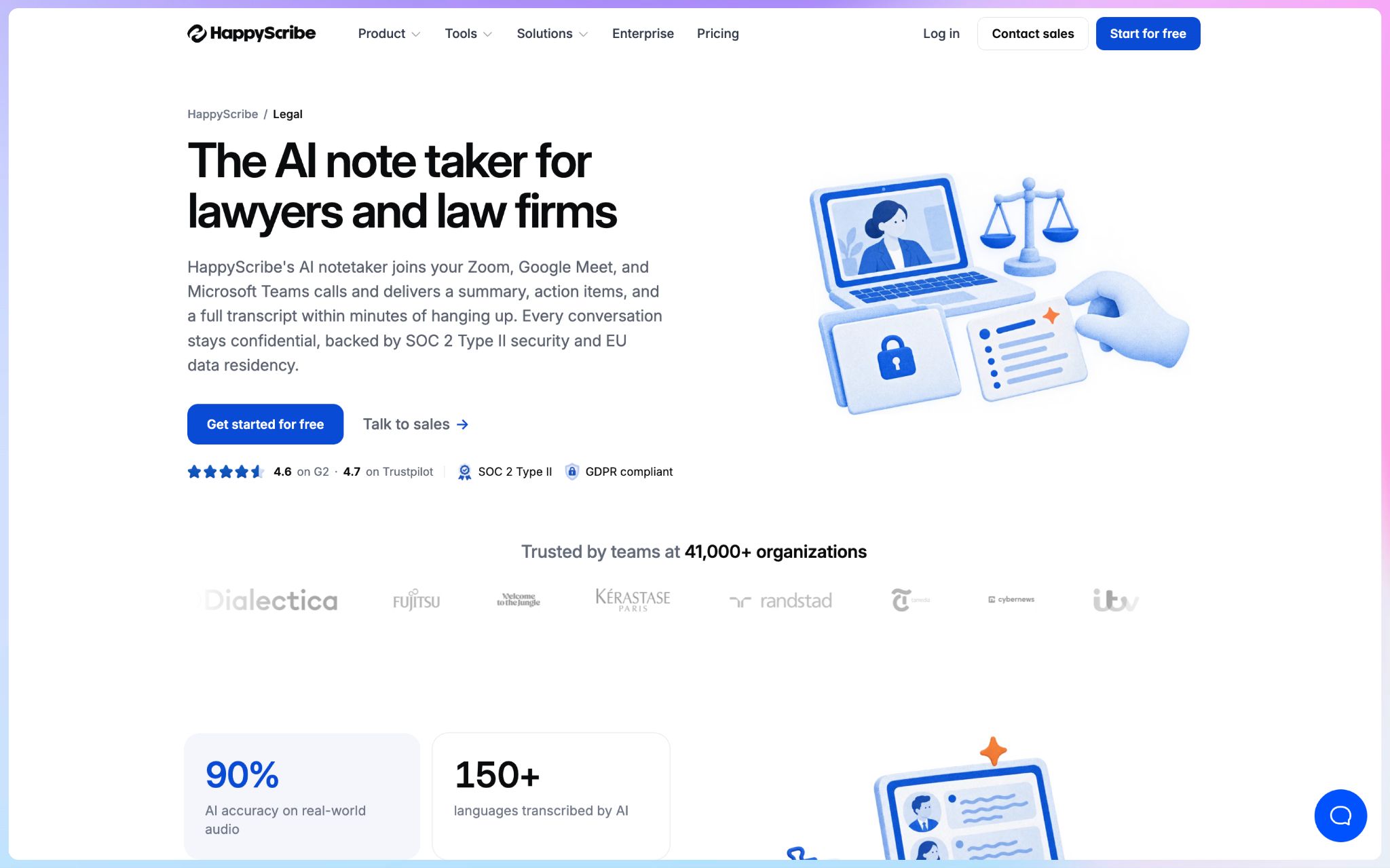
There is no model training on your data unless you explicitly opt in. Role-based access and private folders limit who can open each recording, and firms can set retention controls and sign a DPA before rollout. Enterprise plans add single sign-on.
The note taker joins Zoom, Google Meet and Microsoft Teams on demand or from your calendar, so you decide which calls it attends.
For in-person client meetings, the AI notetaker mobile app records the room with no bot involved. When a transcript is headed for the file, human legal transcription from NDA-bound transcribers raises accuracy to 99%+.
Does a secure tool guarantee privilege?
No vendor can promise that. Security answers the confidentiality question, but King & Spalding’s review of Heppner points out that Rakoff’s reasoning about AI not being a lawyer does not depend on whether a tool is public or private.
Even enterprise terms deserve a close read. Clark Hill’s analysis of Heppner notes that the court leaned on a clause allowing disclosure to government authorities, language that also appears in many enterprise privacy policies.
Privilege comes from how the firm structures the work. Counsel directs the tool, the client consents, the vendor contract restricts data use and a lawyer reviews every record. Firms that build those habits now will be ready as courts settle the open questions.
FAQs on lawyers’ use of AI note takers
Does using an AI note taker automatically waive attorney-client privilege?
No court has held that. Heppner involved a client acting alone on a consumer AI platform, and commentators expect attorney-directed tools with strong confidentiality terms to fare better.
Do lawyers need client consent to use an AI note taker?
Under NYC Bar Formal Opinion 2025-6, yes, even in one-party consent states. ABA Formal Opinion 512 also requires informed consent before client information enters a self-learning AI tool.
Are AI meeting transcripts discoverable?
They can be. Unprivileged transcripts are ordinary documents in discovery, and NYC Bar Formal Opinion 2026-2 specifically flags recordings of witness conversations.

Rodoshi Das
Rodoshi is the Content Lead at HappyScribe, the privacy-first transcription and AI notetaker platform based in Barcelona. Shaping content strategies and building AI workflows excites her as much as exploring new SaaS tools. She specializes in product-led content that informs rather than sells, grounded in honest product benchmarking and low tolerance for empty marketing speak.