


The debate between AI vs human transcription comes down to speed versus the level of human judgment you need.
AI transcription can turn hours of audio into searchable text in minutes. Human transcription takes longer and costs more, but it gives you another layer of review when every word needs to be right.
So which one should you use?
The answer depends on what you plan to do with the transcript and how difficult the recording is.
Recent research shows that AI transcription can work remarkably well, but performance still varies across languages, accents, recording conditions, and types of speech. Privacy and security also need consideration.
Let’s see how to decide when AI, human transcription, or a combination of both makes sense.
AI vs human transcription at a glance
| Factor | AI transcription | Human transcription |
|---|---|---|
| Turnaround | Minutes | Hours or days |
| Cost | Usually lower | Higher |
| Large volumes | Easy to scale | Requires more human time |
| Clear everyday speech | Often highly usable | Strong |
| Difficult accents or dialects | Performance varies | Depends on the transcriber’s familiarity with the accent or dialect |
| Overlapping speech | Can struggle | A human can replay and interpret ambiguous sections |
| Specialist terminology | Depends on the system and vocabulary support | Better when the transcriber has relevant subject expertise |
| Verbatim detail | May require review | Better suited |
| Privacy consideration | Data may be processed by AI systems and subprocessors | A person needs access to the recording |
| Best for | Fast, searchable transcripts at scale | High-stakes or publication-ready transcripts |
For many recordings, that is a better choice than treating AI and human transcription as an either-or decision.
What is AI transcription?
AI transcription uses automatic speech recognition, or ASR, to convert spoken language into text.
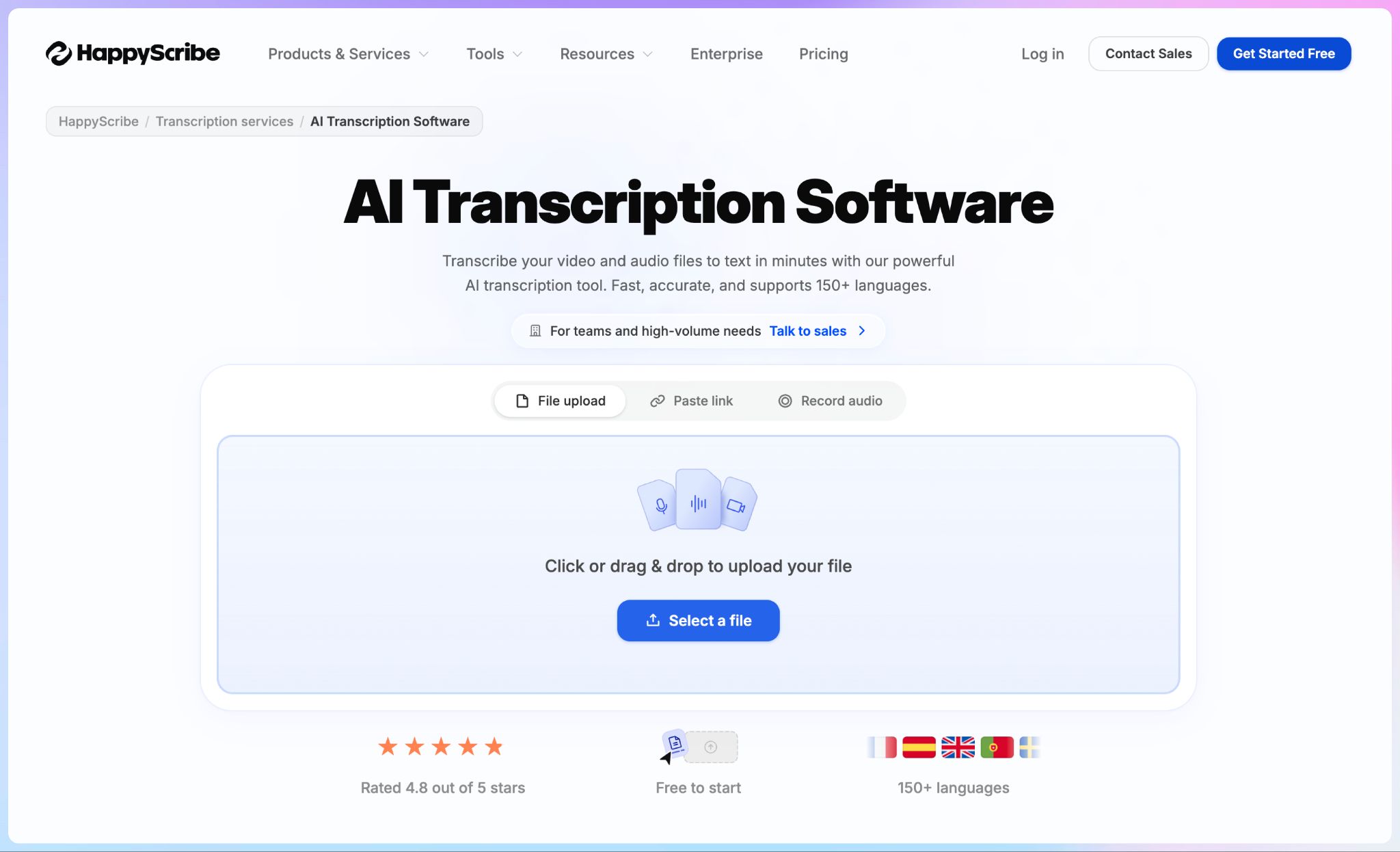
Modern systems do more than recognize isolated sounds. They use linguistic context to determine what was most likely said, which makes them much better at handling natural speech than earlier speech-to-text technology.
The biggest advantages are speed and scale.
Once audio is transcribed, you can search for a phrase, jump to timestamps, identify speakers, or analyze large collections of conversations without manually listening through every recording.
That makes AI particularly useful for meetings, lectures, interviews, podcasts, research datasets, and other workflows where the transcript acts primarily as a searchable representation of the recording.
The limitation is that the generated text is still an unverified interpretation of the audio. It should not automatically be treated as an error-free ultimate source of truth.
What is human transcription?
Human transcription puts a person in charge of creating or verifying the transcript.
Depending on the service, a professional may transcribe the recording manually or work from an automated draft and carefully check it against the source audio.
A human can replay an unclear sentence, use context to distinguish similar-sounding words, research an unfamiliar name, and flag passages that genuinely cannot be heard.
Human transcription is not automatically error-free, though.
A 2026 scoping review published in Annals, Academy of Medicine, Singapore notes that manual transcription is itself interpretive. A transcriber makes decisions about how speech should be represented, which can introduce mistakes or bias.
The real comparison is therefore between different error profiles and levels of human involvement, rather than perfect humans versus unreliable machines.
How accurate is AI transcription in 2026?
The scoping review in Annals, Academy of Medicine identified nine comparative studies evaluating 11 automatic speech-recognition tools for qualitative interviews.
Seven of the studies had been published in 2024 or 2025, and eight of the nine supported using AI transcription.
However, the review also found that performance changed with language, audio quality, accents, speech speed, technical terminology, background noise, and crosstalk.
It makes “How accurate is AI transcription?” difficult to answer with a specific percentage.
A system that performs extremely well on clear English audio may perform very differently on a noisy multilingual focus group.
What matters is how well it performs on recordings that resemble yours.
Accent and speaking style can change accuracy
A 2024 study in JASA Express Letters evaluated OpenAI Whisper across different native and non-native English accents.
The researchers found better recognition for American English than British and Australian English. Native English speakers were recognized more accurately overall than non-native speakers.
Whisper also performed better on read speech than conversational speech.
That last finding is important for everyday transcription.
A person reading prepared sentences into a microphone presents a much easier speech-recognition problem than two interview participants interrupting each other or several people talking around a conference-room table.
So test transcription software with recordings similar to the ones you actually produce; don’t rely exclusively on benchmark accuracy.
Language can make an even bigger difference
A BMC Research Notes study tested a Whisper-based transcription application on realistic interviews audio across 14 languages.
In its proof-of-principle sample, the researchers reported word error rates below 10% for Chinese, Portuguese, Filipino, English, German, Bahasa Indonesia, and Turkish. Malagasy, Tamil, and Burmese exceeded 40%.
The time required to correct transcripts also varied considerably by language.
These figures should not be treated as universal performance benchmarks. The assessment used a small sample, and the authors themselves described it as proof-of-principle research.
Its broader finding is more useful: a system can technically support many languages while producing very different levels of transcription quality across them.
If multilingual transcription is important to your workflow, test the actual languages, speakers, and recording conditions you expect to encounter.
Word error rate doesn't tell you how serious an error is
Speech-recognition research commonly uses word error rate (WER). It measures how many words were inserted, deleted, or substituted compared with a reference transcript.
But every error does not have the same consequence.
Consider:
The contract is worth $15 million.
and:
The contract is worth $50 million.
Only one small part of the transcript changed, but the meaning changed substantially.
Names, dates, figures, technical terminology, quotations, and negatives such as did and didn't create the same problem.
So raw accuracy alone is not enough when deciding whether a transcript requires human review.
Ask a more practical question:
What happens if the AI gets an important word wrong?
An error in searchable meeting notes may be inconvenient. But the same error in published testimony or research can have much bigger consequences.
AI transcription can sometimes hallucinate
AI speech recognition can produce another kind of mistake: text that sounds plausible but was never spoken.
The 2024 ACM FAccT paper Careless Whisper: Speech-to-Text Hallucination Harms examined more than 13,000 audio segments transcribed with Whisper.
The researchers found that roughly 1% of transcriptions contained entire hallucinated phrases or sentences that did not exist in the source audio. Among the hallucinations they identified, 38% contained potentially harmful content.
The study evaluated a particular model and version, so 1% is not a universal hallucination rate for AI transcription.
But it does point to an important risk.
A spelling mistake may be easy to notice. A fluent sentence that was never spoken can be harder to catch because it sounds believable.
For high-stakes material, you should therefore verify important passages against the original recording.
When should you use AI transcription?
AI transcription works particularly well when the transcript's main job is to make recorded information accessible, searchable, and easier to analyze.
Use cases include:
- internal meetings
- lectures and study recordings
- podcasts being repurposed into content
- recorded webinars
- customer calls
- large interview datasets
- searchable audio or video archives
- first drafts of qualitative research interviews
Volume also plays a role.
The 2024 BMC Research Notes study elaborates that manual verbatim transcription can take many times the duration of the original recording.
Automated transcription can shift that work from producing every word manually to reviewing and correcting the output.
For a large collection of recordings, that difference quickly becomes significant.
When should you use human transcription?
Human transcription becomes more valuable as the consequence of an error rises.
You may want professional human involvement when:
- quotations will be published
- exact wording is analytically important
- recordings contain difficult specialist terminology
- several speakers frequently overlap
- audio quality is poor
- detailed verbatim transcription is required
- the transcript will form part of an important official record
Human review can also make sense after testing AI on a representative recording.
If the automated transcript requires so much correction that you are effectively retranscribing it yourself, the time advantage disappears.
The decision should not depend solely on the industry. A clear legal team meeting may be easier to transcribe than a chaotic consumer focus group. Judge the individual recording and the consequences of mistakes.
AI + human review is the better answer
The most useful workflow often sits between fully automated and fully manual transcription. AI creates the initial transcript. A person then checks as much of it as the use case requires.
| Use case | Suggested workflow |
|---|---|
| Internal team meeting | AI |
| Lecture | AI, with important details checked |
| Podcast repurposed into an article | AI + verify quotes and names |
| Customer interview | AI + review key passages |
| Qualitative research interview | AI + human/researcher verification |
| Published executive interview | Human review |
| Difficult multilingual focus group | Test AI + extensive review if required |
| Legal or evidentiary record | Professional human transcription or AI + rigorous verification |
As the consequence of an error increases, increase the level of human verification.
Privacy changes the AI vs human calculation
AI transcription also changes who or what handles your recording.
Before uploading sensitive audio, check:
- where files are processed and stored
- which subprocessors may handle data
- whether customer content is used for model training
- how long recordings are retained
- whether permanent deletion is available
- what security standards the provider follows
- whether regional data-residency requirements are supported
Human transcription creates a different privacy surface.
A person needs access to the recording, so you also need to understand who can handle it, how that access is controlled, and whether confidentiality agreements apply.
“Human” does not automatically mean “more private.”
The underlying security architecture, contractual safeguards, and data-handling practices matter in both workflows.
AI transcription can affect informed consent
The privacy issue is especially important in research.
In a 2025 editorial in the Journal of Empirical Research on Human Research Ethics, Gabrielle Samuel and Doug Wassenaar argue that researchers should tell participants when AI transcription software will process recorded responses and obtain explicit consent for that use.
They discuss issues including cloud processing, third-party access, retention, potential model improvement, and transcription errors. The authors recommend human verification of AI transcripts and, where feasible, offering manual transcription as an alternative.
The exact consent requirements for your project depend on your jurisdiction, institution, and type of data.
The broader lesson is useful beyond academic research: Consent to being recorded does not necessarily answer every question about how that recording can subsequently be processed.
📚 Also read:
How to decide between AI and human transcription
Before choosing a transcription method, ask:
👉 How will the transcript be used? A searchable reference requires a different standard from a published quotation or official record.
👉 How difficult is the audio? Consider accents, languages, background noise, technical vocabulary, and overlapping speakers.
👉 How expensive would an error be? A typo in meeting notes has very different consequences from an incorrect figure in evidence or published research.
👉 How much content do you have? AI becomes increasingly attractive as recording volume grows.
👉 What are your privacy requirements? Look at storage, retention, model-training policies, subprocessors, and human access.
👉 Can you review important passages yourself? Sometimes AI plus targeted verification offers the best balance of speed, cost, and reliability.
HappyScribe gives you both options
HappyScribe, a Barcelona-based AI notetaker and transcription platform, offers both AI and human transcription. You can choose the level of human involvement for each file.
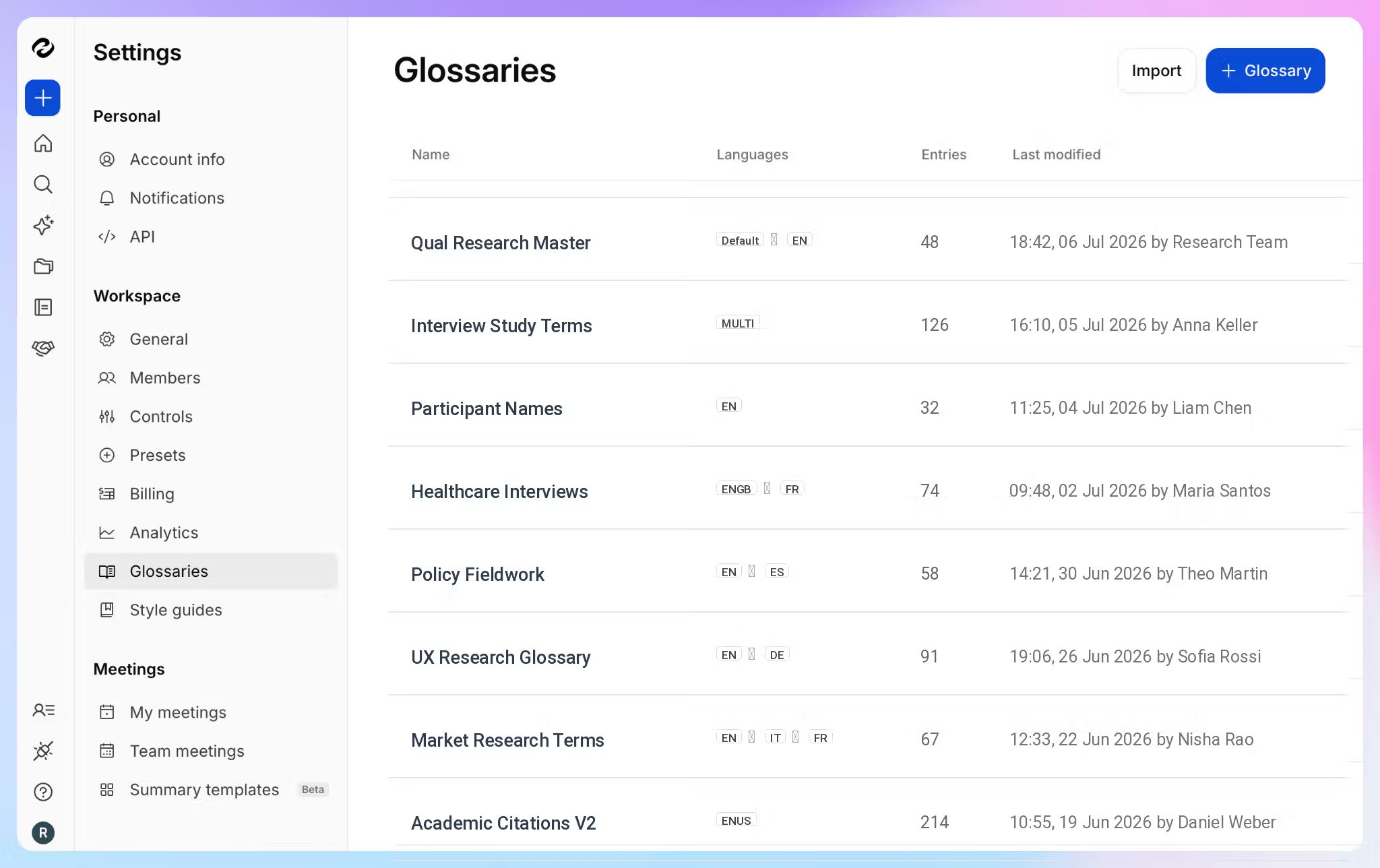
Its AI transcription supports 150+ languages and offers 95%+ accuracy. Custom glossaries help the system recognize names and specialist terminology that general speech-recognition models may miss.
HappyScribe also adds speaker identification and timestamps, and its transcript editor lets you review the text against the original recording.
For files that require greater scrutiny, HappyScribe provides professional human transcription in 60+ languages with 99%+ accuracy. The service supports clean-read and verbatim transcription for academic research, interviews, legal material, and business content.
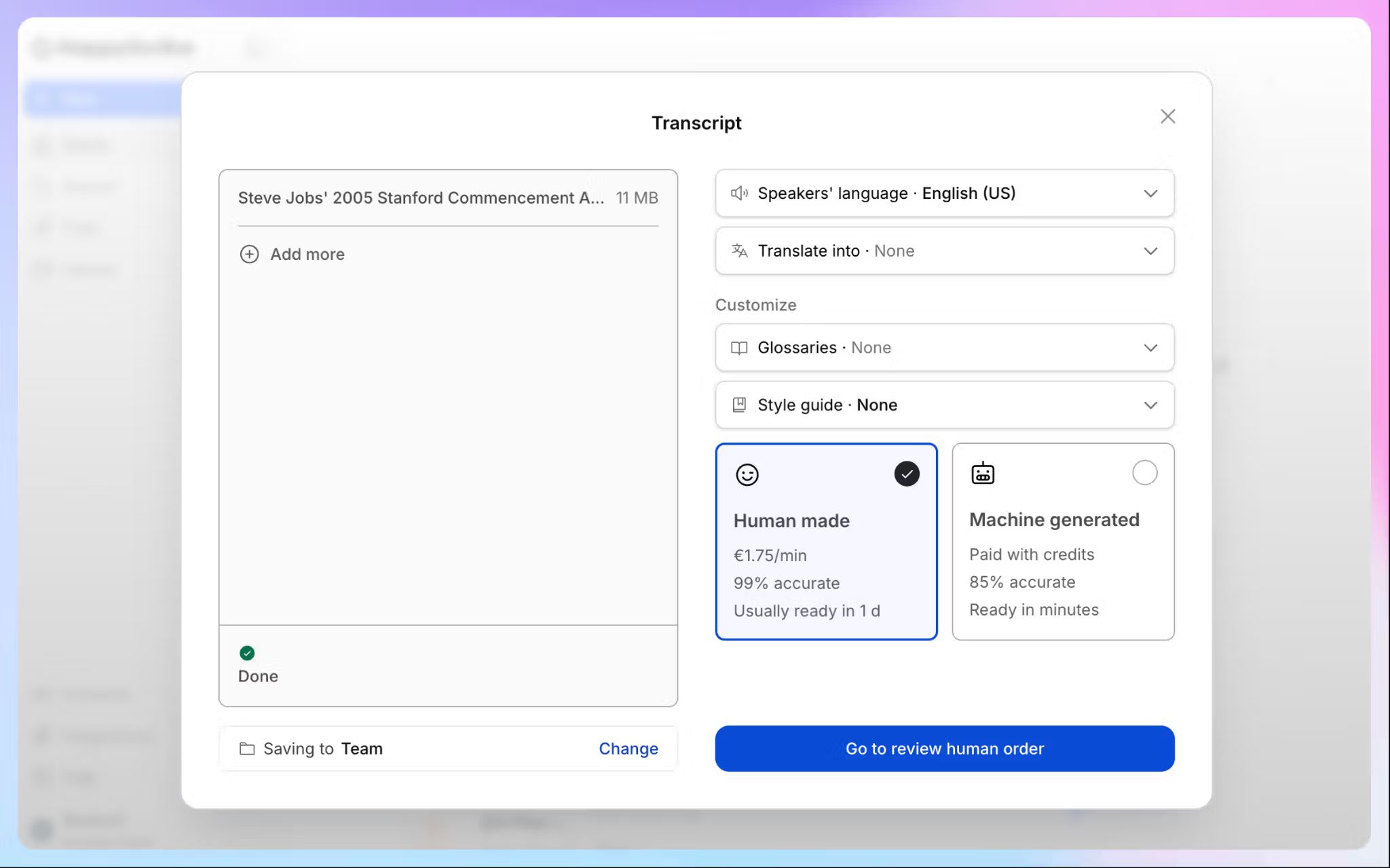
You can therefore use AI for faster, high-volume work and switch to human transcription when exact wording requires professional verification.
You can analyze the transcript after it's created
HappyScribe offers AI Chat for working with transcripts after they have been generated.
You can use it to ask questions about a transcript, generate summaries, extract timestamped quotes, identify action items, or search for information across multiple files and meetings.
This is useful when transcription is only the first step.
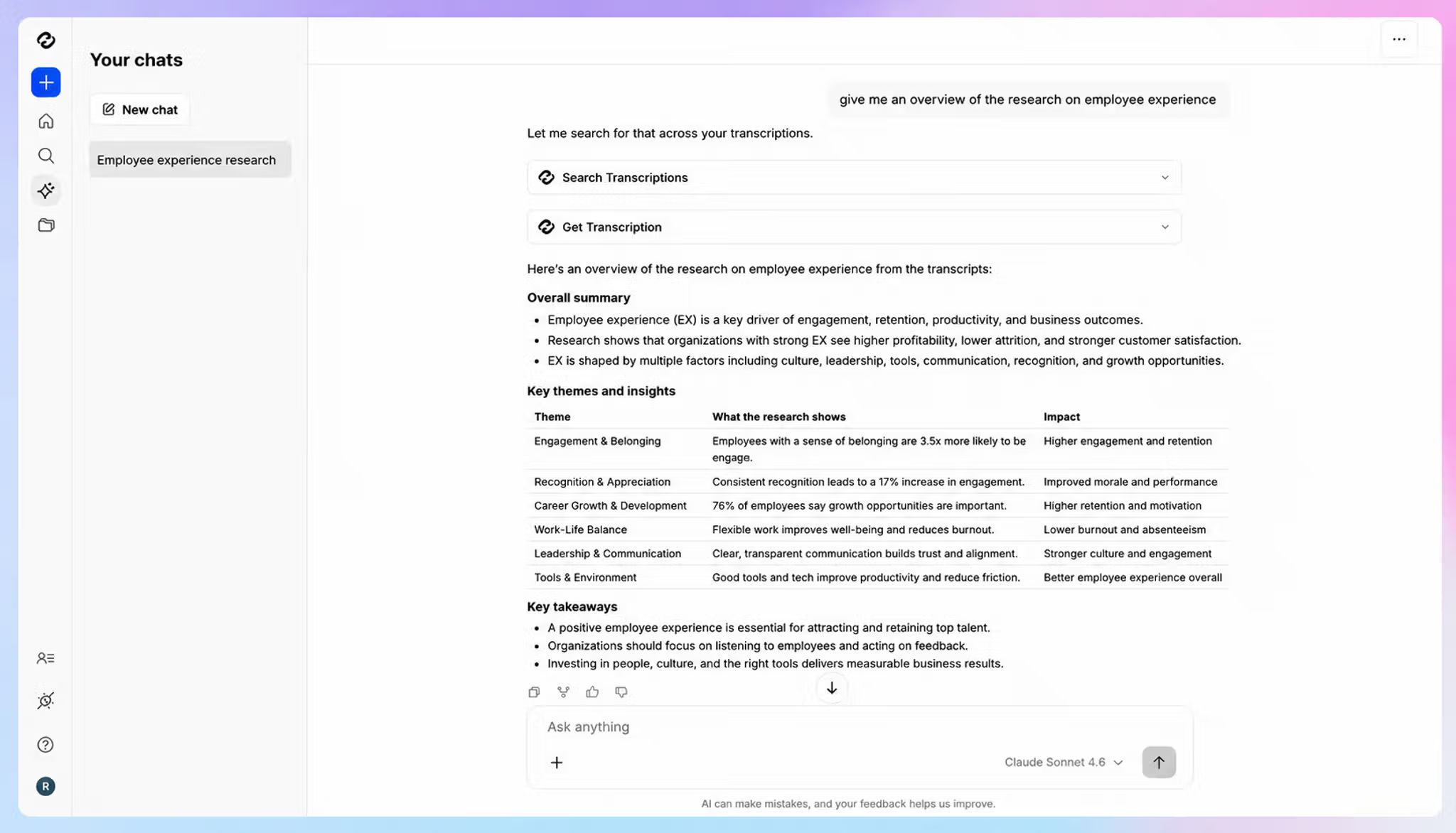
For example, you might transcribe a collection of customer interviews and then use AI Chat to surface recurring themes or retrieve relevant quotations.
The quality of that analysis still depends on the underlying transcript. If an important quote, number, decision, or conclusion is crucial, verify it against the original recording.
How does HappyScribe handle security and privacy?
HappyScribe stores recordings and transcripts in the European Union. The platform is SOC 2 Type II certified and GDPR compliant. It protects data with TLS encryption in transit and AES-256 encryption at rest, while encrypted backups provide an additional safeguard.
For enterprise teams, HappyScribe supports single sign-on and role-based access control. Administrators can provision or remove access centrally, assign permissions, and delete recordings or transcripts on demand.
HappyScribe can also provide a Data Processing Agreement and its current list of subprocessors on request.
Network protections include firewalls and intrusion detection and prevention controls.
HappyScribe monitors its applications for attacks and unusual activity. Employee and administrator access to user data is restricted, except in limited customer-support cases, and all employees sign nondisclosure and confidentiality agreements.
What about privacy with human transcription?
Choosing human transcription means a person needs access to the recording.
With AI, you need to understand how technological systems and subprocessors handle the recording.
With professional transcription, you also need to consider how human access is controlled.
HappyScribe’s professional transcription work is carried out by expert linguists who operate under strict NDAs, and confidentiality protections apply to sensitive material.
So, should you choose AI or human transcription?
For most everyday recordings, AI is now the sensible starting point.
The research papers I discussed above show that automated transcription can produce useful results across interviews, languages, and real-world workflows while reducing the amount of manual transcription required.
They also show why those results still need context.
Accuracy varies. Some errors matter much more than others. And an easy-to-read transcript should not automatically be assumed to reproduce a recording perfectly.
Use AI when you primarily need fast, searchable text.
Add human verification when important claims, quotations, or decisions depend on exact wording.
Choose professional human transcription when the transcript itself needs a much higher level of scrutiny.
HappyScribe lets you make that decision recording by recording, with both AI and professional human transcription available on the same platform.
FAQs on AI transcription vs. human transcription
How should you compare human vs AI transcription for your recordings?
Run the same representative sample through both options. Track correction time, speaker-label errors, missed terminology, and the total cost after review. This test gives you a more useful comparison than advertised accuracy rates because it reflects your speakers and recording conditions.
How do AI transcription tools handle an audio file with multiple voices?
Clear separation between speakers improves results. Use individual microphones or separate audio channels when possible, and limit people talking over one another. After transcription, check whether the system assigned dialogue to the correct person before you rely on the transcript.
Is manual transcription still the gold standard when accuracy matters?
It remains a strong choice for professional use because an experienced transcriber brings contextual understanding to unclear speech. However, human work is not automatically error-free. Sensitive legal, academic, or published material may still require a second reviewer with relevant subject knowledge.
What role does artificial intelligence play in a human vs AI workflow?
Artificial intelligence can produce the first transcript, while a person checks information with the greatest consequences. Define review priorities before work begins. Names, figures, direct quotations, and final conclusions usually require more attention than routine discussion.
When should legal professionals choose human transcription services for court proceedings?
Expert human transcription suits professional use when unclear audio or poor audio puts an accurate record at risk. Human transcriptionists provide the human touch required to understand context and resolve ambiguity. Human-made transcripts often deliver high accuracy, but the process is more time consuming. Before selecting transcription services, check the provider’s data security standards and confidentiality controls.
Are AI transcription services the right tool for multi speaker audio recordings?
AI-based transcription uses automatic transcription to turn video files into written text. It is increasingly popular because it can transcribe words quickly, save time, and improve workflow efficiency at a low cost. That cost effectiveness falls when AI-generated transcripts need manual editing because multiple speakers, poor audio quality, proper nouns, or technical terms reduce speaker recognition and transcription accuracy.

Rodoshi Das
Rodoshi is the Content Lead at HappyScribe, the privacy-first transcription and AI notetaker platform based in Barcelona. Shaping content strategies and building AI workflows excites her as much as exploring new SaaS tools. She specializes in product-led content that informs rather than sells, grounded in honest product benchmarking and low tolerance for empty marketing speak.