![5 Best AI Meeting Note Takers for Sales Teams [2026]](/sanity-images/ejgwz1gl/redesign/b665ff909093717337a3bf03897c05aa3b1f274b-1536x1024.jpg?auto=format&w=1536.0&rect=0,128,1536,768&h=768)
TL;DR ⏩
After testing several AI note takers on sales calls, here are the best ones for reps and managers:
- Gong: Best for large revenue teams with enterprise budgets looking for deep conversation and forecasting intelligence
- Chorus by ZoomInfo: Best for enterprise and mid-market sales teams already inside the ZoomInfo ecosystem
- HappyScribe: Best for global or Europe-based sales teams that want accurate multilingual call records, AI chat assistance, and EU data residency
- Avoma: Best for sales teams that want sales pipeline management without separate contracts for lead routing, scheduling, and revenue intelligence
- Plaud: Best for field reps and AEs looking for wearable recorders to capture in-person conversations
Did you know sales reps spend 60% of their average workweek on admin tasks and NOT actually selling?
Data entry and meetings take up valuable hours every week. One of the best ways you can save time is by using an AI meeting note taker, especially one that’s built for sales teams.
To build this list, I’ve tested popular note takers in the market and talked to colleagues in sales to understand their challenges and how they’re working around it everyday. It has something for everyone: enterprise sales, mid-market reps, and solopreneurs.
If you’re looking to transcribe sales meetings with better accuracy and visibility and save time along the way, this is the list for you.
5 Best AI meeting note takers for sales teams: At a glance
| Factors | Gong | Chorus by ZoomInfo | HappyScribe | Avoma | Plaud |
|---|---|---|---|---|---|
| Best for | Large revenue teams with RevOps support | Sales teams inside the ZoomInfo ecosystem | Global sales teams that want multilingual accuracy and EU data residency | Mid-market teams that want consolidated sales tools | Field reps and AEs looking for recording hardware to close in person |
| Key features | Conversation intelligence, coaching libraries, forecast and pipeline analytics | Call recording with auto-tagged moments, coaching scorecards, ZoomInfo data sync | Multilingual transcription, objection and competitor highlights, AI Chat across meetings, bot or bot-free recording | AI notes with CRM auto-fill, live answer assistant, lead router | Wearable hardware capture, summary templates, and Ask Plaud across recordings |
| Supported languages | 70+ | 50+ | 150+ at 95%+ AI accuracy | 70+ | 112 |
| Security and compliance | SOC 2 Type II, ISO 27001, ISO 27701, GDPR, HIPAA | SOC 2 Type II, ISO 27001, ISO 27701, TRUSTe, GDPR | SOC 2 Type II, GDPR, AES-256, EU data residency, AI training opt-out | SOC 2 Type II, GDPR | SOC 2, ISO 27001, ISO 27701, GDPR, HIPAA, EN 18031 |
| Starting price | Custom quote | Custom quote | Free plan available. Paid plans from $8.50/month billed annually or $17/month billed monthly | No free plan. Paid plan starts from $29/month | $159 device plus free starter plan |
1. Gong
Best for: Large revenue teams with dedicated RevOps support that want deep conversation intelligence, coaching, and forecasting in one platform
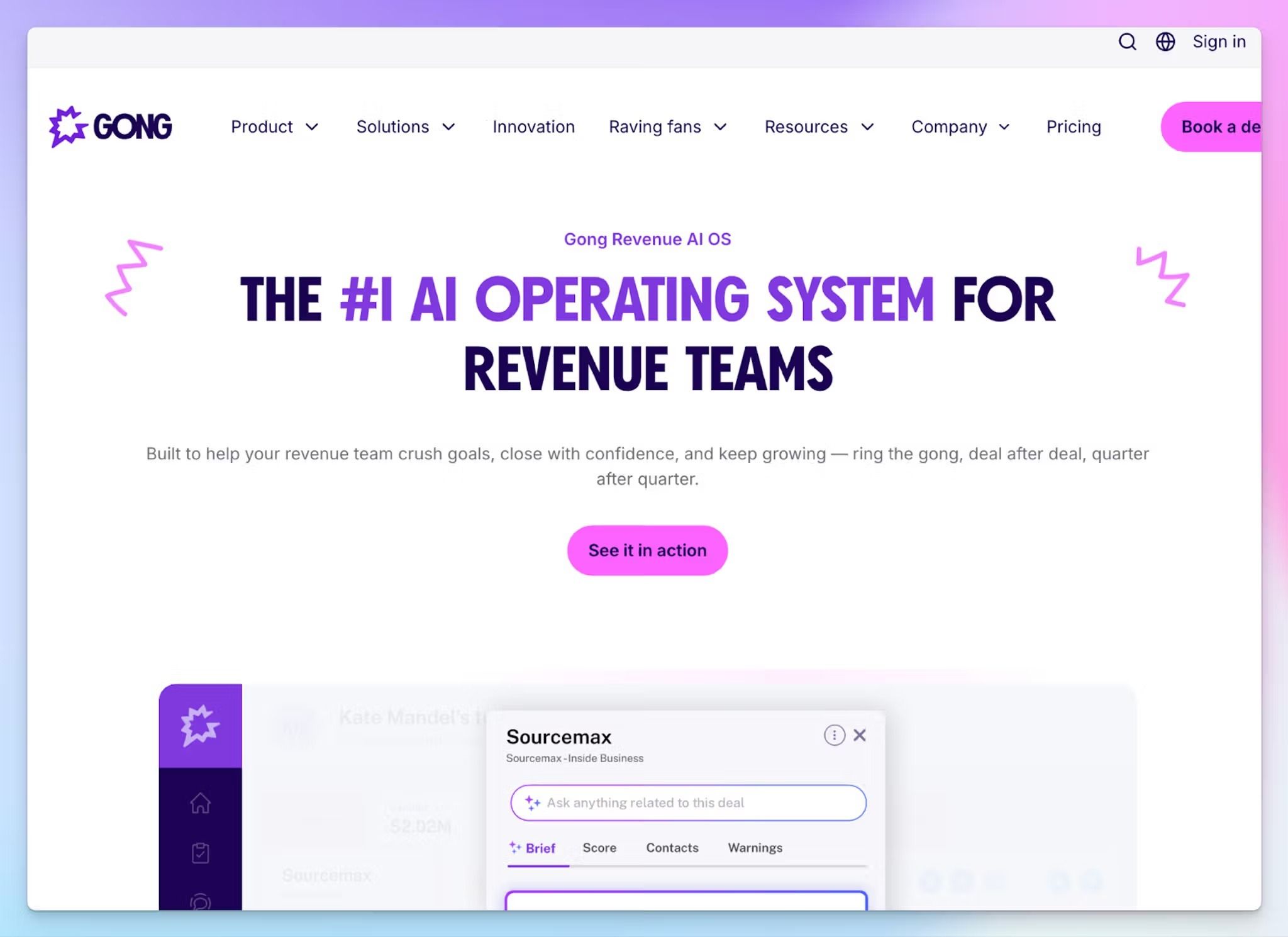
Gong is one of the earliest movers in the conversation intelligence space, and it has only gotten better (and convoluted) with time. It not only transcribes calls, but turns them into sales assets.
If you run a sizable sales org and want every call analyzed closely, Gong is one of the most feature-packed tools on the list. It's also the most expensive to run, which I'll discuss later.
Gong's key features
- Conversation intelligence tracks every call for objections, competitor mentions, buying signals, and talk-time patterns, then sorts them by deals, reps, and other filters
- Transcripts and recording are synced, so you click any line to jump to that moment, pull snippets to share, and translate to review calls in other languages
- Gong’s coaching tools, like scorecards, call snippets, and searchable call libraries, help managers build a repeatable picture of what good selling looks like
- Revenue teams can use the forecast and pipeline analytics to weigh hundreds of signals to flag at-risk deals before they slip
Gong's pricing
Custom pricing. Generally runs several thousand dollars across user license, platform fee, and onboarding charges.
Gong's pros
- Gong’s sales and revenue intelligence are refined over a decade of customer conversations, so you can get over gut feels and act on transparent data
- You can train new reps faster with Gong’s library of winning calls instead of simple role-plays
- Gong has one of the widest integration stacks for enterprise systems, including Salesforce, HubSpot, Snowflake, Microsoft Dynamics, 6sense, Zendesk, Clari, Segment, Slack, etc.
Gong's cons
- Setting up and running Gong is steep and time-consuming, placing it out of the reach of smaller sales teams
- Thanks to the opaque pricing, you can't benchmark without sitting through a full sales cycle, and the customer support falls short occasionally
- Gong calls itself a Revenue AI platform, and the call notes are a byproduct of a much larger system
📌 Also read:
2. Chorus by ZoomInfo
Best for: Enterprise and mid-market sales teams already inside the ZoomInfo ecosystem
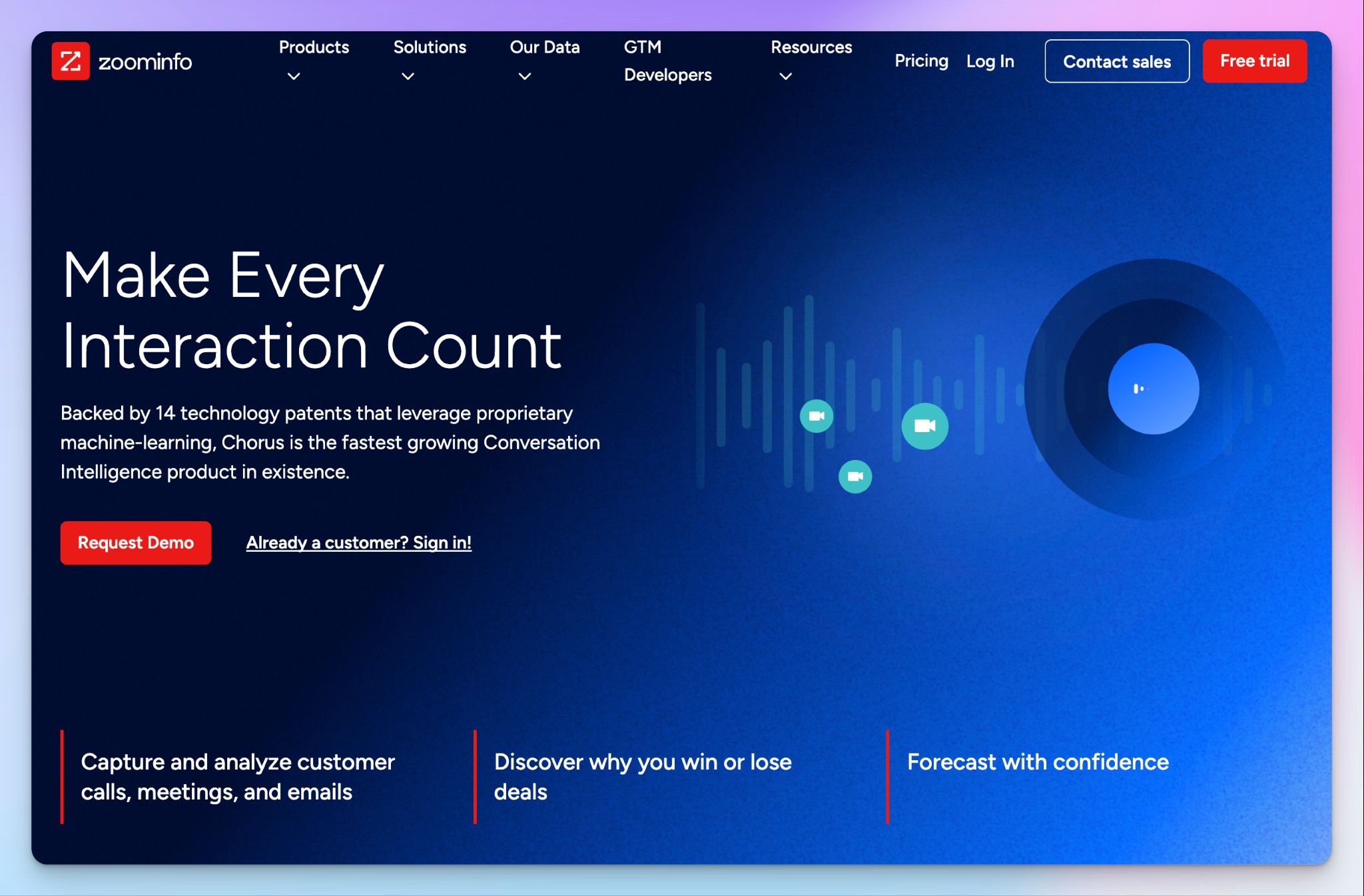
Chorus covers a lot of Gong’s features, but it’s geared towards mid-market ZoomInfo customers.
Since it works within ZoomInfo, that connection runs both ways. Enriched company and contact profiles flow into Chorus, and the conversations flow back into ZoomInfo. So a rep sees who they’re selling to before the call starts, and a competitor mention can trigger a follow-up automatically.
Chorus by ZoomInfo’s key features
- Records and transcribes every call across Zoom, Teams, and Meet, then auto-tags moments like pricing talk, next steps, and competitor mentions with patented trackers
- Coaching includes customizable scorecards, smart playlists that auto-build call libraries, and peer-review recommendations to help new reps
- You can set up complex workflows for go-to-market actions based on what’s said on a call, so a budget risk can kick off the next steps
Chorus by ZoomInfo’s pricing
Custom pricing. Generally runs thousands of dollars.
Chorus by ZoomInfo’s pros
- The live account lookup means reps walk into calls with informed data, which sharpens discovery
- New reps ramp faster by studying their own and peers’ winning calls, and it’s a coaching loop managers actually use
- Feature and competitor mention tracking across calls gives leaders the data to improve their product and help marketing teams with valuable insights
- Entry pricing sits below Gong, so it’s the budget way into enterprise conversation intelligence
Chorus by ZoomInfo’s cons
- Product roadmap of Chorus has slowed down since the 2021 ZoomInfo acquisition, and some teams have moved to competitors for deeper deal inspection
- The Chorus recording bot doesn’t always join on time, so it can miss the opening minutes of a call, and pulling it out mid-call is janky
- Transcription tends to struggle with jargon and heavy accents, which is frustrating when you rely on those transcripts for coaching
📚 Also read:
3. HappyScribe
Best for: Global or Europe-based sales teams that want accurate multilingual call records and EU data residency
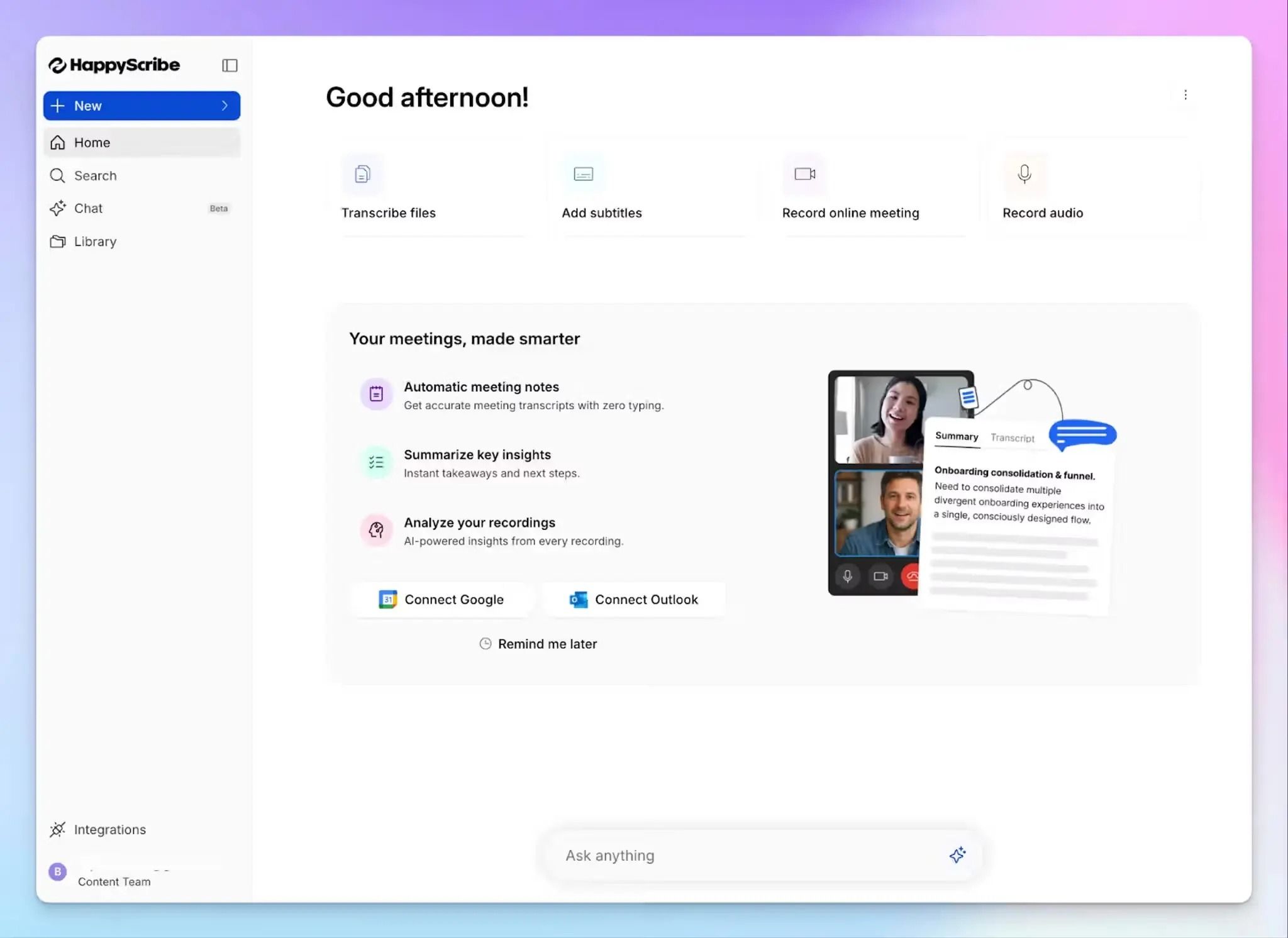
Full disclosure, since this is our blog: HappyScribe isn’t built sales-first the way Gong or Chorus are. But it can still help you in more ways than you expect.
HappyScribe is a transcription and meeting notes platform that helps sales teams get the most out of their conversations. If your reps sell across borders and your security team cares where call data lives, it helps you stay compliant and sell with confidence.
HappyScribe’s key features
- Record and transcribe sales calls in 150+ languages at 95%+ accuracy, with language auto-detection and custom glossaries for jargon and product terms
- The accurate summaries and action items can highlight objections and competitor mentions, pull timelines and procurement, and assign stakeholders
- HappyScribe AI Chat helps reps prepare before calls and analyze data afterward. You can ask what a prospect said about the budget two weeks ago, and it’ll take you to the exact moment
- Sales reps can capture calls with a branded note taker bot or bot-free for impromptu and in-person calls
HappyScribe’s pricing
- Free: Unlimited meeting recordings (45 mins per recording), 10-minute trial of AI transcription, subtitling, and translation
- Basic: $8.50/month (billed annually) or $17/month (billed monthly)
- Pro: $19/month (billed annually) or $29/month (billed monthly)
- Business: $59/month (billed annually) or $89/month (billed monthly)
- Enterprise: Contact sales for tailored solutions
HappyScribe’s pros
- The 150+ language coverage is the real draw for global sales teams. If your reps are selling in France, Brazil, Japan, or South Africa, one tool covers all calls
- SOC 2 Type II, GDPR, EU data residency, and AI-training opt-out pass a prospect's security review faster
- HappyScribe’s generous free plan covers unlimited meeting note-taking, so sales teams can save thousands of dollars each month
- Record in-person conversions on the move with HappyScribe mobile apps and use the summary templates to give notes structure
HappyScribe’s cons
- No native two-way CRM sync. Instead, you use Zapier, MCP, or API
- HappyScribe doesn’t have pipeline dashboards yet, so it can’t flag at-risk deals or help with real-time coaching
4. Avoma
Best for: Mid-market sales teams of 10 to 100 reps that want sales pipeline management without separate contracts for lead routing
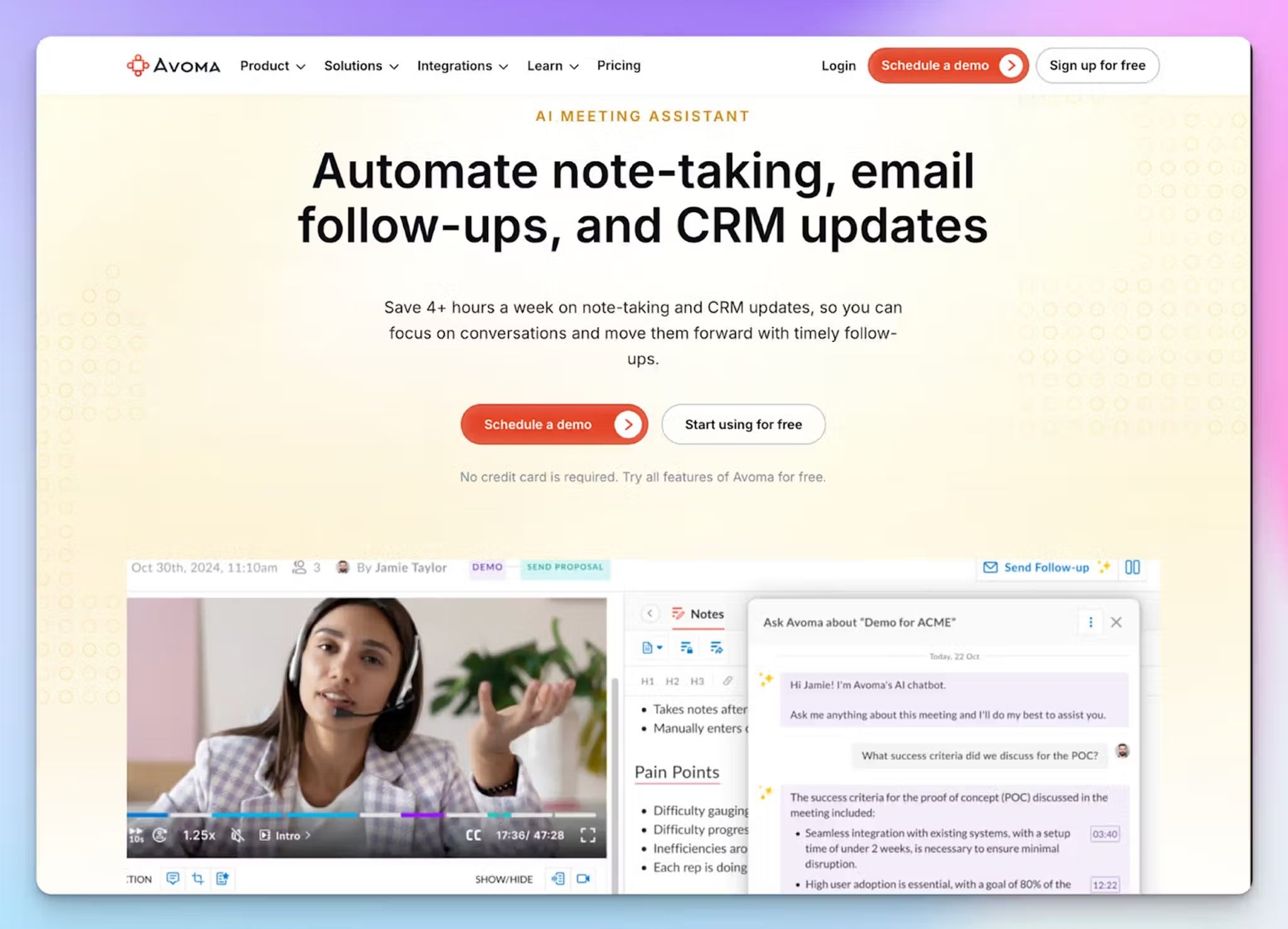
Avoma’s moat is that it brings essential tools reps use under one platform. For a growing sales team that’s stitching together Calendly, a CI tool, an AI note taker, and a forecasting dashboard, consolidation is the whole appeal.
The catch is that the $29 entry price buys you the meeting notes. The sales features cost more as add-ons.
Avoma’s key features
- Records and transcribes every call in 70+ languages with AI notes, smart chapters, and automatic CRM field updates for MEDDIC, SPICED, BANT, and other methodologies powered by add-ons
- Avoma’s live answer assistant surfaces relevant responses to objections during a call in real time, so reps have support right in the moment
- With conversation intelligence, managers can track talk patterns and topic trends, and build coaching playlists for reps and deal stages
- Revenue intelligence flags deal and churn risk from conversation signals and runs pipeline reviews with two-way CRM field updates, all from one dashboard
Avoma’s pricing
- Startup: $29/month
- Organization: $39/month
- Enterprise: $39/month (billed annually)
- Conversation Intelligence add-on: $35/month
- Revenue Intelligence Add-on: $35/month
- Lead router add-on: $25/month
Avoma’s pros
- You can schedule 1:1 calls and automate team scheduling with round-robin routing and advanced distribution rules
- Avoma’s pricing is fully transparent, and the features are available at mid-market pricing, so teams can make informed choices
- Avoma syncs with a wide range of tools like Aircall, Copper, Dialpad, Salesloft, HubSpot, Pipedrive, and Zoho
Avoma’s cons
- Avoma’s recording bot isn’t reliable. It sometimes doesn’t join on time or skips meetings entirely
- Transcription accuracy takes a hit with technical terminology and jargon, which is disappointing given it’s a sales-focused note taker
5. Plaud
Best for: Field sales reps and account executives who want a wearable device that captures conversations hands-free
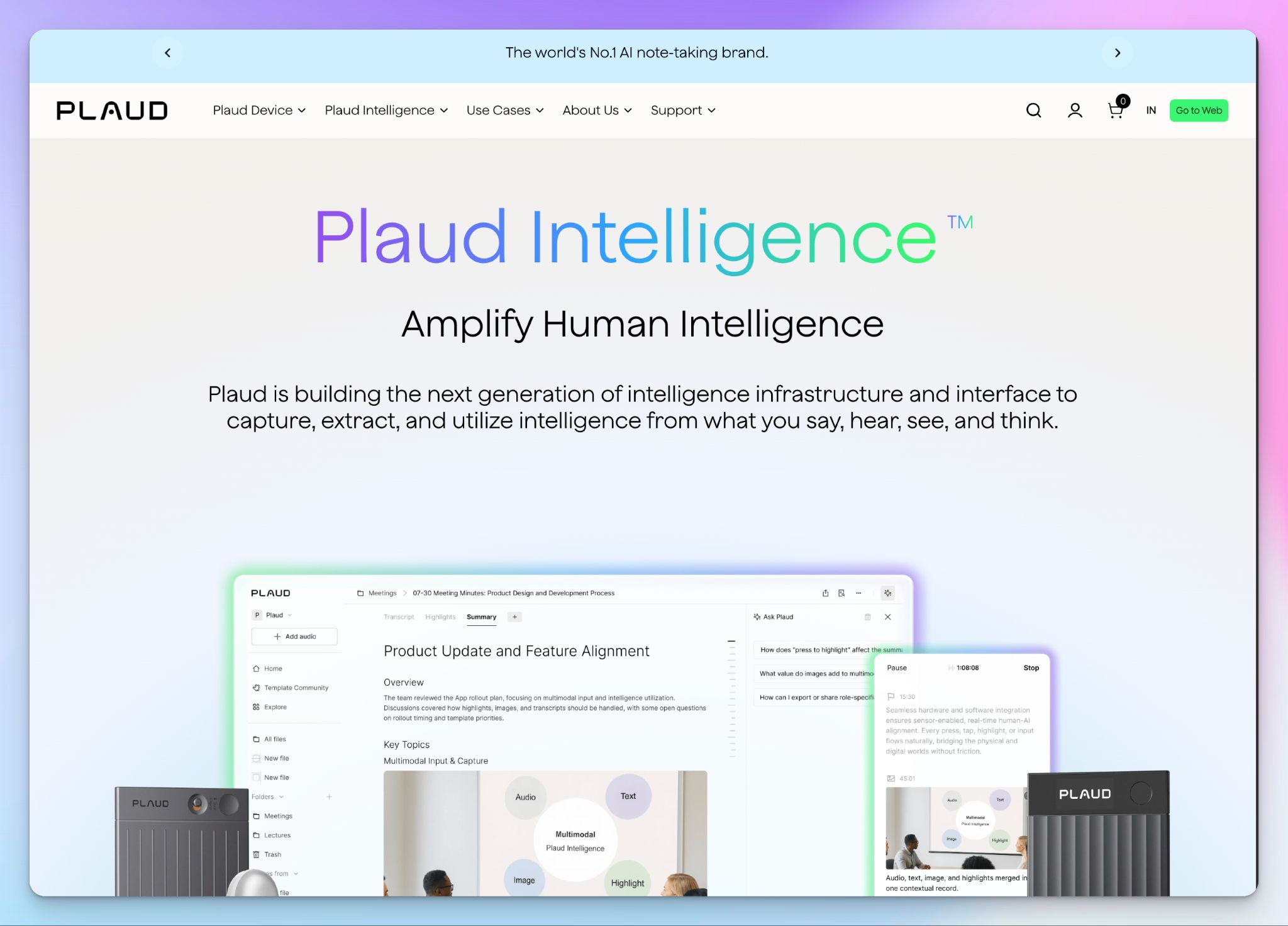
Plaud is primarily built for the kind of selling that doesn't happen on a screen. It's a physical device, either a wearable pin or a credit-card-sized recorder that snaps to the back of your phone and records conversations.
If you're an AE closing over lunch, a real estate agent walking a property, or a rep whose best conversations happen in a hallway, Plaud captures what other tools can't reach.
The trade-off is that it's hardware with a subscription on top, and the sales workflows are limited.
Plaud's key features
- Plaud lets you customize summary templates to turn a recorded conversation into BANT, MEDPICC, and custom-method summaries, plus executive overviews and extracted action items
- Reps can use Ask Plaud to find insights across past conversations and surface decisions and follow-ups, so they can prep for the next meeting
- Plaud captures audio through a wearable device, then transcribes across 100+ languages with speaker labels and industry glossaries for accuracy
- For longer recordings, AutoFlow runs post-call triggers by transcribing, summarizing, and emailing the results
Plaud's pricing
- Starter: Free
- Pro: $17.99 /month
- Unlimited: $29.99/month
- Team: $35/month
Plaud hardware: Starts from $159
Plaud's pros
- Plaud Note and Plaud NotePin devices capture in-person and on-the-go conversations for field sales
- Setup is effortless. Press to record, and the summary lands minutes later, with a strong compliance stack covering SOC 2, HIPAA, GDPR, and ISO 27001
- The free 300-minute tier and one-time hardware cost make it an affordable entry point on the list for a rep
Plaud's cons
- Plaud doesn't have CRM integration yet. So notes flow to Salesforce or HubSpot only through manual export or a Zapier workaround
- The wearable Pin models don't record phone calls, so a rep who takes calls needs the pricier Note Pro, and audio accuracy falls off if the device isn't worn at the collar level
- Touch controls are finicky, and taps don't always register, so conversations you thought you captured might not be recorded at all
Which AI meeting note taker should you choose?
The right AI note taker for your sales calls comes down to your team size, scale of meetings, and where the selling actually happens.
👉 Gong is for large revenue teams with the budget and RevOps support to run a full conversation intelligence platform.
👉 Chorus by ZoomInfo suits mid-market and enterprise teams already inside the ZoomInfo ecosystem.
👉 Avoma fits mid-market teams that want customer intelligence, scheduling, and pipeline management consolidated into one platform.
👉 Plaud is for field reps and AEs whose best conversations happen in person, not on a screen.
👉 HappyScribe is worth considering for global sales teams. It’s a true AI note taker that also handles file transcription, subtitling, and translation work that the sales-native tools don't always cover.
If your reps sell across borders in niche languages and your security team cares where call data lives, HappyScribe handles both with EU data residency and 95%+ multilingual accuracy.
The free plan is an easy way to test it on your own sales calls before committing to a paid plan.
FAQs on the best AI meeting note takers for sales teams
Can you use AI to take meeting notes in Teams?
Yes. Most AI meeting assistants transcribe meetings natively on Microsoft Teams, Zoom, and Google Meet. They join as a meeting participant or run in the background, then deliver meeting summaries, AI-generated notes, and follow-up emails after the call. Tools like Gong, Chorus, Avoma, and HappyScribe all record sales calls on Teams. Some, like HappyScribe, also offer a bot-free recording option for impromptu or sensitive internal team meetings.
What is the best AI note taker for sales teams?
The right pick depends on your team size and sales process. HappyScribe fits global teams that need accurate meeting transcription across 150+ languages. Gong is built for large revenue teams that want deep meeting insights and forecasting. Avoma and Chorus suit mid-market teams that want structured notes and sales insights in one platform. Plaud covers in-person sales conversations with a recording device.
Does Microsoft have an AI meeting note taker?
Yes. Microsoft Copilot in Microsoft Teams is the platform's native AI meeting notetaker. It captures key points for every meeting participant, generates summaries, and surfaces AI features like meeting recap and action items. It only works inside Microsoft 365, so teams that use multiple meeting platforms often pair it with a third-party tool like HappyScribe that covers Zoom and Google Meet as well.
Which AI tool is best for sales?
It depends on what part of the sales process you're trying to fix. For pipeline coaching and revenue forecasting, Gong's AI agent reads past meetings and surfaces deal risk. For mid-market teams that want to extract key insights from sales conversations, Avoma combines call analytics, AI-powered search across meeting data, and follow-up emails in one user-friendly tool. For in-person sales meetings, Plaud captures conversations on a wearable device and tags pain points automatically.
What is an affordable note taker for sales?
HappyScribe's free plan gives unlimited recordings (45-minute cap) with AI transcription and easy access to meeting summaries, which is enough to use the note-taking tool on real sales calls. Read AI and Fathom also offer generous free tiers. For regulated industries that care about transcription quality and where call data lives, look for tools with SOC 2 and GDPR compliance built in from day one.

Biplab Mazumder
Biplab is a content marketer and writer who helps high-growth brands scale content visibility across AI search channels. His works have been published in HubSpot, Freshworks, Atlassian, SurferSEO, etc. When he's not planning content strategy, he's testing AI content workflows and use cases.