If an AI note taker for meetings is all you’re looking for, you might have come across Fireflies AI. It’s a powerful tool for conversation intelligence, but some of its flaws are now in front of a judge.
Luckily, Fireflies is not the only AI note taker in the market. HappyScribe, for instance, covers the same meeting notes without the privacy issues.
But you don’t have to make a decision based on an elevator pitch.
I've tested these tools in the same meetings, and I can tell you how they actually function, what you get, and things you should look out for.
Think of this HappyScribe vs Fireflies showdown as a look inside both tools, without signing up for either:
HappyScribe vs. Fireflies AI at a glance
| Feature | HappyScribe | Fireflies |
|---|---|---|
| Best for | Accurate meeting notes and transcription across languages with a simple UI and generous free plan | CRM-heavy sales and ops teams that want conversation intelligence at scale |
| Transcription accuracy | ✅ Clean on speakers, codes, and numbers, plus a 99% human-verified option | ❌ Unreliable transcripts often fail to pick multiple speakers, codes, and numbers |
| Meeting capture | ✅ Transparent bot with mid-call controls, web recorder, and mobile apps | ☑️ Broad capture, but the bot tends to stay on calls after the user leaves, recording unwanted conversations |
| AI features and conversation intelligence | ☑️ Cited AI Chat insights across your library, plus MCP | ✅ AskFred, sentiment, topic trackers, AI Skills, and voice agents |
| Language support | ✅ 150+ AI, 60+ human, auto-detect, and mid-call switching | ☑️ 100+ |
| Compliance and consent | ✅ SOC 2 Type II, GDPR, EU residency, AI training opt-out | ❌ US processing, forced calendar access, two BIPA class action lawsuits |
| HIPAA | ❌ Not offered | ✅ Enterprise only |
| Integrations | ☑️ Calendars, storage, video platforms, Zapier, REST API, MCP | ✅ Native Salesforce and HubSpot sync, plus 100+ connectors |
| Human expert tier | ✅ 60+ languages from $2.00/min | ❌ None |
| Free plan | ✅ Unlimited AI meeting notes | ☑️ Capped at 400 minutes, with no transcript downloads |
| Starting price | ✅ $8.50/month billed annually | ✅ $10/month billed annually |
What does HappyScribe do?
Barcelona-based HappyScribe started off as a transcription platform, and that focus on accuracy has propped up its AI meeting note taker. It now joins your meetings and writes up the notes, but that's just the entry point.
You also get file transcription, a human-expert tier for documents that have to be exact, and subtitles and translation in the same workspace.
HappyScribe is built for creators, researchers, and teams that want one platform for meeting and research documentation, based in Europe. I'll get into why that European footing changes the math later.
What does Fireflies AI do?
Fireflies is a meeting assistant that has grown into a full conversation-intelligence system. Its bot, Fred, joins your calls, records them, and hands back a transcript with an AI summary and action items.
On top of that sits a sales layer for managers and reps. Fireflies goes deep into talk-time analytics, sentiment tracking, and automated AI tasks.
If your team needs meetings to connect with a large tech stack, Fireflies is built for that.
If you want an in-depth look at Fireflies in 2026, check out the Fireflies AI review.
HappyScribe vs. Fireflies AI: Transcription accuracy
To test the real accuracy of transcripts and notes, I ran the same meetings through both tools. The calls were packed with details you need your note taker to identify consistently.
HappyScribe's accuracy
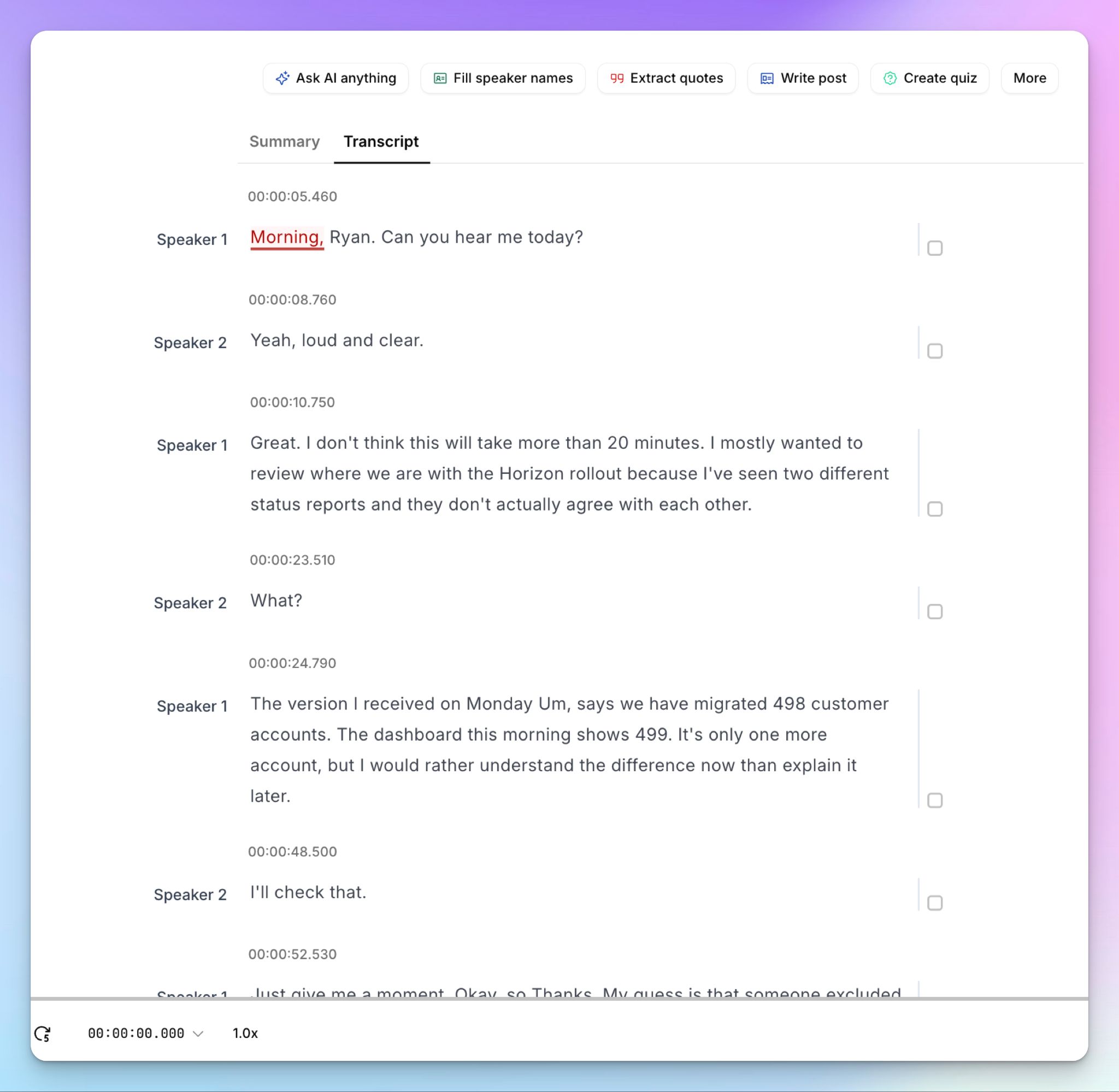
HappyScribe keeps the meeting transcript clean. It can identify multiple speakers reliably, keep specific codes and numbers intact (HRZ-2419-B, in this case), and structure everything with proper speaker labels, timestamps, and paragraph breaks.
You can read it top to bottom, play the synced audio, and verify what you're reading.
When a transcript has to be flawless for research or legal work, you can send the same file to a human expert to take it to 99% accuracy. That option alone changes what the tool is good for.
Fireflies AI's accuracy
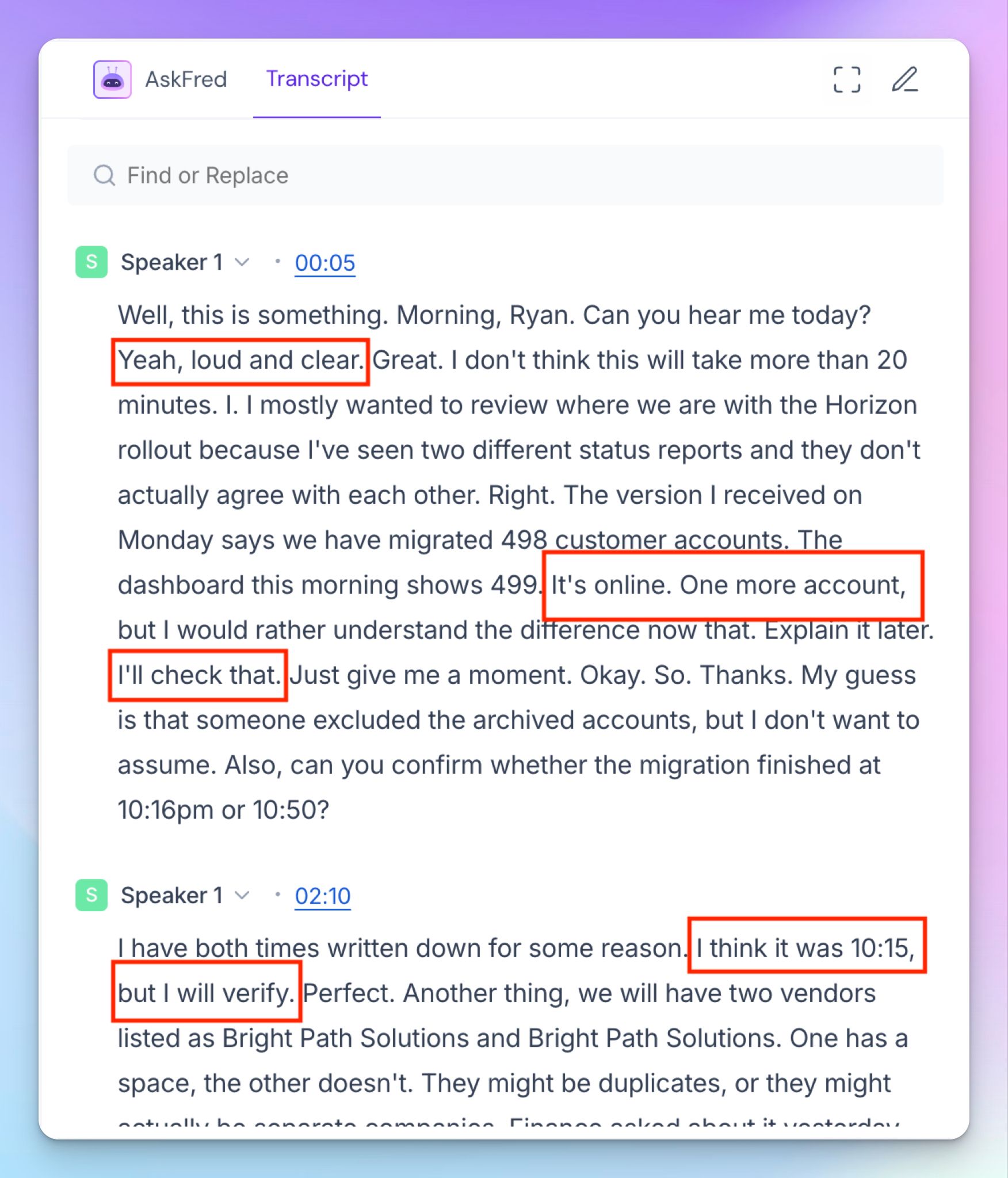
Fireflies is passable for clean, simple audio, but falls apart in meetings with jargon and noise. In this meeting, it couldn't work out that two people were talking, so it filed the entire conversation under "Speaker 1" and produced a wall of text.
As the transcript ran, full sentences collapsed into fragments like "Explain it later. I'll check that. Just give me a moment. Okay. So. Thanks."
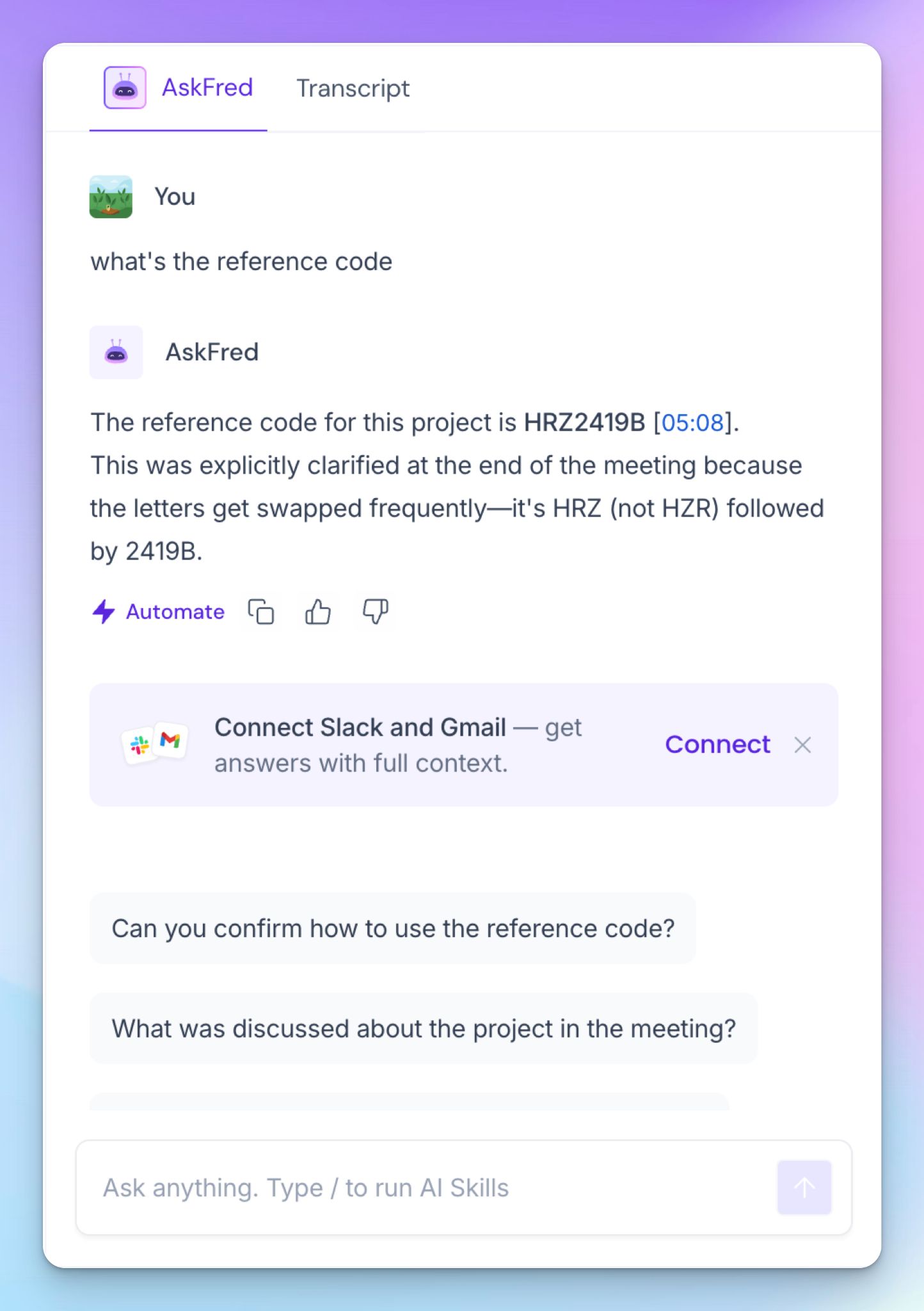
The reference code I read out clearly, HRZ-2419-B, came back butchered. I used AskFred to pull the correct code from the call, but it couldn't recover what the transcript had already lost.
This is the part that should worry you. When your summaries and action items rely on shaky transcripts, you act on the wrong details without ever knowing they were wrong.
📌 Verdict:
HappyScribe is the clear winner. It keeps names, numbers, terms, and codes intact where Fireflies loses them, and its human tier reaches an accuracy level Fireflies doesn't offer at all.
HappyScribe vs. Fireflies: Meeting capture and workflow
Both HappyScribe and Fireflies capture meetings every way you'd want: calendar auto-join, impromptu meeting links, recording uploads, and even a mobile app for in-person conversations. The difference is what happens around the recording.
HappyScribe's meeting capture
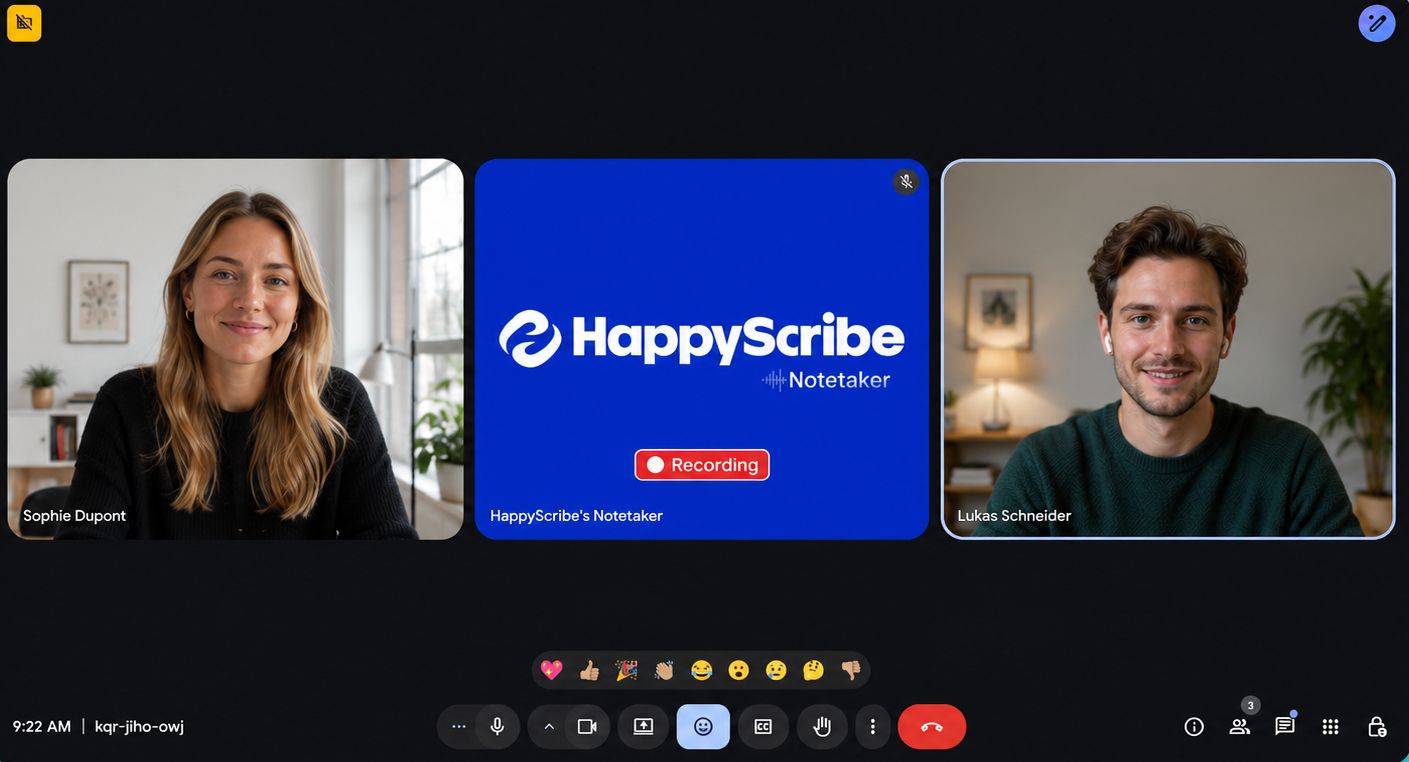
For scheduled meetings, HappyScribe's bot announces itself when it joins, so everyone on the call knows a recording has started. This is the best route for transparency and compliance.
You can pause it or remove it mid-meeting if someone objects, and you can rebrand it with your own name and logo.
Based on my usage, the meeting bot is reliable, and you can customize how it behaves before and after the call, so it doesn’t disturb attendees.
When a visible bot isn't right, the web audio recorder captures the conversation without anything joining the call, and the HappyScribe mobile apps do the same for meetings that happen away from the screen.
You stay in control of how you want to record and transcribe meetings, which is the point.
Fireflies AI's meeting capture
Fireflies captures just as broadly with live assist added on, and Fred joins as a named participant, so that part is visible too. The trouble starts after you leave.
On several calls, Fred stayed in the meeting after I'd left the room and kept recording conversations it was not supposed to. I had to stop it manually from my dashboard.
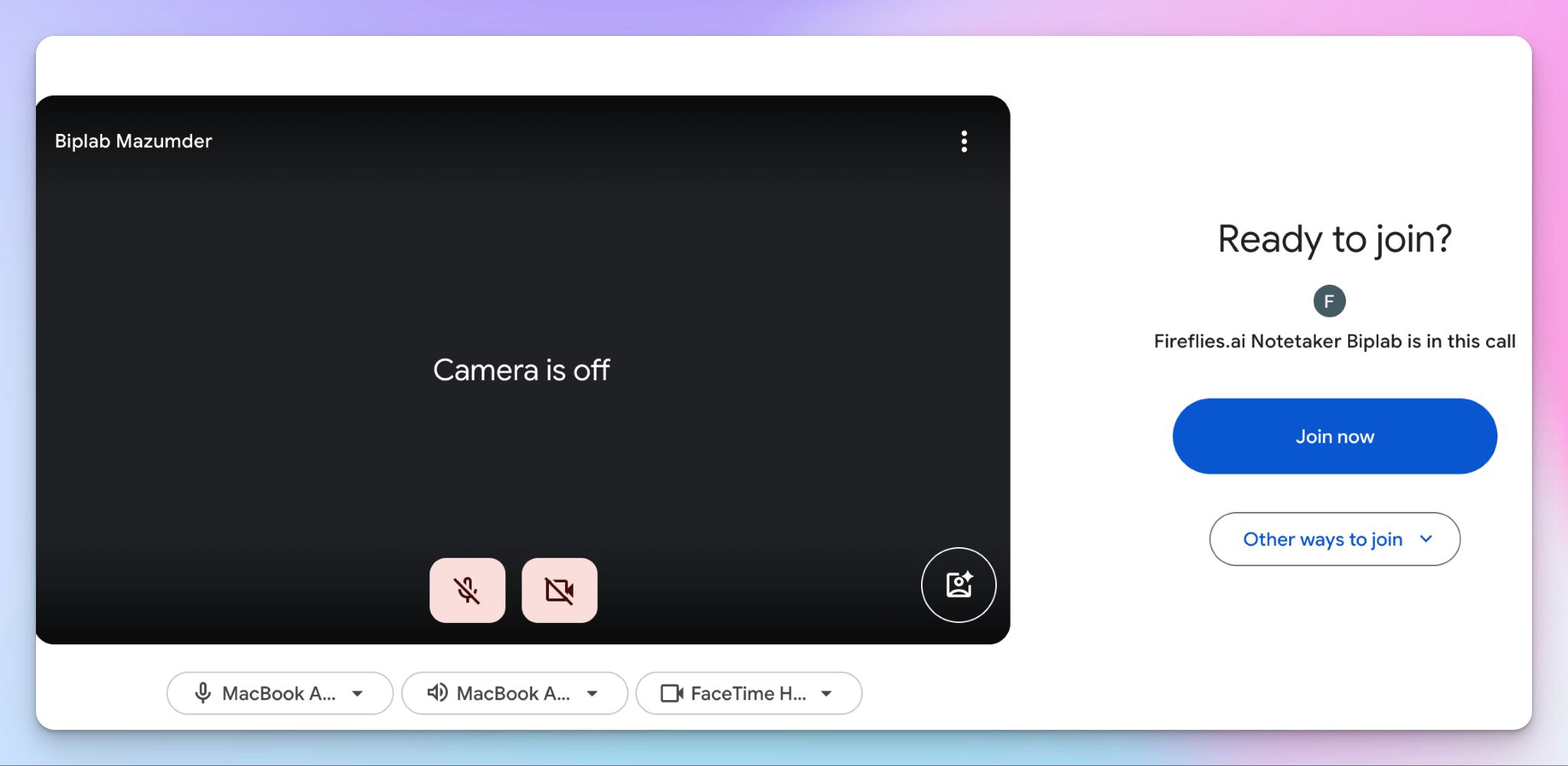
A bot that doesn’t follow the user’s choices for meetings is a liability, and it's worse when it's someone else's Fred bot still taking notes on you.
📌 Verdict:
HappyScribe wins on control. Both cover the capture methods that count, but the unreliability of Fireflies’ meeting bot can lead to some risky situations at work.
HappyScribe vs. Fireflies: AI features and conversation intelligence
Now it’s time to check the “AI” in AI note takers. Both tools let you chat with your meetings, but they differ in approach.
HappyScribe's AI features
HappyScribe's AI approach is focused: search, analyze, and export.
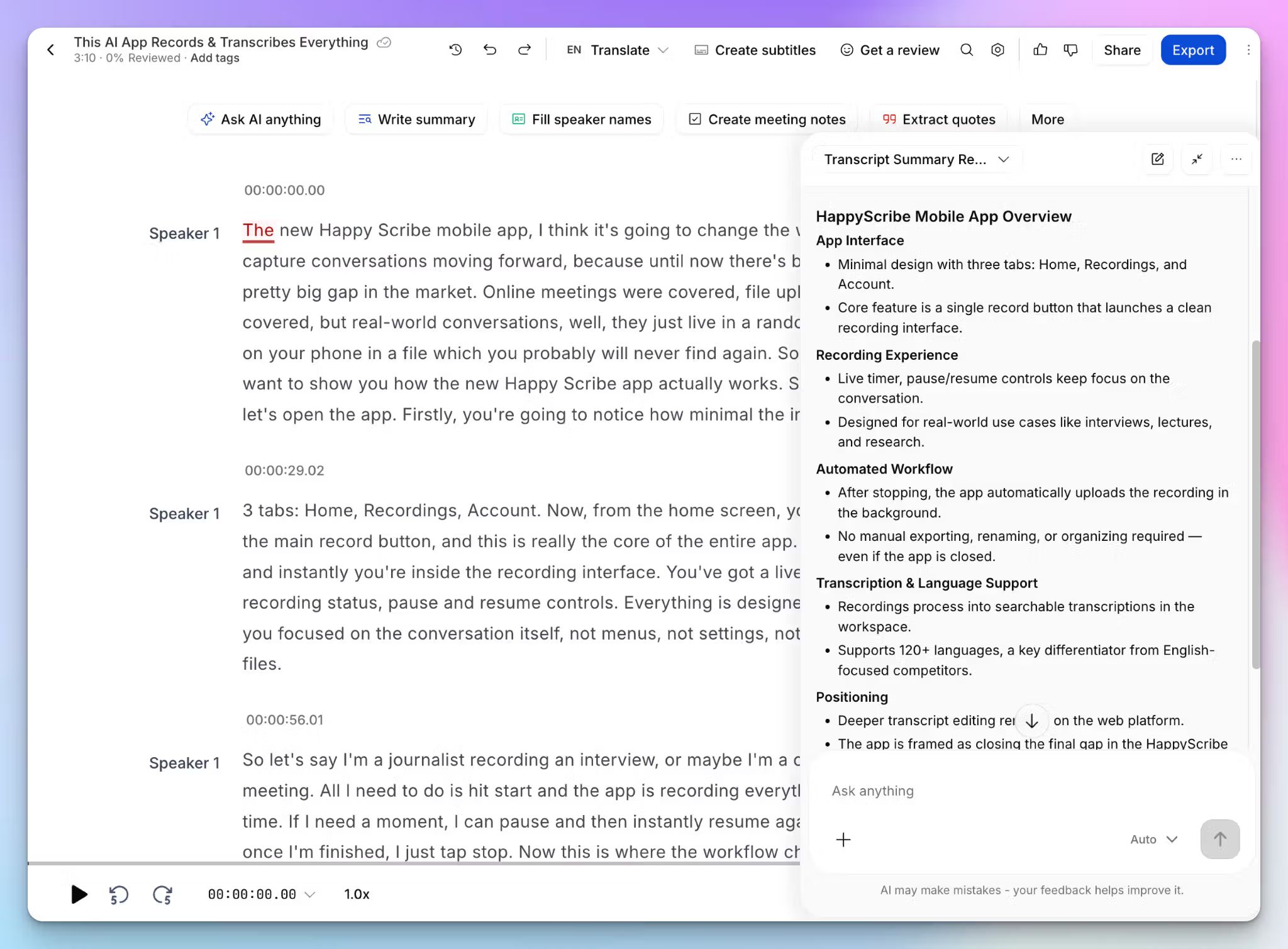
The AI Chat answers questions about your transcripts in plain language and cites its sources, so every answer points back to a speaker and a timestamp you can check.
It works on a single file or across your entire library, which means you can pull a decision from a call six weeks ago or prep for tomorrow's. The same chat writes summaries, finds action items, and extracts quotes.
You can also connect your meeting data to Claude and ChatGPT through the MCP server, so your notes flow into the AI tools you already work in.
Fireflies' AI features
Fireflies goes further with AI features. AskFred runs across your whole meeting history and drafts your follow-ups so it has the basics covered.
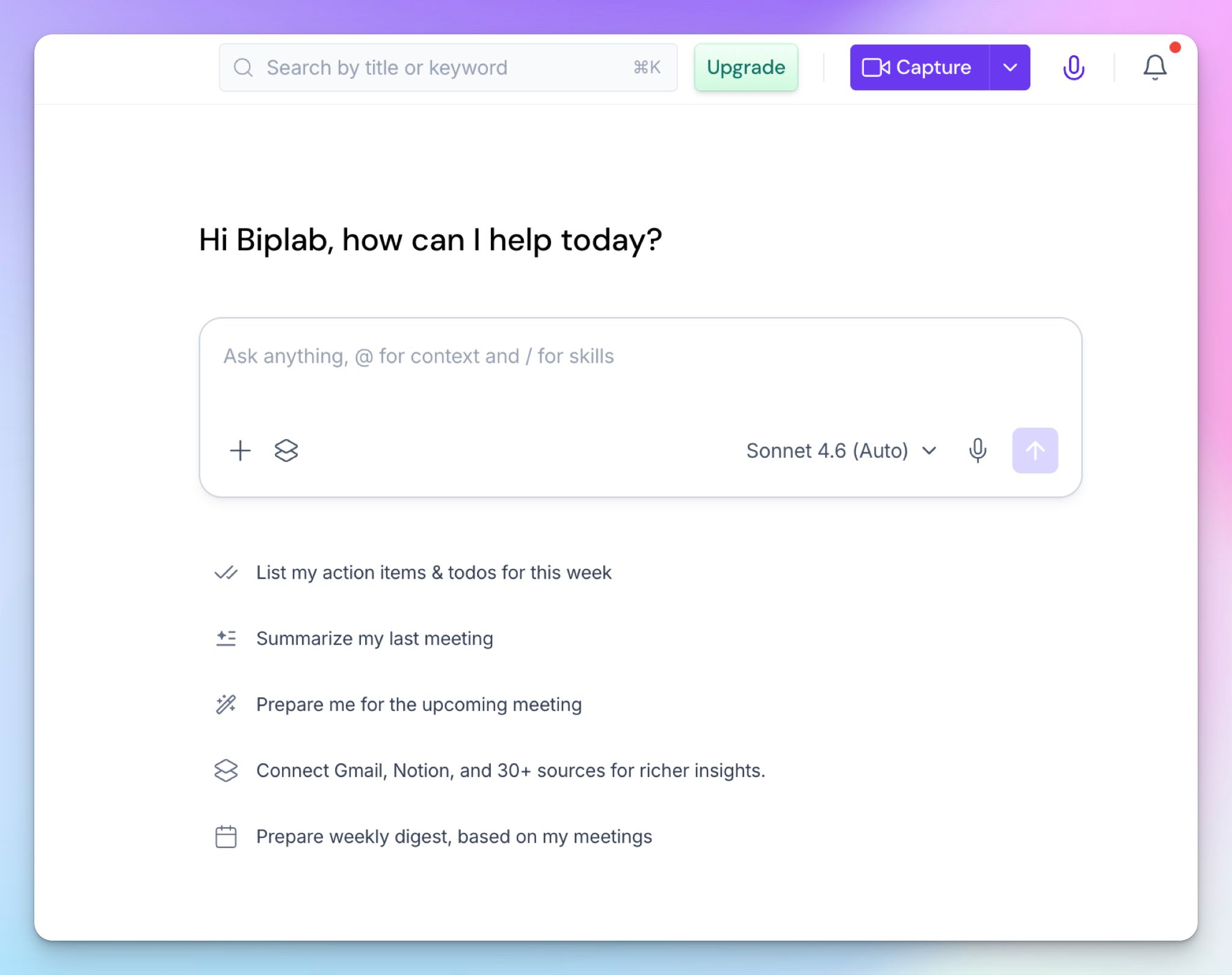
But Fireflies can connect those conversations to analytics for deeper insights. Things like talk-to-listen ratio, filler words, monologues, and topic trackers help you analyze how reps perform on calls and track sentiment KPIs to improve conversations at scale.
Then there are AI Skills. You pick from more than 200 templates, like BANT reports or hiring scorecards, or write your own, and let them run after every matching meeting. It also has voice agents that handle screening calls when you can't. The catch is that all of it runs on AI credits, so how much you get depends on your plan.
📌 Verdict:
Both tools offer valuable AI features. HappyScribe's cited AI Chat is better for finding insights and verifying data, and on the other hand, Fireflies is a conversation-intelligence system.
HappyScribe vs. Fireflies: Language support
HappyScribe's language support
HappyScribe transcribes and translates in 150+ languages and dialects with AI, and 60+ with human experts. You can also translate transcripts in 80+ languages.
The range goes well past the usual English, Spanish, and French, into rarer territory like Swiss German, Galician, Macedonian, Javanese, and Uzbek.
Upload a file, and it detects the language for you, and it keeps up when speakers switch languages mid-call.
Fireflies AI's language support
Fireflies advertises 100+ languages, but that number deserves a closer look.
It works best in English, and as you saw already, accuracy in English calls was already the weak point. If you want to go ahead, make sure you test out your specific language before building a workflow on it.
📌 Verdict:
HappyScribe wins. It covers more languages, including some less-represented ones, and extends human accuracy to 60+ languages.
HappyScribe vs. Fireflies: Compliance, security, and consent
This is the section that decides the matchup for a lot of readers.
HappyScribe's security and privacy
HappyScribe is SOC 2 Type II-certified and GDPR compliant, and it stores your files in a Tier IV, PCI DSS, and ISO 27001-compliant EU data center with AES-256 encryption in transit and at rest. Higher tiers add SSO and granular access controls.
Your data sits inside the EU, which complies with European laws and also helps UK users looking for note takers. And you can opt out of anonymized AI training from your settings, which is off by default for enterprise accounts.
The box HappyScribe doesn't tick is HIPAA, so US medical recordings are where it isn't the right fit.
Fireflies AI's security and privacy
Fireflies has SOC 2, GDPR, and HIPAA on paper, with HIPAA reserved for Enterprise. It’s heavy on the badges, but you have to look past them.
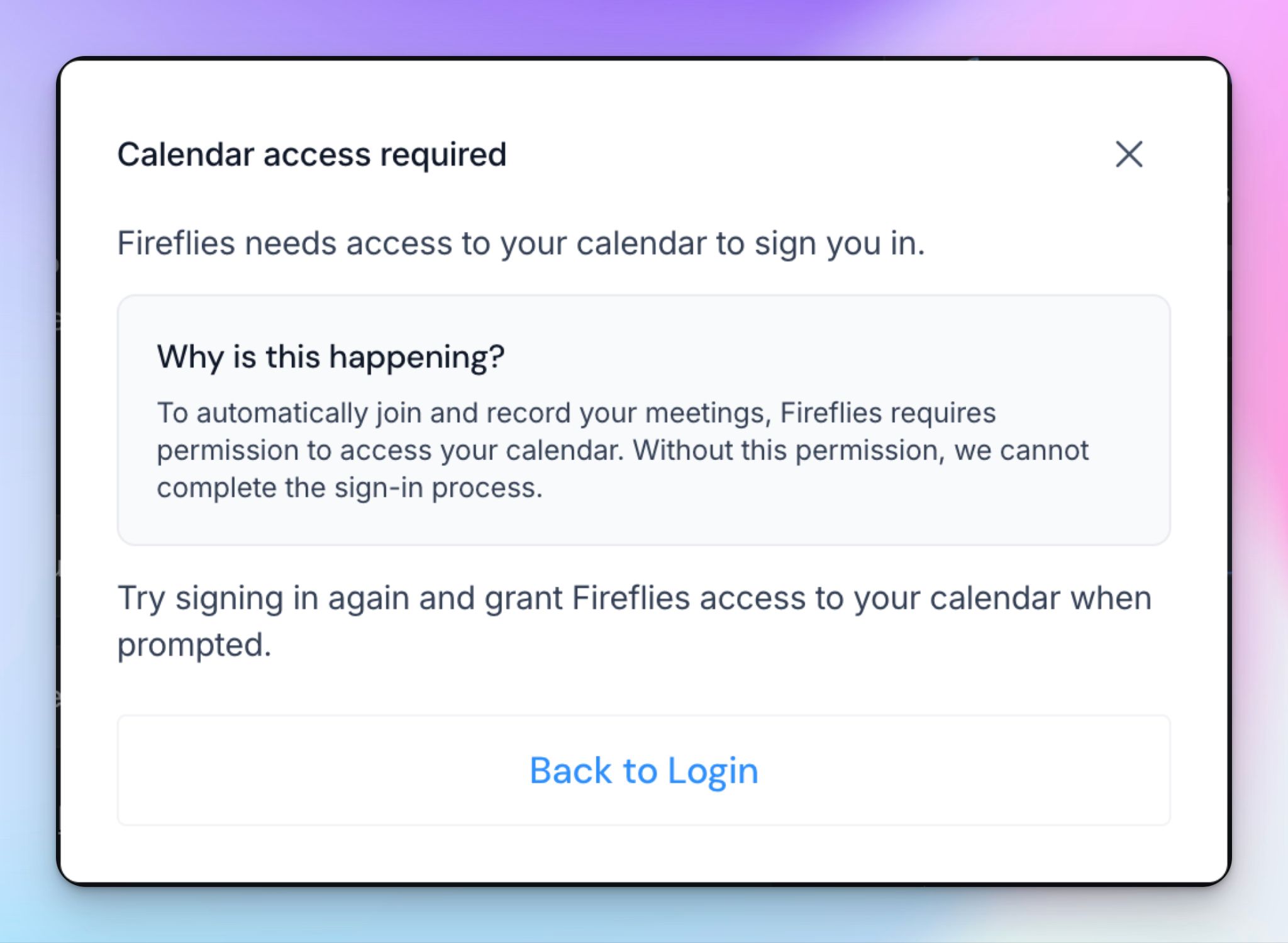
Fireflies won't let you create an account unless you hand over access to all calendar events. There's no in-app way to revoke it either. You either delete your account or revoke access from your Google’s linked apps page, which might break the account anyway.
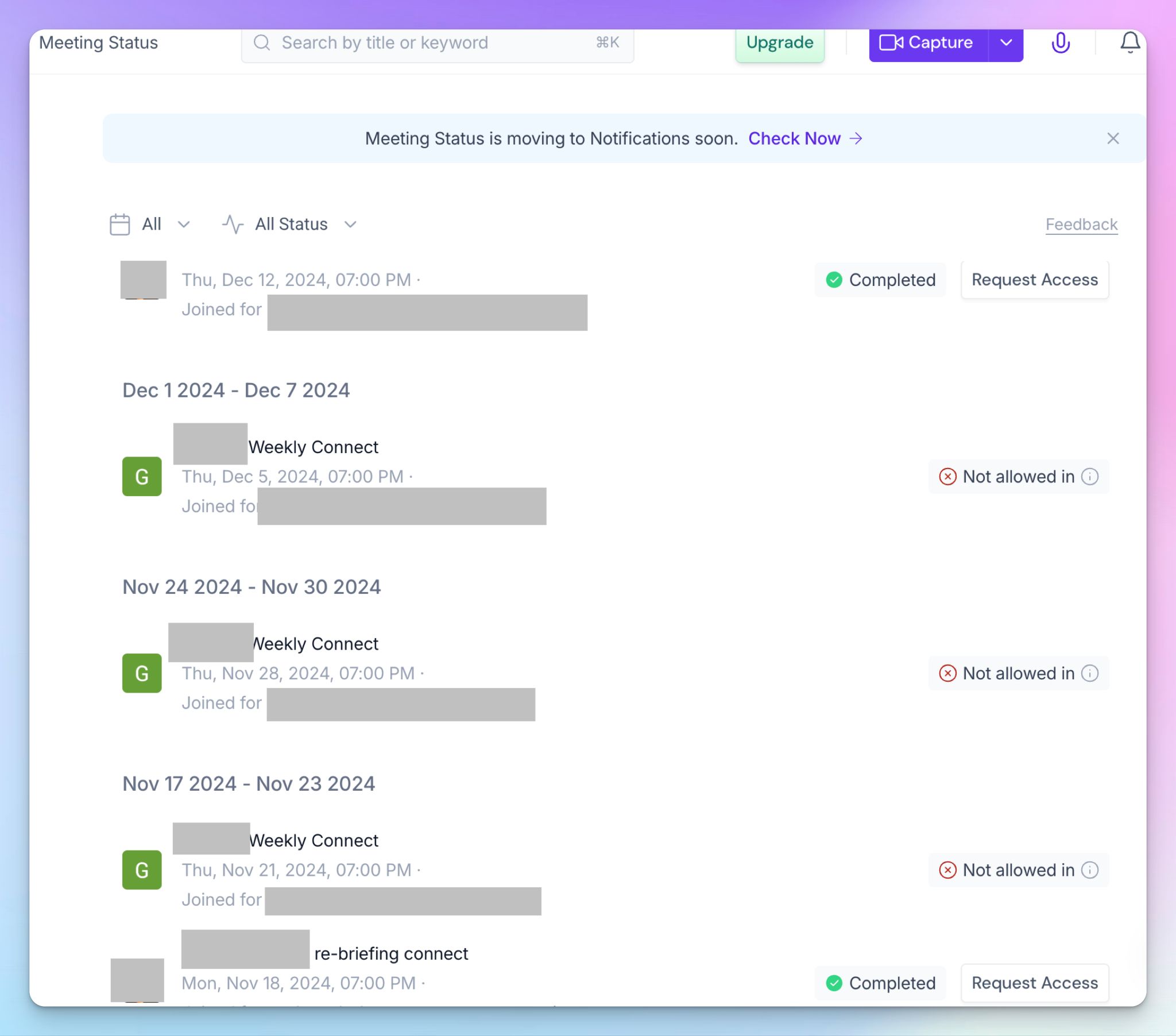
Then there's the data it collects from people who are not even Fireflies users. My brand-new 2026 account was already populated with meetings going back to 2024 from a previous employer, for calls I attended but never recorded. Fireflies started building a profile on me without my consent.
Two class actions now allege the same pattern: Cruz v. Fireflies.AI, filed in December 2025 in the Central District of Illinois, and Fricker v. Fireflies.AI, filed in March 2026 in the Northern District of Illinois. Both lawsuits claim that Fireflies’ speaker recognition feature generates voiceprints of everyone on a call, including people who never created an account or agreed to anything.
Illinois' biometric law requires written notice and consent for that, but Fireflies still has no updates on voiceprinting non-users.
Add US-based processing to that, and recording EU participants gets tricky. You can check European alternatives to Fireflies AI for more options.
📌 Verdict:
HappyScribe wins. Fireflies has an edge only where HIPAA is a hard requirement, and you have an Enterprise budget.
HappyScribe vs. Fireflies: Integrations
HappyScribe's integrations
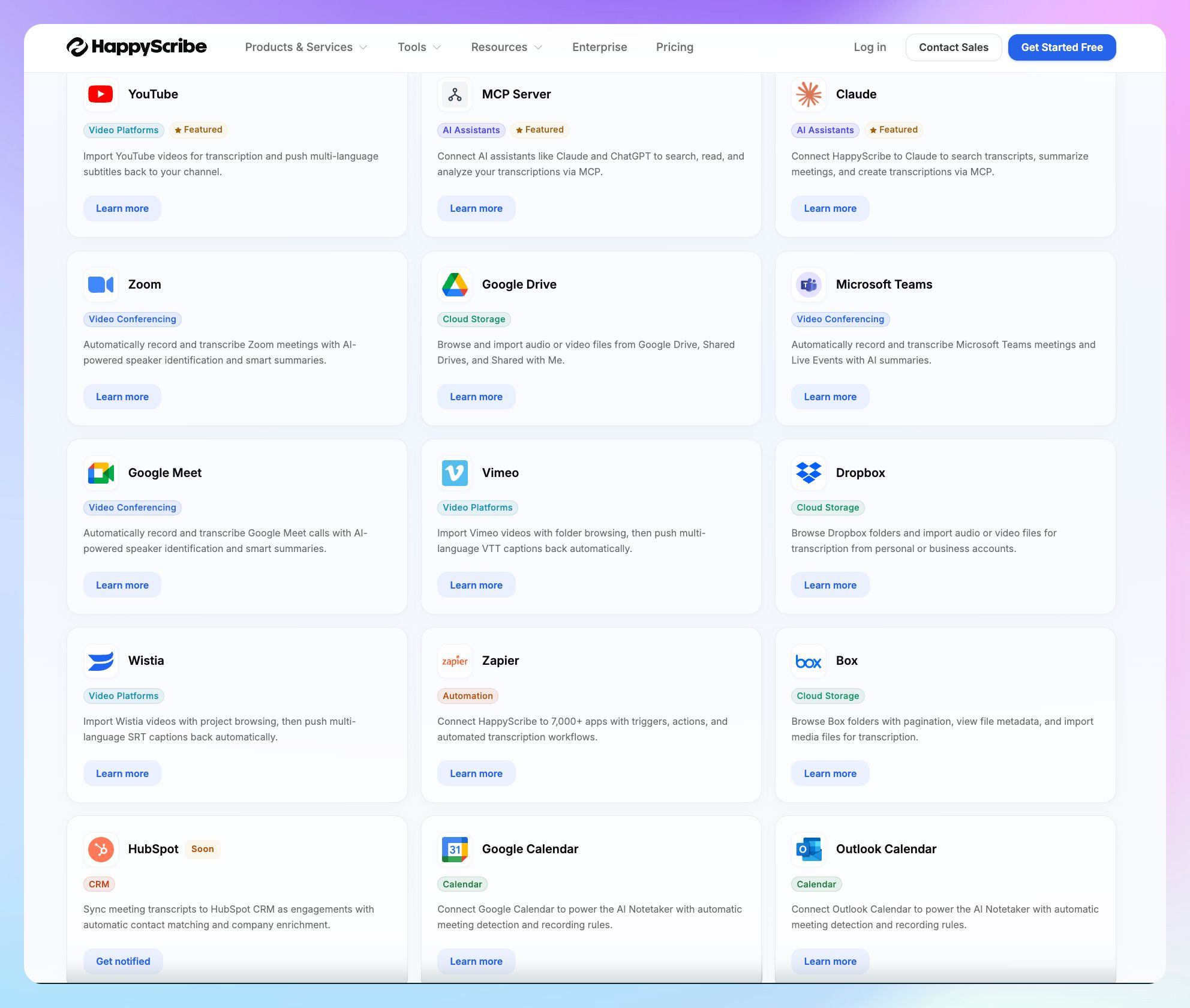
HappyScribe connects to the tools that deal with transcripts and meetings. It syncs with Google and Outlook calendars, joins Zoom, Google Meet, and Microsoft Teams, and imports files from Google Drive, Dropbox, and Box.
For direct video transcription, it pulls from YouTube, Vimeo, and Wistia, then pushes finished subtitles back to those platforms, so the workflow runs both directions.
Zapier extends HappyScribe to thousands of apps, and HubSpot sync is on the way. For projects at scale, there's a REST API and an MCP server that links your transcripts to other AI tools.
Fireflies AI's integrations
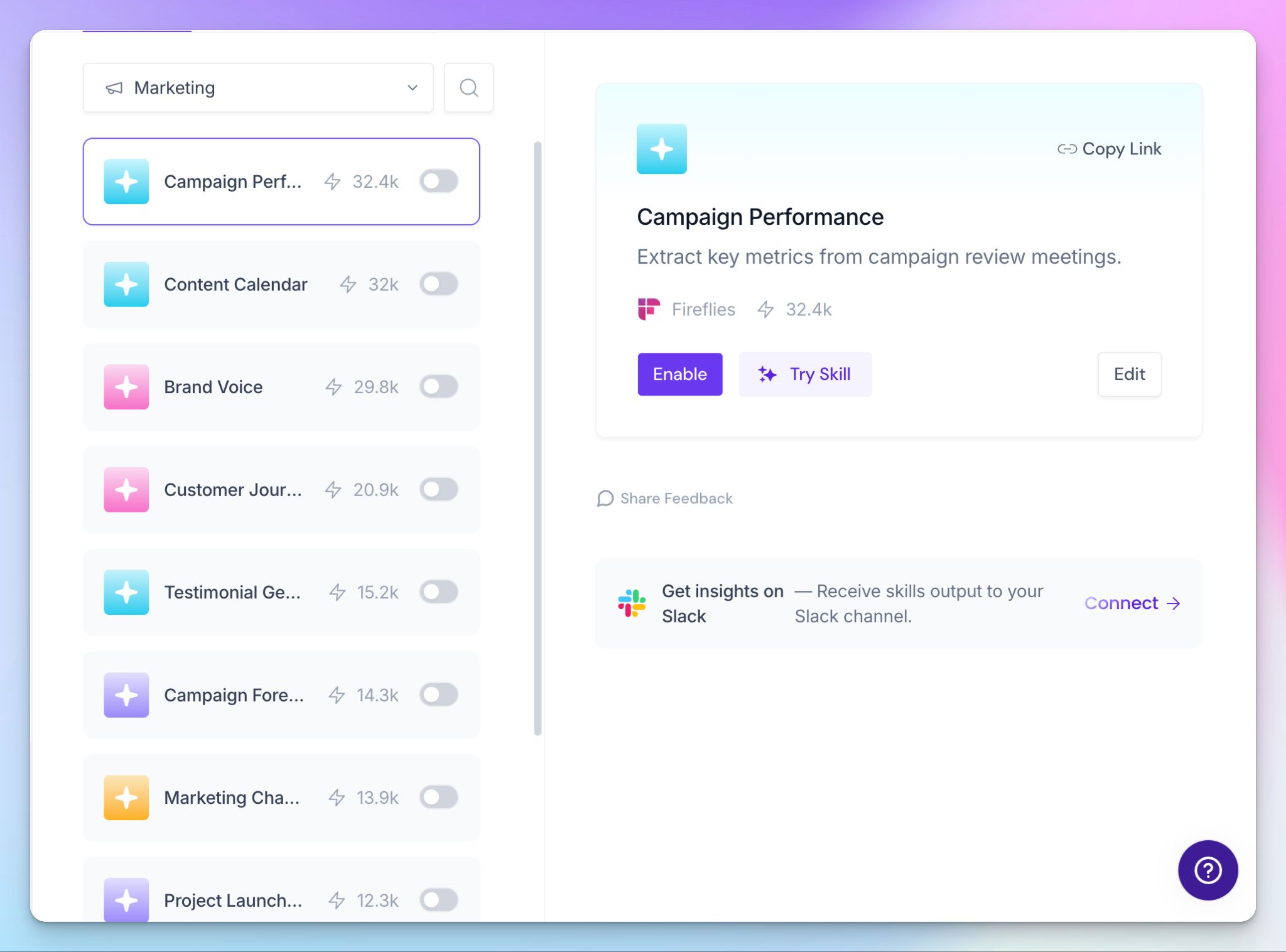
Fireflies is wired into far more of the stack, and this is its strongest suit. It syncs natively with CRMs like Salesforce and HubSpot, filling in call notes and next steps automatically.
Beyond that, Fireflies integrates with a catalog of more than 100 tools, and not just the predictable ones. Greenhouse, Lever, Aircall, Salesloft, Any.do, Wealthbox, MindStudio, and Redtail are all native, alongside Slack and Google Drive. Zapier and the Fireflies API cover whatever's left, and the docs are easy to follow.
📌 Verdict:
Fireflies wins, on breadth. HappyScribe covers media and documentation workflows, but if your meetings need to connect with a complex tech stack, chances are Fireflies already has the connector built.
HappyScribe vs. Fireflies: Pricing
HappyScribe's pricing
AI transcription plans
- Free: Unlimited AI meeting notes, plus a short trial of file transcription, subtitling, and translation
- Basic: $8.50/month billed annually or $17/month billed monthly
- Pro: $19/month billed annually or $29/month billed monthly
- Business: $59/month billed annually or $89/month billed monthly
- Enterprise: Contact sales
Human transcription service: Starts from $2.00/min, with extra discounts for Business users
Fireflies AI's pricing
- Free: 400 minutes of storage for the whole team per month, but no transcript downloads
- Pro: $10/month billed annually or $18/month billed monthly
- Business: $19/month billed annually or $29/month billed monthly
- Enterprise: $39/seat/month, billed annually only
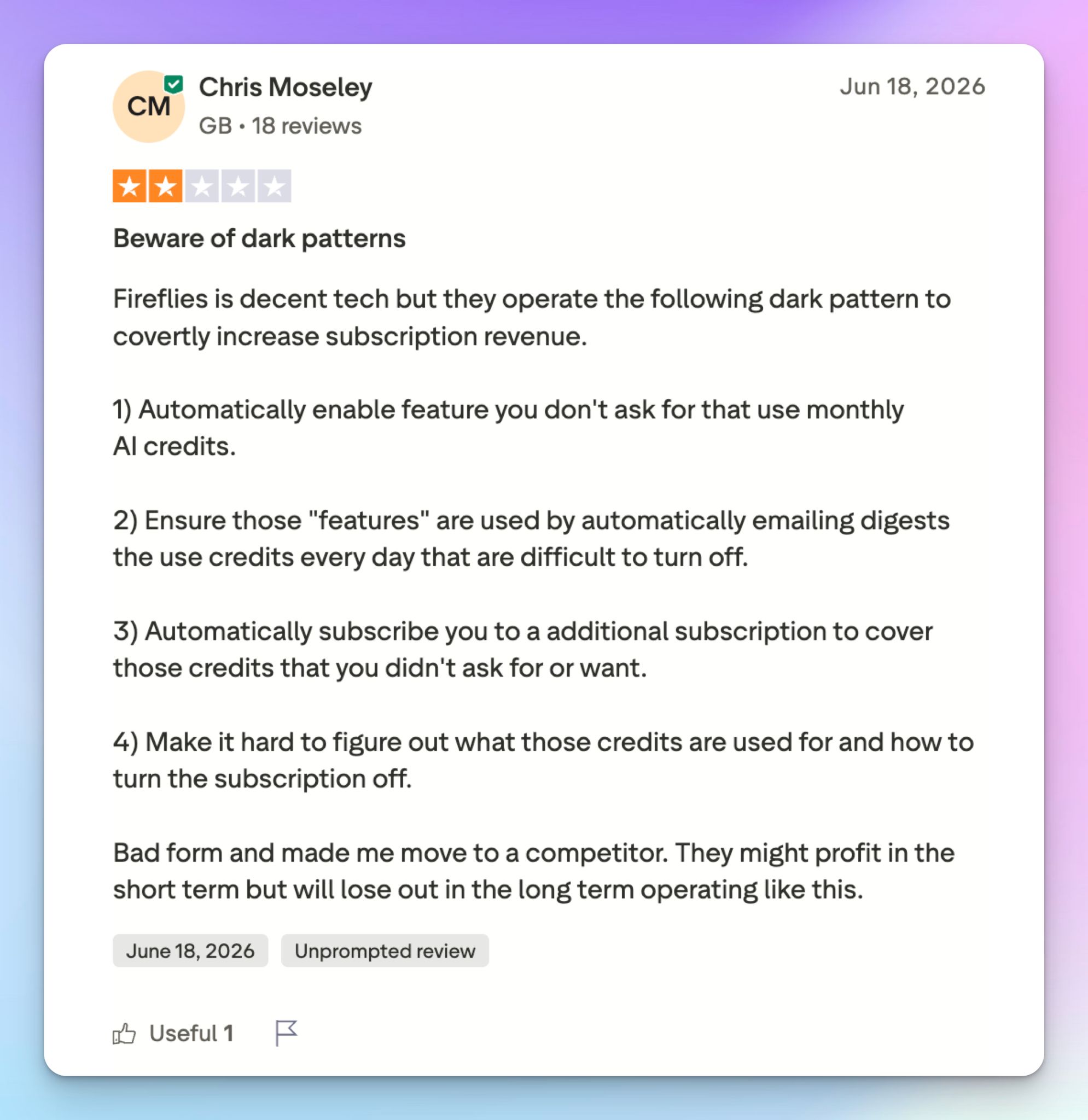
Fireflies’ pricing tiers look reasonable. The catch is AI credits.
Every feature worth having, from AskFred to AI Skills to CRM autofill, draws from a credit pool shared across your team. Upgrading replaces your credits instead of stacking them, and each request is priced dynamically, so a complex task will cost you more.
Run out, and you're buying add-on bundles that auto-renew and don't carry over. Some users have bluntly called it dark patterns.
📌 Verdict:
HappyScribe is the better choice. Cheaper entry, a free plan that doesn't expire in a week, and pricing that scales with work.
What are customers saying?
HappyScribe customer reviews
What users love
The product has great UX. The transcription performance is the best out of the different services I've tested (Fireflies, Fathom, Gemini). The pricing is good for teams. And Support is responsive and helpful.
I use HappyScribe mainly for meeting minutes. It saves time and automates workflows for me. I really like the support for a lot of languages, and the AI and MCP integration is great. The integrated AI can work with transcripts and prepare minutes and to-dos, and MCP can be used to integrate this into the company IT infrastructure.
What could be better
I do wish I had more credits, but I understand why we get limited. A website as great as this needs the funding to be able to keep being up.
The Human-powered transcription and translation is expensive. Sometimes the quality is a little lower than expected, but HappyScribe always makes it right in the end. I believe this issue will be improved in the short term.
Fireflies AI customer reviews
What users love
What I liked most about Fireflies.ai was its ability to automatically capture meeting notes, transcriptions, and action items in a very organized way. It helped reduce manual note-taking and made follow-ups much easier across teams. I also appreciated the integrations and searchable meeting history.
Fireflies is so versatile and useful. It’s also intuitive and you can really make use of it’s live transcription (w/c by the way detects multiple languages!) it’s so fun to use and integrate across work.
What could be better
It listens and records without you knowing. I just had a horrible experience this Fireflies.ai. I work in special education in a school district. A few weeks ago someone used Fireflies to summarize an IEP meeting. I had to create an account to look at the meeting notes and was impressed with the format and information. Little did I know that Fireflies.ai had infiltrated my Google calendar and was recording meetings and sending out transcripts to all those in attendance--even if I was not in attendance. I did not sign-up for that--I only wanted to read a transcript from a meeting I couldn't attend. It caused huge problems at work, violated confidentiality, parent and student rights under FERPA and created a bunch of turmoil on our team when it was recording a venting session that it had no business recording. I was not able to figure out how to get rid of this on my own.
2 big pain points: 1) their hubspot integration is unreliable. Tasks often don't get assigned to the right deal/companies, which creates a huge pain in the back 2) their summary emails are full of marketing rubbish. I'm already a paying customer and I don't feel comfortable sharing their summary emails with my clients, why do i have to advertise another company to my clients, although I'm already a paying user?!!! They need to sharpen their summary emails and the meeting notes, as well as removing all that marketing fluff.
HappyScribe works best when:
✅ Your meetings and files span multiple languages and dialects, and you want them transcribed and translated accurately
✅ You need near-perfect accuracy for research, legal, or media work, and want a human-expert tier to finish the job
✅ You handle EU participant recordings and want European residency with control over AI training
✅ You want transcription, subtitles, and translation in one workspace instead of three separate tools
✅ You want a free plan with unlimited meeting notes rather than a trial that runs out in a week
✅ You need an AI assistant that surfaces insights and patterns with cited speakers and timestamps
HappyScribe doesn't work well when:
❌ You transcribe US medical or clinical recordings that require HIPAA compliance
❌ You want sales-focused sentiment analysis and deal-risk flags built into your notes
❌ You need role-based AI agents that run screening calls or draft follow-ups for a sales team
❌ You want call notes pushed into CRMs, ATS, and project management tools without connecting to Zapier
Fireflies AI works best when
✅ You manage reps and want talk-time analytics, topic trackers, and sentiment scoring across calls
✅ Your tech stack is wide and complex, and you’d rather have native connectors to CRMs, ATS, marketing, task, and project management tools
✅ You run the same play repeatedly and want AI Skills to produce sales reports, brand consistency, and scorecards on their own
✅ You want voice agents to handle screening or discovery when you can't take the call
✅ Your work isn't bound by all-party consent rules or strict EU data requirements
Fireflies AI doesn't work well when
❌ You need raw transcripts to be accurate, and you can’t afford to act on summaries built on unreliable texts
❌ You record in all-party-consent regions and can't put a bot in sensitive meetings that might record extra conversations
❌ You handle EU participant data and can't send it to US-based processing
❌ You aren't willing to hand over your full calendar just to create an account
❌ You want predictable and transparent costs, and don’t want to deal with shady billing practices
Final verdict: HappyScribe vs. Fireflies AI
Choose Fireflies if your revenue team wants meeting notes to connect to CRM, you want conversation intelligence and coaching data on every call, and the consent questions aren't yours to answer.
Choose HappyScribe if you want transcripts you can trust, wide language coverage, European data residency, and transparent pricing that doesn't catch you off guard.
For researchers, media teams, and anyone whose meetings carry details that have to be right, HappyScribe covers more ground in one workspace. Fireflies will tell you how the call went. HappyScribe will tell you what was actually said.
Frequently asked questions about HappyScribe and Fireflies AI
Which is more accurate, HappyScribe or Fireflies AI?
HappyScribe. Running both tools on the same calls, HappyScribe holds speaker identification and keeps names and spoken reference codes intact, while Fireflies labels two people as one speaker and garbles the same code. HappyScribe's automated transcription lands around 95% accuracy, and it pairs AI speed with optional human review to push it up to 99%, so high accuracy is available when a transcript has to be exact. Fireflies has no human tier, which means transcription quality depends entirely on how clean your audio is.
Is Fireflies AI a privacy risk?
Fireflies AI carries real privacy exposure. Fireflies requires access to all calendar events before you can create an account, and there is no in-app way to revoke it. Processing happens in the US, so customer data from EU participants leaves the region. Two biometric class actions, Cruz v. Fireflies.AI (December 2025) and Fricker v. Fireflies.AI (March 2026), allege that its speaker recognition builds voiceprints of people who never signed up. If you want more control, HappyScribe is the AI alternative with EU data residency, GDPR compliance, and data sharing settings you can switch off yourself.
Which has the better free plan, Fireflies AI or HappyScribe?
HappyScribe is the better choice. Its free plan includes unlimited AI meeting notes, so unlimited transcription of your internal meetings costs nothing, and you also get a short trial of file transcription and subtitles. Fireflies caps free users at 400 minutes of storage per month for the entire team and blocks transcript downloads, which makes it hard to properly test its meeting intelligence features before you move to paid plans.
Is HappyScribe trustworthy?
Yes, particularly if you care where your recordings are stored. HappyScribe is SOC 2 Type II certified and GDPR compliant, with files held in an EU data centre under AES-256 encryption at rest and in transit. You control data sharing settings, including an opt-out from anonymised AI training. Its AI Chat cites the speaker and timestamp behind every answer, so actionable insights trace back to something you can verify rather than trust blindly. The one gap is HIPAA, which HappyScribe does not offer, so US clinical recordings need a different transcription tool.
How much does HappyScribe cost?
The free plan covers unlimited AI meeting notes, and paid plans start at $8.50/month billed annually.
- Basic: $8.50/month annually, or $17/month monthly
- Pro plan: $19/month annually, or $29/month monthly
- Business: $59/month annually, or $89/month monthly
- Human transcription: from $2.00/min
Paid tiers add transcription for pre-recorded audio files and video files in most common formats, so key features like AI note taking and smart summaries sit in the same workspace as subtitles and translation.
Fireflies vs. HappyScribe: which tool supports more languages?
HappyScribe covers more languages. It handles 150+ languages and dialects with AI, plus 60+ with human experts, and transcripts can be translated into 80+ languages. It detects the language on upload and keeps up when speakers switch mid-call, which is useful for multilingual teams. Fireflies advertises 100+ languages, but its real time transcription performs best in English, where accuracy was already the weak point in testing. Since HappyScribe focuses on strong multilingual support, it is the more solid choice as an AI meeting assistant.

Biplab Mazumder
Biplab is a content marketer and writer who helps high-growth brands scale content visibility across AI search channels. His works have been published in HubSpot, Freshworks, Atlassian, SurferSEO, etc. When he's not planning content strategy, he's testing AI content workflows and use cases.